| ChinAfrica |
| Deeper Dive |
| Underwater robots find wide application in China |
| By Ge Lijun | VOL. 17 September 2025 ·2025-09-10 |
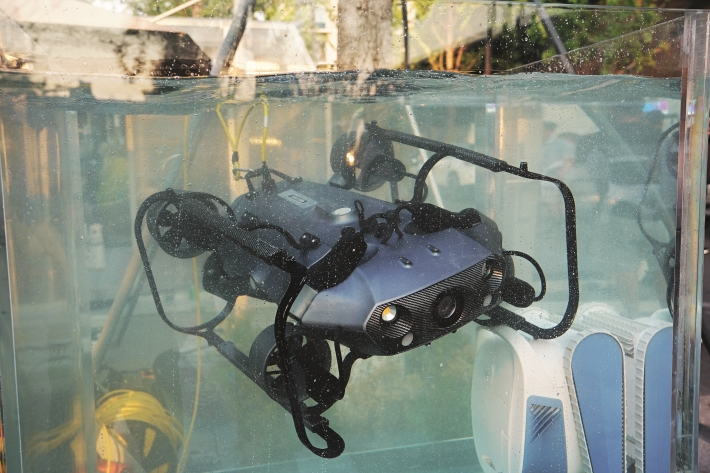
An underwater robot during a demonstration in Chengdu, Sichuan Province, on 30 July (CNS)
In the mysterious depths of the ocean, robots glide between reefs and corals, avoid obstacles, navigate independently, and fulfil their tasks as if they had a vision that could penetrate the murkiness of the water.
The Chinese company Chasing has developed a robot capable of diving to a depth of 350 metres. As an underwater photographer, lifeguard or swimming pool cleaner, it demonstrates the expertise the company has acquired over years of research and development work, which is now recognised worldwide in the fields of underwater communication, underwater vehicle design and propulsion systems. Its products are exported to more than 100 countries and regions, from Europe to Japan.
According to the ChinaIRN research institute, underwater robot technology is undergoing its third major revolution. The integration of AI algorithms has significantly improved environmental perception and decision-making capabilities and enables, for example, real-time seabed modelling and object identification through deep learning. Advances in 5G technology make it possible to coordinate multiple vehicles simultaneously by significantly reducing transmission latency.
The global market continues to be dominated by North America, which has a 46 percent share thanks to its technological lead and a mature industrial chain. Europe is making a name for itself in the eco-friendly robot segment, while the Asia-Pacific region - China in particular - is becoming the growth engine: Chinese production is expected to increase by 12 percent this year compared to last year, reaching 25 percent of the global market.
In China, marine technology accounts for 35 percent of demand, driven by the increasing exploitation of deep-sea resources such as polymetallic nodules and combustible ice, which fuels the need for large-capacity robots. In second place is aquaculture (20 percent), with equipment capable of continuously monitoring water temperature, pH, dissolved oxygen and salinity levels.
Research is also gathering pace in the area of specialised applications. Sealien Robotics recently supplied a foreign customer with a remotely operated vehicle capable of burying optical cables at a depth of 3,000 metres - a first for a Chinese manufacturer. The cables must be protected from fish bites and movement by currents; the new robot ensures precise laying, significantly reducing the risks. Lanqi Robot has developed a cleaning robot that can clean ship hulls covered in mussels and algae dozens of metres below the water’s surface.
In the future, convergence with 5G and 6G networks, the Internet of Things and Big Data will enable networked operation and instant data analysis. The areas of application will diversify from testing space equipment to supporting inspection and rescue operations in smart ports, or creating immersive experiences in aquariums by combining robotics with virtual reality.
|
||||||||||||
| About Us | Contact Us | Advertise with Us | Subscribe |
| Copyright Beijing Review All rights reserved 京ICP备08005356号-5 京公网安备110102005860号 |


