| ChinAfrica |
| The Architecture of Openness |
| The CIIE demonstrates China’s commitment to opening up and cooperation |
| By Liu Liang and Liao Shuozhong | VOL. 17 December 2025 ·2025-12-01 |
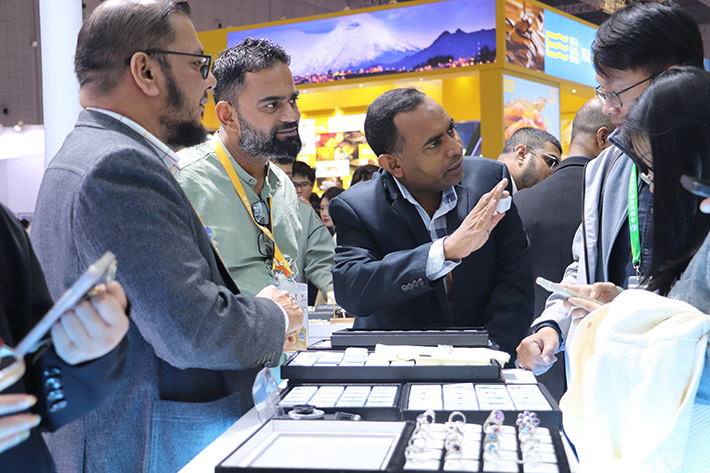
Exhibitors from Sri Lanka promote jewellery to visitors at the eighth China International Import Expo in Shanghai on 9 November (HU FAN)
The eighth China International Import Expo (CIIE), held in Shanghai from 5 to 10 November, once again underscored China’s commitment to deepening institutional opening up. With unprecedented exhibition space, number of participants, and intended deals, the expo highlighted the strong appeal of China’s vast market and its drive to widen global opportunities, reinforce mechanisms for shared development, and inject fresh vitality into the world economy.
Over its eight editions, the CIIE has become an important vantage point for observing China’s opening up. Through optimising customs procedures, tax policies, intellectual property protection, and market access, it has generated replicable institutional practices, demonstrating how China promotes reform and development through opening up and integrates more fully into high-standard global trade rules.
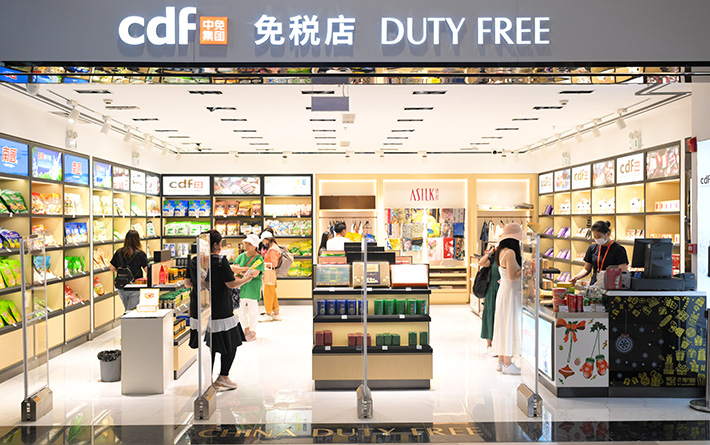
Tourists visit a duty free store in Sanya, Hainan Province, on 26 July 2023 (XINHUA)
Stable progress
Institutional opening up seeks to align domestic rules, regulations, management, and standards with advanced international practices, fostering greater convergence between domestic governance and the global economic system. Since the 18th CPC National Congress in 2012, China has made notable strides in building an open economy, laying a solid groundwork for deeper institutional opening up.
The establishment of pilot free trade zones (FTZs) is a major strategic move to further reform and opening up. Since the launch of the first pilot FTZ in Shanghai in 2013, China has created 22 such FTZs nationwide. The reform and innovation measures piloted in these zones have charted new paths and accumulated new experiences for broader national implementation. Institutional innovations developed within the FTZs have been replicated and extended across the country, cultivating a favourable environment in which the dividends of reform are shared and the benefits of opening up become broadly accessible.
The FTZs’ role in piloting alignment with high-standard global trade agreements equips China with effective mechanisms for rule convergence and bolsters its capacity to safeguard an open, inclusive multilateral trading system. Financial opening up has likewise advanced during the 14th Five-Year Plan (2021-2025) period.
To draw in external resources, China further shortened the negative list for foreign investment, fully eliminated manufacturing restrictions, upgraded the Qualified Foreign Institutional Investor (QFII) regime, and broadened cross-border connectivity channels. Thirteen additional foreign-controlled financial institutions were approved, and more than 900 QFII institutions now operate in the country, with foreign holdings of A-shares surpassing 3.4 trillion yuan ($478.35 billion).
Outbound expansion progressed concurrently as Chinese enterprises adopted more diverse global financing models, such as A+H listings and global depositary receipts, shifting from basic product exports to exporting entire industrial chains and jointly creating value. Measures including Shanghai’s upgraded integrated domestic-foreign currency cash-pool pilot in 2025 further enhanced cross-border capital management efficiency, strengthened support for multinational corporations’ global operations, and reaffirmed China’s sustained commitment to high-level financial opening up.
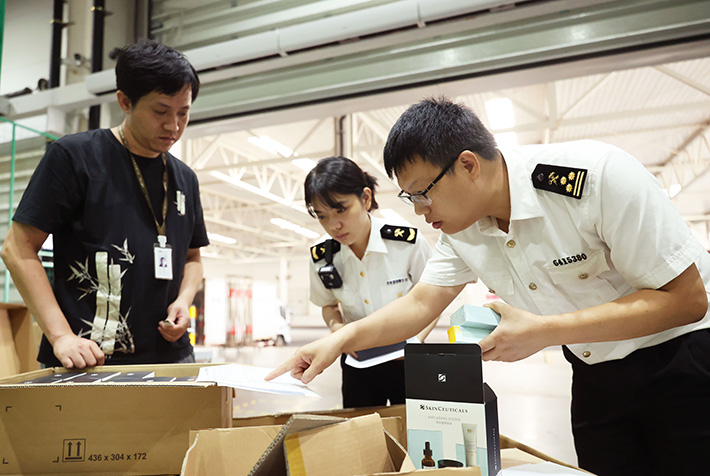
Customs staff monitor the unloading of duty-free cargos in Haikou, Hainan Province, on 26 May (XINHUA)
Navigating headwinds
China’s institutional opening up is advancing in an international environment characterised by heightened uncertainty. Major-power competition is playing a more prominent role in shaping global affairs, while economic and political dynamics are undergoing deep transformation. Rising protectionism, escalating trade frictions, and unilateral sanctions have introduced new complications.
Global competition has expanded from traditional trade and investment to the contest over rule-making in emerging fields. In digital trade and green development, some Western economies have promoted exclusive regulatory frameworks built around unrestricted data flows and strict intellectual property protections. These standards often overlook the development needs of emerging economies, particularly in areas such as data sovereignty and industrial policy. China aims to navigate pressure from advanced economies while cooperating with developing countries to advance a fairer and more inclusive global governance system for digital and emerging sectors.
On the domestic front, China’s shift from high-speed to high-quality growth adds further layers of complexity. Traditional industries face increasing pressure to upgrade as digitalisation, intelligent manufacturing, and green transformation reshape global production networks.
Striking a balance between openness and security, efficiency and equity, and external rule alignment and domestic institutional improvement has become a central policy challenge. Addressing this challenge calls for overcoming entrenched institutional bottlenecks and enhancing China’s capacity to participate in - and contribute to - the evolution of global economic governance.
Pathways for future
The Recommendations of the CPC Central Committee for Formulating the 15th Five-Year Plan for National Economic and Social Development, adopted at the fourth Plenary Session of the 20th CPC Central Committee, underscore the need to steadily expand institutional opening up, uphold the multilateral trading system, and promote development through reform and opening up. Recent State Council deliberations on deepening reform in key areas further signal that institutional opening up will become a central driver of China’s high-quality development from 2026 to 2030.
China will promote opening up by aligning domestic practices with high-standard international economic and trade rules. Its applications to join the Comprehensive and Progressive Agreement for Trans-Pacific Partnership and the Digital Economy Partnership Agreement offer opportunities to benchmark against advanced standards in trade in services, digital governance, and intellectual property protection.
Reform in the service sector is expected to serve as a major breakthrough. In recent years, China’s intensified efforts to open up the services industry have already produced tangible results, making it the primary sector for attracting foreign investment. Nevertheless, significant room for further expansion remains.
The State Council’s recent decision to optimise market access rules for services signals deeper opening up in finance, education, health care, and telecommunications. Achieving this requires not only easing foreign entry, but also reforming domestic regulatory frameworks to ensure qualification recognition, consistent supervision, and enhanced cross-border service mechanisms.
In terms of regional opening up, China will continue developing FTZs and building a high-standard Hainan Free Trade Port. With the official launch of island-wide special customs operations on 18 December, Hainan is evolving into a comprehensive modern industrial hub.
China will further broaden two-way investment, improve market access, implement a unified negative list, and ensure national treatment for foreign enterprises throughout their entire life cycle. Reforms will focus on expanding opening up in telecommunications, internet services, education, culture, and health care; strengthening investment protection; and enhancing risk prevention for enterprises operating abroad.
Efforts will also be made to advance trade facilitation, promote smooth and secure cross-border data flows, and build a transparent, stable, and predictable institutional environment to accelerate China’s transformation into a trader of quality.
High-quality Belt and Road cooperation will remain a strategic pillar of China’s institutional opening up. Over the past decade, China has signed more than 200 cooperation documents with over 150 countries and 30 international organisations, delivering flagship projects and numerous “small yet smart” livelihood programmes. Strengthening mechanisms for coordinated planning, connectivity, industrial chain cooperation, and emerging-sector collaboration will help to foster mutually beneficial global development.
Standing at the starting point of the 15th Five-Year Plan (2026-2030) period, China continues to view opening up as a key pathway to development. Despite the headwinds of deglobalisation, China will maintain firm confidence and adopt more proactive measures to provide certainty to the world economy.
Liu Liang, Deputy Director and Research Fellow, Institute of Applied Economics, Shanghai Academy of Social Sciences
Liao Shuozhong, Master’s Student, Shanghai Academy of Social Sciences
|
||||||||||||
| About Us | Contact Us | Advertise with Us | Subscribe |
| Copyright Beijing Review All rights reserved 京ICP备08005356号-5 京公网安备110102005860号 |


