| ChinAfrica |
| Dance Meets Therapy |
| China’s inaugural dance therapy degree begins classes |
| By Ji Jing | VOL. 17 December 2025 ·2025-12-01 |
During a dance therapy class at Nanjing Normal University of Special Education (NNUSE), Liu Shanshan, director of the Dance Therapy Teaching and Research Office, posed a question: “Can you describe your current physical and mental state in one word or sentence?” She then guided students through gentle movements designed to promote physical relaxation.
Dance therapy is one of the 29 new additions to the Ministry of Education’s catalogue of undergraduate majors for general colleges and universities, updated in April. NNUSE is the first to launch the programme, with its first cohort of students currently studying there.
Originating in Europe and the US in the 1940s, dance therapy was initially employed in the rehabilitation of war veterans, including those with schizophrenia. The discipline entered China in the 1990s and has been offered alongside other expressive art therapies like music and painting.
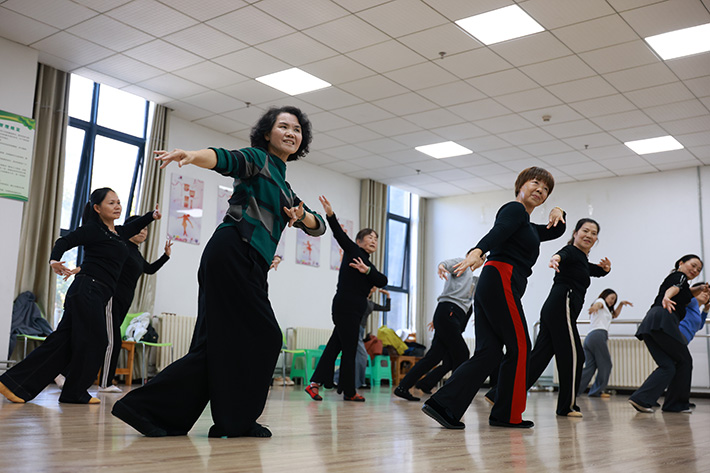
Senior citizens attend a dance class at a community university in Guiyang, Guizhou Province, on 28 October (XINHUA)
Reshaping body and mind
Dance therapy differs significantly from traditional dance. Zhang Qiang, dean of the School of Music and Dance at NNUSE, told People’s Daily newspaper, “Dance therapy does not prioritise the gracefulness or uniformity of movements.” He further explained that “through scientific guidance, it helps people to express emotions that are difficult to articulate, thereby achieving the objective of reshaping mind and body.”
Dance therapy is an interdisciplinary applied field. It integrates principles from psychology, dance, medicine and rehabilitation science, utilising bodily movements as a primary mode of communication. It aims to facilitate the regulation of psychological states, improve emotional well-being, enhance social skills and foster healthy development.
Zhang explained that dance therapy has a broad range of applications, benefitting groups such as children with autism, Alzheimer’s patients and individuals with social anxiety disorder. It also supports those experiencing emotional distress. Dance therapy effectively aids in releasing suppressed emotions and repairing psychological trauma.
The palpable healing effects of dance are evident in teaching practice. Liu shared an example: at the beginning of the class, students often rate their physical and mental state as only 3-4 out of 10, but after dance activities, many report improvements to 8-9 out of 10.
“From the start to the end of the semester, they clearly perceive positive changes in their mind-body state,” Liu observed.
“As university students, we often feel anxious, but Liu’s class helps us to relax,” Hu Chengyu, a student at NNUSE, told People’s Daily. “Young people today face significant mental pressure, and personally, I find dance therapy a highly effective way to alleviate it.”
The Dance Therapy major in NNUSE is based on solid ground. Zhang said that the college has over 40 years of special education expertise and began offering dance healing courses more than a decade ago.
Through years of practice, teachers have witnessed transformative effects: autistic adolescents opening up through rhythmic movement and Parkinson’s patients seeing improvements in walking.
The curriculum is comprehensive. Students will systematically study psychology, including general psychology and abnormal psychology (a branch of psychology that deals with psychopathology and abnormal behaviour, or the patterns of emotion, thought and behaviour that can be signs of a mental health condition). They will also learn modern dance, which emphasises expression, freedom and individuality in movement, and Laban Movement Analysis (LMA), a core component of the new programme.
Developed by Hungarian dance artist and theorist Rudolf Laban in the early 20th century, LMA is a framework and language for describing, visualising, interpreting and documenting all varieties of human movement. It offers a systematic and comprehensive approach to understanding motion, encompassing both its physical and expressive dimensions.
During the students’ first semester of senior year, they will complete internships at relevant medical institutions, rehabilitation centres, special education schools and community eldercare facilities.
“Although dance therapy is an emerging field in China, it holds significant potential for application and promising prospects for development, driven by increasing social pressure, growing health awareness and the advancement of special education,” Liu said.
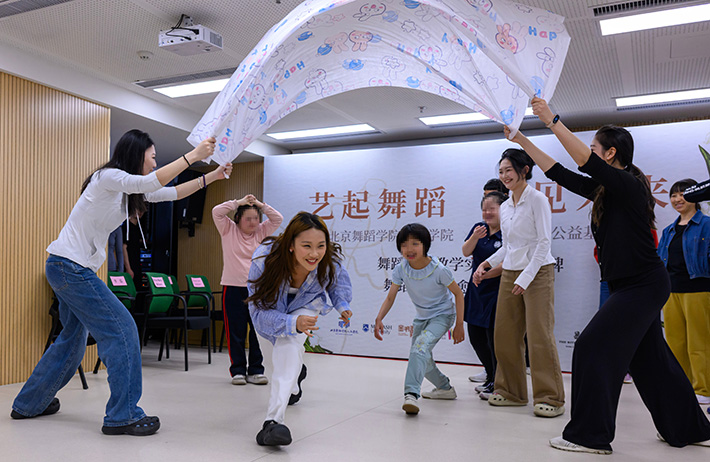
Students from Beijing Dance Academy play games with children with autism in Beijing during the inauguration of a teaching base for dance therapy on 8 May (XINHUA)
Potential and challenges
Dance therapy has broad development prospects, according to Zhang. He said graduate careers include medical rehabilitation, participating in psychosomatic illness treatment in general hospitals, or offering auxiliary treatment for anxiety and post-traumatic stress disorders in psychiatric or neurological hospitals. In education, they can assist children with autism in developing social skills at special education schools or design emotion management courses for regular primary and secondary schools to support students’ psychological well-being. Graduates can also work in elderly care to help to slow cognitive decline, design stress-reduction programmes for corporate employees in high-pressure environments, or become independent dance therapists.
However, despite its potential, the development of dance therapy still faces challenges.
Li Jing, an instructor specialising in art therapy at the School of Public Health and Management of Guangzhou University of Chinese Medicine, told Yicai magazine that issues such as the lack of an official professional certification system indicate that dance therapy in China is still in its early stages. Supply falls far short of demand, and the field’s appeal to talent is still weak.
To address these challenges, Li said it is necessary to integrate dance therapists into the health care and education systems, establish dedicated positions instead of having them filled part-time by dance teachers or rehabilitation specialists, and create clear career advancement pathways.
|
||
| About Us | Contact Us | Advertise with Us | Subscribe |
| Copyright Beijing Review All rights reserved 京ICP备08005356号-5 京公网安备110102005860号 |


