| ChinAfrica |
| Materials of the Future |
| New materials reshape daily life through safer, smarter technology |
| By GE LIJUN | VOL. 17 December 2025 ·2025-12-01 |
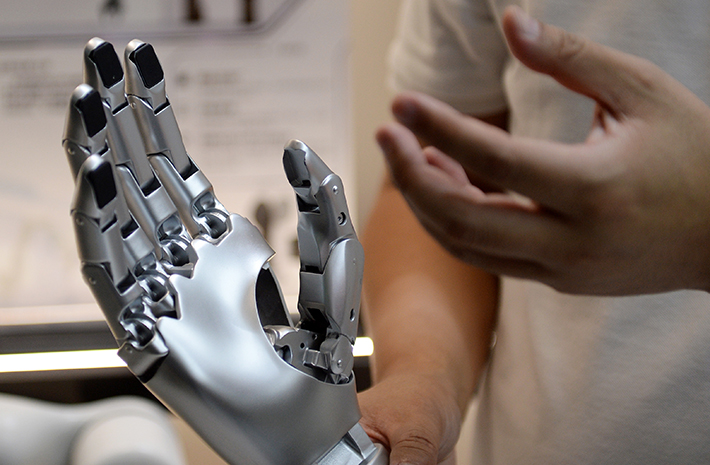
An employee of the Chinese company Moxian Technology in Dongguan, Guangdong Province, presents an electronic skin installed on a robot’s hand on 25 March (XINHUA)
From connected clothing to domestic objects and smart medical devices, new materials are permeating every aspect of our daily lives, transforming our relationship with comfort, health and technology.
What was once nearly unthinkable is now reality. Thanks to a material known as ultra-low expansion microcrystalline glass, you can place a pan directly from the hob into the refrigerator without any risk of breakage.
Normally, ceramic or glass utensils break under thermal shock, as temperature variations cause internal stresses from uneven expansion. The secret of microcrystalline glass lies in its near-zero coefficient of thermal expansion, which allows it to withstand sudden temperature changes without cracking.
Scientists at the China National Building Material Group developed this material by precisely controlling the nucleation and crystallisation processes, creating a crystalline structure that contracts slightly when heated and compensates for the expansion of the surrounding glass. Beyond kitchenware, this material is now used to manufacture telescope lenses, laser gyroscope frames and other precision scientific equipment.
Another major innovation is electronic skin. Developed by the Chongqing Institute of Graphene, this artificial skin is a thousand times more sensitive than similar devices and reacts in 2.4 milliseconds, even faster than human skin. It can accurately identify an object’s texture, roughness, elasticity, hardness or thickness and can even detect a pulse in real time through simple touch.
For amputees, this technology is a huge step forward. Prostheses equipped with electronic skin now allow users to feel the temperature of a cup, read Braille or handle delicate objects.
The medical applications are equally promising. When integrated into a smart mattress, electronic skin can continuously monitor pressure on different areas of a bedridden patient’s body. If an area remains compressed for over two hours, the system automatically alerts nursing staff to help to prevent bedsores.
What if our clothes could store energy and recharge our phones? This science fiction scenario is already a reality, thanks to a fibre-based lithium-ion polymer battery developed by a team at Fudan University.
Unlike conventional batteries that contain flammable liquid electrolytes, these fibre batteries incorporate porous channels to prevent leakage or explosion. The result is a flexible, safe and rechargeable battery that can withstand extreme conditions, including washing, deformation, abrasion and cutting.
These show how new materials are shaping a safer, more sustainable future by integrating technology into everyday life.
|
||
| About Us | Contact Us | Advertise with Us | Subscribe |
| Copyright Beijing Review All rights reserved 京ICP备08005356号-5 京公网安备110102005860号 |


