|
||||||||||
| Home Top News Economy/Tech Culture/Sports China in Foreign Eyes Green Development Videos Intangible Cultural Heritages |
|
||||||||||
| Home Top News Economy/Tech Culture/Sports China in Foreign Eyes Green Development Videos Intangible Cultural Heritages |
| ChinAfrica |
| A Palace Preserved |
| Inside Beijing’s Palace Museum, priceless artefacts make history come alive |
| By Li Qing | VOL. 17 December 2025 ·2025-12-01 |
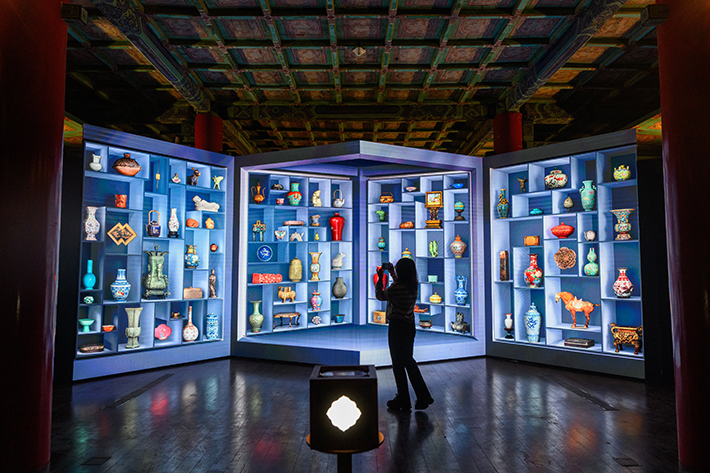
A 3D digital display at the exhibition in the Palace Museum to mark its 100th anniversary is arranged on 29 September (XINHUA)
In the heart of Beijing, the former imperial residence, also known as the Forbidden City, stands as a silent witness to the ebb and flow of China’s history. For centuries, ordinary people could only catch fleeting glimpses of the palace’s gilded ridges from beyond its towering walls, their imaginations wandering through the mysteries hidden within.
That long-standing veil was finally lifted on 10 October 1925. Once home to 24 emperors of the Ming (1368-1644) and Qing (1644-1911) dynasties, the Forbidden City was repurposed as the Palace Museum, unveiling its priceless collections of cultural relics to the public for the first time. Crowds poured through the Meridian Gate, the former southern entrance to the imperial court.
From that moment on, the Palace Museum became a place of pilgrimage for visitors from around the world. Today, it stands among the most visited museums in the world, with annual attendance surpassing 10 million for the first time in 2009 and reaching more than 17.6 million in 2024.
During this year’s National Day holiday from 1 to 8 October, thousands waited patiently in long lines to immerse themselves in a grand exhibition marking the museum’s centenary.
The exhibition traces the museum’s remarkable journey, from its tentative beginnings to steady growth, perseverance through hardships and bold innovation in a new era. The excitement filling its courtyards today echoes the same awe and wonder that stirred those who, a hundred years ago, first stepped through the gates of the once-forbidden palace.
Preserving the legacy
In its early years, the Palace Museum faced daunting challenges. The buildings were worn and dilapidated, courtyards overgrown, and its mission was just beginning. Without a complete record of its treasures, the museum could not truly take shape.
In the winter of 1924, staff began the unprecedented task of cataloguing every item housed within its walls. This monumental effort continued until March 1930, producing the original archives of more than a million artefacts.
“The Palace Museum’s collections are a priceless cultural heritage of the Chinese nation,” former Curator Zheng Xinmiao told Xinhua News Agency in October. Thoroughly accounting for and properly safeguarding these treasures is a responsibility to the nation and the people, Zheng said.
Since then, the museum has carried out several comprehensive inventories. Between 1949 and 2010 alone, four major cataloguing campaigns were completed. Today, the Palace Museum houses 1.95 million items or sets, divided into 25 major categories and over 100 subcategories, forming an invaluable cultural treasury.
Following the September 18th Incident in 1931, the beginning of Japan’s aggression of northeast China, the Palace Museum made a decision to undertake what would become one of the greatest preservation efforts in Chinese history, moving its most precious artefacts southward to protect them from possible destruction and looting as the threat of a Japanese invasion of north China loomed large.
Over 19,000 boxes of national treasures travelled thousands of kilometres to Shanghai and southwestern provinces such as Sichuan and Guizhou. After the victory in the War of Resistance Against Japanese Aggression in 1945, some returned to the Palace Museum, some were transported to Taiwan by the Kuomintang and others remain in the collections of other museums across the country to this day. 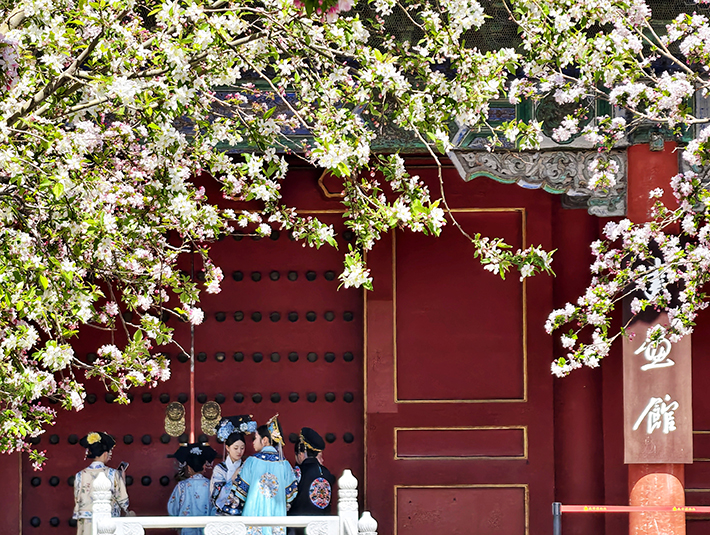
Visitors dressed in Qing Dynasty (1644-1911) attire tour the Palace Museum on 1 April (XINHUA)
The living palace
“May the Palace Museum not be a dead relic of Chinese history, but a living museum for millions of years to come.” This hope was expressed by Li Yuying, one of its founders. Today, that vision has come to life.
The centenary exhibition shows how the Palace Museum lives in the digital age. High-resolution images of countless artefacts can be explored through the Digital Museum Database, letting visitors across the globe experience treasures that would otherwise remain hidden behind palace walls.
History also comes alive in playful ways. At the museum’s restaurants, visitors can enjoy ice creams shaped like the animal statues that perch atop the palace roofs.
The Palace Museum’s cultural products have also captured public imagination. Among nearly 20,000 items, the Palace Museum Calendar featuring cultural artefacts collected in the museum stands out. Published annually for 17 years, it has sold over 8.5 million copies, with the 2025 edition selling 1.2 million.
Earlier this year, the museum hosted China’s first major exhibition on Greece’s Minoan civilisation, presenting 172 artefacts in collaboration with the Heraklion Archaeological Museum and Greek cultural authorities.
Since 2012, the Palace Museum has organised nearly 30 exhibitions from Asia, Europe, and the Americas, and hosted 79 exhibitions in other countries.
The partnerships the Palace Museums have built with global institutions such as the Louvre, the British Museum and the Metropolitan Museum of Art have led to the hosting of more joint exhibitions and academic forums and launch of digital projects, turning the museum into a bridge for connecting civilisations.
| About Us | Contact Us | Advertise with Us | Subscribe |
| Copyright Beijing Review All rights reserved 京ICP备08005356号-5 京公网安备110102005860号 |


