| ChinAfrica |
| The Diplomatic Power of Proverbs |
| Xi Jinping’s African discourse harmonises Chinese and African wisdom and boosts the construction of a China-Africa community with a shared future |
| By Etienne Bankuwiha | VOL. 18 January 2026 ·2025-12-31 |
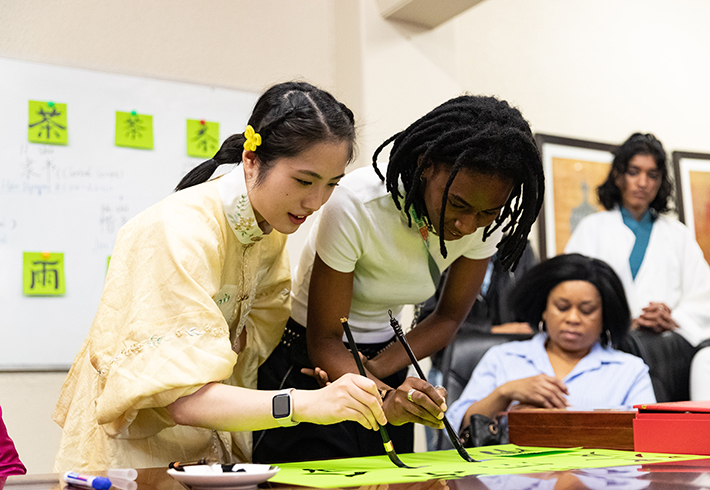
An African student and a Confucius Institute volunteer write Chinese calligraphy during a Chinese Language Day event in Johannesburg, South Africa, on 17 April 2025 (XINHUA)
As a Burundian doctoral student at Nanjing University, my personal journey is closely intertwined with China’s development in the new era and the deepening China-Africa partnership. Recently, my experiences have given me a deeper appreciation of the importance of people-to-people exchanges between China and Africa.
During the 2025 World Chinese Language Conference, several young Sinologists, including myself, wrote a letter to President Xi Jinping expressing our commitment to fostering cultural exchanges. We were honoured to receive his reply, which greatly encouraged me. This experience signalled recognition of my research on China-Africa civilisational dialogue. I firmly believe that linguistic and cultural exchanges serve as a strong bridge connecting diverse civilisations and nurturing friendship among peoples.
Reflecting on my journey, I began systematically studying Chinese in Africa in 2012, the same year Xi became General Secretary of the Communist Party of China Central Committee, marking a new era of Chinese socialism. The following year, I had the opportunity to study in China.
After immersing myself in Chinese culture, I came to understand that China’s development reflects not only economic progress but also the renewed vitality of an ancient civilisation’s wisdom. President Xi’s distinctive diplomatic discourse, especially his skilful use of Chinese and African proverbs, captivated me and inspired my research.
President Xi’s “proverb diplomacy” is a masterful art of empathetic communication. It goes beyond policy language, linking broad cooperation ideas with popular wisdom and making the concept of a “community with a shared future” concrete and meaningful. This approach infuses diplomacy with warmth and grounds vision in reality.
Bidirectional translation
President Xi’s speeches on Africa are characterised by equality and respect, avoiding any condescending tone. He skilfully translates profound policy concepts into familiar proverbs, facilitating effective communication from official discourse to popular understanding.
For instance, when expounding on the core concept of “mutually beneficial cooperation,” he cites the African proverb, “If you want to go fast, go alone; if you want to go far, go together,” complementing it with the Chinese saying, “When big rivers have water, the small ones are filled; and when small rivers have water, the big ones are filled.” This rhetorical symmetry embodies a convergence of development philosophies, vividly illustrating the interconnectedness and mutual reliance between China and Africa - the world’s largest developing country and the continent with the most developing countries - on their modernisation journey. We are not solitary travellers, but fellow travellers learning from and inspiring each other.
When tracing the historical roots of China-Africa friendship, he quotes, “A river has a source, and its water is deep,” emphasising the enduring bond between China and Africa. He then envisions future cooperation with the Chinese verse, “How can the pond water be so clear? It is because a steady source of living water keeps flowing in.” This reminds me of the Tanzania-Zambia Railway story, where Chinese builders and their African brothers worked side by side under harsh conditions, even sacrificing their lives, as well as the historic moment when African nations supported China’s entry into the UN. These shared historical memories, like a deep, gushing spring, serve as an inexhaustible “source of living water” for today’s China-Africa cooperation.
President Xi’s use of proverbs continually awakens and activates this profound emotional and historical legacy. In the face of global challenges, he cites the African proverb, “One log cannot build a house,” stressing the necessity of solidarity and cooperation, which resonates with the Chinese saying, “The going is difficult when doing it alone; the going becomes easier when doing it with many others.” Today, across the vast African continent - from highways facilitating the circulation of agricultural products to ports enhancing trade efficiency, and from employment-creating industrial parks to skill-training initiatives - concrete China-Africa cooperation outcomes testify to the practical power of ancient wisdom. Africa is hailed as the “land of hope,” and this hope is the joint creation of the sweat and wisdom of China and Africa.
Ethical resonance
Profound civilisational dialogue is built on the mutual recognition of values. President Xi has insightfully highlighted the intrinsic resonance between Africa’s Ubuntu philosophy, encapsulated in “I am because we are,” and the ideals of Chinese civilisation, such as datong (great harmony) and renmin aiwu (benevolence towards people and love for things). Reading his discussions on this topic, I was profoundly struck by the realisation that, despite the great geographical distance between China and Africa, our ancient sages attained comparable heights of wisdom on fundamental questions such as how humans coexist within society and how to build a harmonious community.
The Ubuntu philosophy emphasises the individual’s existence within a community and the realisation of value through collective well-being. Similarly, the Confucian ideal of datong seeks to transcend self-interest and pursue global harmony. This shared advocacy for inclusiveness, harmony, solidarity, and mutual assistance forms a profound cultural foundation for China-Africa relations, enabling them to go beyond mere transactional exchanges towards a genuine “hand-in-hand” partnership.
When President Xi speaks about “I am because we are,” he connects it with Chinese ideas such as “lips and teeth depend on each other” and “one tree does not make a forest,” engaging in deep civilisational dialogue. Likewise, the Chinese saying, “When brothers are of the same mind, they can cut metal through” resonates with Africa’s idea, “One hand cannot hold a gourd on the head.” This symbolises a handshake of civilisations: a shared rejection of the old view of a world divided into “centre” and “periphery,” and a clear commitment to fairness, justice, and dignified development for all developing countries.
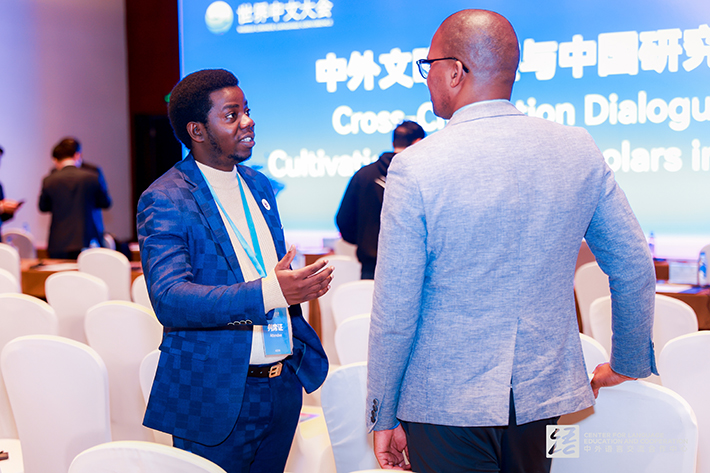
Etienne Bankuwiha (left) talks to another attendee at the 2025 World Chinese Language Conference in Beijing on 15 November 2025 (COURTESY)
A common pathway
The value of concepts ultimately reveals itself through action. President Xi captures the essence of China-Africa relations by invoking the African proverb, “Travelling companions are true friends,” which resonates with the ancient Chinese saying, “A partnership forged with the right approach defies distance.” China and Africa are “fellow travellers” on the journey towards modernisation and the realisation of national dreams. China is strengthening itself through Chinese modernisation, while Africa is steadily advancing towards the goals outlined in the AU’s Agenda 2063.
Together, China and Africa account for over one-third of the world’s population, and the global landscape of modernisation would be incomplete without their contributions. Being “fellow travellers” makes the meaning of “united we go far” clear in practice. China’s announcement of the Ten Partnership Actions with Africa is a practical extension of the concept, “If you want to go fast, go alone; if you want to go far, go together” in areas such as development, security, people-to-people exchanges and green development, fully embodying the principle of “extensive consultation, joint contribution, and shared benefits.” The pursuit of a future of modernisation is focused on fairness, inclusiveness, and sustainability - prioritising people, diversity, ecological balance, and peace. This shared progress is expected to spark a new wave of modernisation in the Global South and open a new chapter in building a community with a shared future for humanity.
The power of civilisational dialogue
President Xi’s reply letter serves as tremendous encouragement not only to me personally, but also as an affirmation and expectation for all individuals worldwide committed to fostering cultural exchanges between China and foreign countries. His practice of “proverb diplomacy” and emphasis on people-to-people exchanges hold profound significance: they enable Africa’s ancient wisdom to resonate within the great Eastern nation, while allowing Chinese philosophical thought to take root in Africa. This transcends mere language translation, representing mutual learning among civilisations.
This kind of diplomacy offers three key insights. First, genuine global leadership is rooted not only in national strength, but more importantly in the appeal of culture and the inclusiveness of civilisation. Second, traditional wisdom is not an impediment to modernisation but a valuable resource for addressing contemporary challenges and driving theoretical innovation. Third, sustainable partnerships must be built on a solid foundation of mutual appreciation of civilisations and shared values, rather than fleeting interests.
Looking ahead, with China and Africa designating 2026 as the China-Africa Year of People-to-People Exchanges, exchanges and mutual learning centred on the theme “Consolidate All-Weather Friendship, Pursue Shared Dream of Modernisation” are set to deepen.
Continued civilisational dialogue, grounded in proverbial wisdom, philosophical resonance and joint action, is expected to further strengthen the emotional bond between Chinese and African peoples, bringing more enduring vitality to the construction of a high-level, all-weather China-Africa community with a shared future. Active participation in initiatives such as the World Chinese Language Conference and related collaborative programmes contributes to sustaining this great endeavour.
The author is Ph.D. Candidate of Nanjing University
|
||||
| About Us | Contact Us | Advertise with Us | Subscribe |
| Copyright Beijing Review All rights reserved 京ICP备08005356号-5 京公网安备110102005860号 |


