| ChinAfrica |
| Big Screen Boom |
| The robust growth of China’s film market points to a strong post-pandemic recovery and reflects its immense potential |
| By Lu Jiajun | VOL. 18 February 2026 ·2026-02-12 |
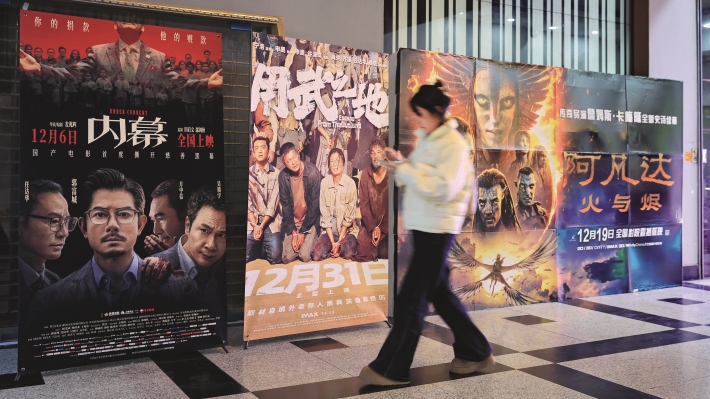
A moviegoer passes by film posters in a cinema in Nanjing, Jiangsu Province, on 13 December 2025 (XINHUA)
The year 2025 marks the 120th anniversary of the birth of Chinese filmmaking. From the first film Dingjun Mountain released in 1905, which captured scenes from Peking opera, to the present day where artificial intelligence (AI) is utilised in film production, the Chinese film industry has been developing for over a century. Data from the China Film Administration shows that China’s 2025 box office revenue topped 51.8 billion yuan ($7.4 billion), realising a year-on-year increase of nearly 22 percent.
Such robust growth displays the strong recovery of China’s film market from the post-pandemic period, and also reflects its resilience, vitality, and immense potential. It highlights the dominance of domestic films in the Chinese market, as well as China’s cultural confidence and inclusiveness. At a time when a new round of technological revolution is accelerating and the global film industry is undergoing profound changes, China’s film industry is steadily taking a leading role globally.
Various domestic films
The year 2025 saw a wave of movie-watching enthusiasm in China, with the box office of domestic films accounting for nearly 41.3 billion yuan ($5.9 billion), making up nearly 80 percent of the total. A series of high-quality domestic films emerged to tell Chinese stories. Audiences were deeply impressed with the excellent content and showed their high approval in public reviews.
Since last year also marked the 80th anniversary of the victory of the Chinese People’s War of Resistance Against Japanese Aggression and the World Anti-Fascist War, China produced several films showcasing the suffering and resistance of its people during that time period. These films include Dead to Rights, Evil Unbound, and Dongji Rescue, which received widespread attention.
The film Dead to Rights displays a period of unforgettable Chinese history based on real photographic evidence of Japanese war crimes during the Nanjing Massacre, which occurred between December 1937 and January 1938. It helps audiences to learn the importance of remembering history and cherishing peace. The film became the box office champion during the summer season, and also set a new record for historical films in the summer. It inspired many young people to visit memorials and archives to better understand history.
The growing market influence and cultural impact of Chinese films are not confined to specific genres. In recent years, more Chinese films have focused on themes of traditional culture and contemporary values which align with the aesthetic and spiritual pursuits of Chinese audiences. Meanwhile, the domestic film industry has witnessed significant progress in genre expansion and technological application, reaching world-class standards in both storytelling and visual effects.
In addition to historical films, some animated films that present traditional Chinese culture have also gained much publicity and box office success. Ne Zha 2 became a smash hit with its compelling story and stunning visual effects. Its global box office exceeded 15.9 billion yuan ($2.3 billion), making it the top-grossing animated film worldwide. Nobody, with its Chinese-style visuals and innovative interpretation of traditional mythology, has won the affection of many audiences and became the box office champion for domestic 2D animated films.
In recent years, Chinese films have seen a great advancement in systematic production and full-chain collaboration. A number of new production bases have been established, integrating AI deeper with the film industry to enhance the audiovisual effect of domestic films. As a result, more people are attracted to cinemas.
Stimulating consumption
With greater cultural confidence and robust technological innovation, the Chinese film industry has created excellent artwork on screen and expanded its influence into public consumption. The popularity of movies is stimulating business throughout the entire consumption chain.
The Chinese film industry has entered a new stage of intellectual property (IP) value development throughout the entire industrial chain, integrating movies with innovative cultural products. The consumer market for derivative products related to movies reached a scale of hundreds of billions of yuan, while the cross-industry collaborations of film IPs have unleashed a powerful effect as well. For example, the cooperation between Ne Zha 2 and dozens of brands including food, beauty, automobiles, trendy toys, digital products, and coffee has gained cumulative sales of tens of billions of yuan. Over 800 cultural products related to Nobody have been brought into pop-up stores across the country, with a total sale of nearly 2.5 billion yuan ($358.4 million).
In addition to innovative products, the integration with tourism and the food industry has also become a new trend. Last year, the National Film Administration and China Central Television jointly launched the China Film Consumption Year.
Local governments have also launched events to convert box office into incremental consumption across various fields. The Shanghai dialect film Shanghai Wonton has inspired many viewers to visit Shanghai. The district-level departments, producers, and time-honoured brands in the city jointly promoted a series of offline interactive activities for city walks and local cuisine. The producer of Nobody and Shanxi’s culture and tourism department also jointly launched themed events, like tours of historical sites in the province that served as filming locations in the movie.
The integration of films with daily life consumption has transformed the Chinese film industry from a traditional box office economy into a diversified consumption ecosystem. As a result, this has made the film economy an important engine for boosting consumption and industrial upgrading.
| About Us | Contact Us | Advertise with Us | Subscribe |
| Copyright Beijing Review All rights reserved 京ICP备08005356号-5 京公网安备110102005860号 |


