| ChinAfrica |
| Innovation Without Borders |
| Rwanda-China alliance launches youth innovation union, opening doors for African entrepreneurs |
| By Alafati Mugabo | VOL. 18 March 2026 ·2026-03-09 |
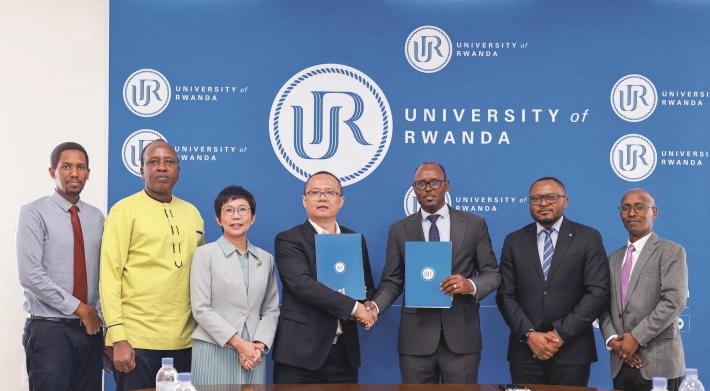
A signing ceremony is held to mark the establishment of the Rwanda Branch Centre of the China-Africa Youth Innovation & Entrepreneurship Union at the University of Rwanda in September 2025 (COURTESY)
On a warm afternoon in Kigali, students filled a conference hall at the University of Rwanda, sitting shoulder to shoulder with lecturers and visitors from China, unsure at first how significant the moment would be. Some came out of curiosity. Others came with hope. By the end of the ceremony, many felt they had witnessed more than the launch of a new academic centre - they had watched a door open.
The event marked the official launch of the Rwanda Branch Centre of the China–Africa Youth Innovation & Entrepreneurship Union, a partnership between the University of Rwanda and China’s Hubei University of Technology. For the young people in the room, it was not just another agreement signed between institutions. It was a signal that their ideas, ambitions and futures now had a place in a wider world.
The partnership was formalised in the presence of a high-level Chinese delegation led by He Xingyang, vice president of Hubei University of Technology, alongside University of Rwanda Vice Chancellor Muganga Didas Kayihura. Beyond its diplomatic significance, the agreement represents a tangible commitment to the futures of hundreds of students and a recognition of their potential to shape the next chapter of global innovation and entrepreneurship.
Among the students present, excitement was palpable. Twenty-three-year-old Jean Paul Niyonzima, a third-year engineering student at the University of Rwanda, could barely contain his enthusiasm as he reflected on what the partnership means for his generation.
“For years, we’ve heard about the incredible technological advancements happening in China - the innovation ecosystems in cities like Shenzhen and Beijing, the entrepreneurial spirit that has transformed entire industries,” Niyonzima said. “But those stories always felt distant, almost like they belonged to another world. Today, that world has come to us.”
Niyonzima, who aspires to develop affordable renewable energy solutions for rural communities, sees the partnership’s promise of access to Chinese innovation and entrepreneurship opportunities as a potential game-changer.
“The chance to learn from Chinese experts and potentially visit Chinese innovation hubs, and to understand how solutions are scaled to serve over a billion people is invaluable for someone like me who wants to create impact at scale,” he explained.
His sentiment was echoed by Aline Uwase, a 21-year-old business administration student whose entrepreneurial journey began in her first year, when she launched a small agricultural technology startup connecting farmers with urban markets.
“Many of us have brilliant ideas, but we lack guidance on how to turn those ideas into viable businesses,” Uwase said. “We don’t always know how to access funding, navigate regulatory frameworks, or scale beyond local markets. The career guidance workshops and professional programmes promised by this partnership will give us the mentorship and practical knowledge we urgently need.”
Distinctive approach
The collaboration between the University of Rwanda and Hubei University of Technology builds on decades of China–Rwanda cooperation, a relationship that has touched nearly every sector of Rwandan society, from infrastructure and health care to agriculture and technology.
Egide Munyankindi, a 20-year-old computer science student aspiring to specialise in artificial intelligence, spoke passionately about what he sees as China’s distinctive approach to engagement with African nations.
“What I appreciate most about China’s partnership with Rwanda is that it’s never felt patronising,” Munyankindi said. “When Chinese partners come here, they come to work alongside us, to share knowledge and to invest in our capacity to build our own solutions.”
Egide is particularly enthusiastic about the lectures and training programmes planned through the union. “In AI and machine learning, China is at the forefront globally. Access to Chinese researchers and industry practitioners could accelerate our development in these fields by years, if not decades.”
For many female students at the University of Rwanda, the partnership carries additional significance, as it promises to open pathways in fields where women remain underrepresented, both in Rwanda and globally.
Grace Iradukunda, a 20-year-old mechanical engineering student and the only woman in several of her advanced courses, sees the union as an opportunity to challenge stereotypes and expand what is possible for young women in STEM.
“Historically, many of the most exciting opportunities in engineering and technology have gone to male students, partly because of networks and partly because of assumptions about women’s capabilities,” Iradukunda said. “Job fairs and professional exchanges create a more level playing field, allowing us to showcase our skills directly to employers and partners.”
Students are keenly aware that the challenges the country faces, such as youth unemployment, technological gaps, climate change and the need for sustainable development, are not unique to Rwanda but shared across much of the African continent. The partnership’s commitment to enrolling more African and Chinese universities into the union creates a network effect that significantly amplifies its impact.
“What excites me most is the vision of a truly pan-African network connected to Chinese innovation ecosystems,” Uwase added. “Imagine students from Nairobi, Lagos, Addis Ababa and Kigali collaborating with peers in Beijing, Shanghai and Wuhan. This is how we build the Africa we want - connected, collaborative and globally competitive.”
Deep appreciation
Beyond inspiration, students are focused on the concrete opportunities ahead. A group of 15 students who spoke to ChinAfrica in Kigali said they plan to participate in every training programme, attend every lecture and engage with every visiting expert.
“We want to learn about China’s innovation ecosystems - how startups are nurtured, how research institutions connect with industry, and how ideas move from labs to markets,” one of the students said.
Throughout these conversations, a theme that emerged consistently was deep appreciation for China’s continued partnership with Rwanda and its investment in young people’s futures.
“China didn’t have to invest in our education or our capacity building,” Iradukunda reflected. “But they chose to engage with us as partners. That investment isn’t just appreciated; it’s something we’re determined to honour by working hard, innovating and building bridges between our nations and continents.”
|
||||||||||||
| About Us | Contact Us | Advertise with Us | Subscribe |
| Copyright Beijing Review All rights reserved 京ICP备08005356号-5 京公网安备110102005860号 |


