|
||||||||||
| Home Top News Economy/Tech Culture/Sports China in Foreign Eyes Green Development Videos Intangible Cultural Heritages |
|
||||||||||
| Home Top News Economy/Tech Culture/Sports China in Foreign Eyes Green Development Videos Intangible Cultural Heritages |
| ChinAfrica |
| A Journey Across Africa |
| A visit to the continent reveals the warmth and resilience of its people and their appreciation for China |
| By Yang Chaohui and Hua Guangcan | VOL. 18 March 2026 ·2026-03-12 |
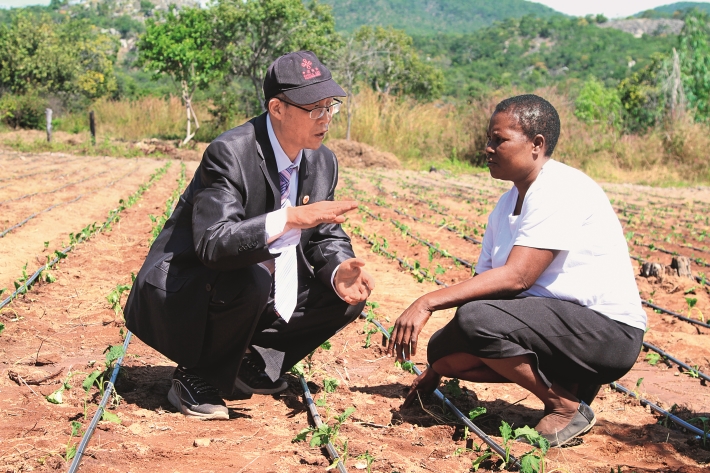
A Chinese agricultural expert speaks with a local farmer in a village in Manicaland Province, Zimbabwe, on 14 May 2025 (XINHUA)
Despite the geographical distance between China and Africa, the rich customs and lifestyles of the African people present an interesting area of study for international professionals. It is this facet of Africa that fascinated us most during our research journey across the continent.
As our plane crossed the skies above the Indian Ocean, the view below changed from deep blue to a mosaic of lush greens. Resilient and full of hope, the land revealed its true character the moment we set foot on African soil.
The striking diversity of economic and social development immediately came into view. In the streets of Nairobi, the Kenyatta International Conference Centre and the Britam Tower rise prominently against the skyline, surrounded by clusters of modern office buildings. Our local guide explained that Kenya reached a historic high GDP of $124.5 billion in 2024.
In Zimbabwe, we encountered the now-famous 100-trillion-dollar banknote, a stark reminder of the country’s past economic turmoil. Local residents noted that more than two decades of Western sanctions had cost the economy over $42 billion. Although hyperinflation once reached extreme levels, by 2024, the economy had rebounded with a growth rate of 3.7 percent, driven largely by agriculture, mining and tourism.
Unmatched warmth
At the University of Zimbabwe, the blend of elegant British-style architecture and African design was striking, and the institution’s expansive campus and broad range of disciplines left a strong impression. Yet local residents acknowledged that high tuition fees put higher education beyond the reach of many ordinary families, while some academic programmes remain insufficiently aligned with societal and labour-market needs. Consequently, graduates often struggle to secure a job, while persistently high youth unemployment has emerged as a major impediment to wider social development.
And yet, the people here possess a life force unmatched in its warmth and vibrancy. Kenya and Zimbabwe both enjoy tropical savanna climates. Year-round warm and humid conditions nurture an inherently optimistic and openhearted spirit.
Handicrafts abound on the streets, each carrying a distinctive charm. In Kenya, Maasai beadwork is crafted from vibrant strings of coloured beads and is instantly recognisable. Green, blue and yellow symbolise the grasslands, the sky and sunlight. Each piece embodies the Maasai people’s love of life and deep reverence for nature.
In Zimbabwe, stone sculptures carved primarily from serpentine are regarded as important artistic treasures. Their clean, fluid lines give rise to a raw and enduring vitality. At an art gallery in Harare, we had the privilege of viewing an exhibition by Dominic Benhura, one of the country’s most celebrated stone sculptors. His works do not depend on technical complexity but draw their power from an immediacy that speaks directly to the heart. Some pieces, formed with softly rounded contours, portray a mother holding her child, expressing deep maternal warmth. Others use abstract forms to depict the human impulse to transcend constraints and grow towards the light, with every carved line seeming to pulse with life.
Beyond the arts, we had the chance to witness a local football match during our stay in Zimbabwe. The streets came alive with cheering fans in team jerseys, and the simplicity and sincerity of their joy left a lasting impression.

A view of Nairobi, Kenya, at sunset on 3 April 2024 (XINHUA)
Feeling the friendship
Throughout this unforgettable journey, the enduring friendship between China and Africa was evident, forming a unifying thread in every experience. Leaving the Jomo Kenyatta International Airport in Nairobi, we were immediately struck by the Chinese-built airport expressway, a major artery that cut the journey to the city centre from two hours to just 30 minutes, revealing the efficiency and impact of China’s contributions.
In a China-Africa agricultural cooperation demonstration village in Zimbabwe, we sat with aid experts and local villagers for a round table discussion. Several villagers spoke repeatedly about how the project had improved access to drinking water, their genuine gratitude leaving a deep impression on us.
In the China-Africa industrial park in Tatu, companies such as Sinotruk and PowerChina have set up operations, selling their products in the local markets as well as exporting to neighbouring countries. Over the past four years, industrial parks built by Chinese enterprises in Africa have created more than 1.1 million local jobs.
The seven-day journey seemed to pass in an instant. As the plane lifted off, we gazed once more at this vast land, hearts full of reluctance and contemplation. The warm greetings of strangers on the street remain vivid in our memory, many of them saying ni hao in halting Chinese. In just a few days, we witnessed both the energy and the challenges of Africa’s economic development. We felt the optimism and love of life that persist despite hardship, and we experienced the profound friendship connecting China and Africa across mountains and seas.
The authors are Research Staffs from Academy of Contemporary China and World Studies
| About Us | Contact Us | Advertise with Us | Subscribe |
| Copyright Beijing Review All rights reserved 京ICP备08005356号-5 京公网安备110102005860号 |


