| ChinAfrica |
| From Peaks to Prosperity |
| Through scenic landscapes, local specialties and digital innovation, Nujiang is changing the lives of its people |
| By Ma Li | VOL. 18 April 2026 ·2026-03-26 |
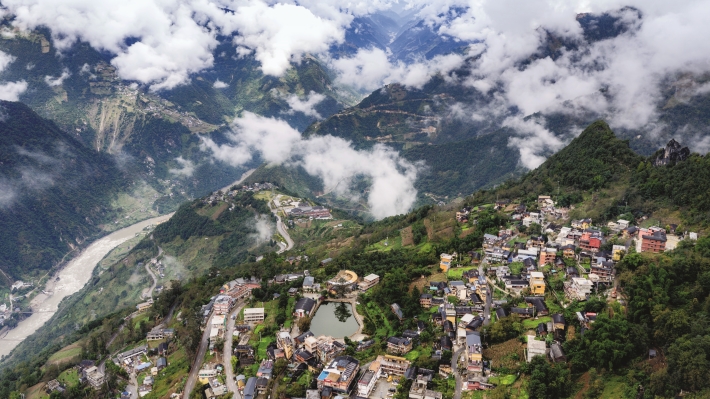
A view of Laomudeng Village, Fugong County, Nujiang Lisu Autonomous Prefecture, Yunnan Province, on 20 October 2025 (XINHUA)
"Every minute counts in the fight against poverty,” Li Wenhui, a National People’s Congress deputy and governor of Nujiang Lisu Autonomous Prefecture in Yunnan Province, said in an interview with China Today on the sidelines of the Two Sessions in 2019, when poverty alleviation was at its most intense stage.
By 2021, after the battle against poverty had been won, he had shifted his focus. “Every moment presents opportunities for development,” he told China Today in another interview.
This year marks the start of the 15th Five-Year Plan, and it is also the first year after the transition period linking poverty alleviation with rural revitalisation. In his third interview with China Today, while the pace of his speech remained unchanged, it carried a new calmness and a broader vision.
“If building roads transformed Nujiang from a natural barrier to a thoroughfare, now what we need to do is to turn this thoroughfare into a real road to prosperity for our people,” Li said, refreshing memories of Nujiang’s nearly 300-km scenic highway.
Utilising local resources
In Nujiang, where mountains and gorges cover 98 percent of the land, people once “lived off the land and climbed slopes to go out.” The construction of National Highway G219 has not only significantly shortened travel times, but also reshaped local mindsets.
“Years ago, our black cardamom couldn’t get out, and visitors couldn’t get in. That was really worrying,” Li recalled. Now, the scenic highway has become a fast lane for local specialties. The cultivation of black cardamom, a ginger-like herb for seasoning and a major local cash crop, stabilises at 1.11 million mu (74,000 hectares), generating a total output value of 3 billion yuan ($436.6 million) and increasing farmers’ income by over 4,000 yuan ($582) per capita. Nujiang has become the country’s core production area for black cardamom.
But Li is not satisfied. The 15th Five-Year Plan marks a bigger vision: local specialties would not only “leave the mountains,” but also “reach the world.” He proudly shared ongoing efforts to build regional public brands for local specialties such as wild mountain produce and coffee. For Li, branding represents Nujiang’s shift from selling raw materials to selling products and culture. When black cardamom and coffee carrying the essence of the mountains and gorges reach distant markets, the region’s hidden resources would turn into better livelihoods for its people.
The highway also brings in people, boosting local tourism. In Laomudeng Village, Fugong County, many villagers get higher income from running rural guesthouses. “In the past, people relied on farming or seasonal work elsewhere. Now, young people are returning home to run homestays, act as guides, or even livestream,” Li said. “Our aim is to let these returning youth earn money at home, making the life they aspire truly attainable.”
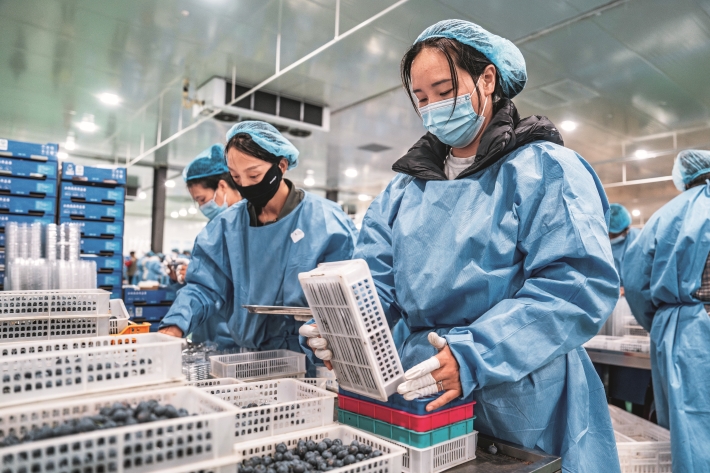
Workers pack blueberries in a modern agricultural park in Lanping County, Nujiang Lisu Autonomous Prefecture, Yunnan Province, on 8 August 2025 (XINHUA)
Safeguarding progress
After poverty eradication, the greatest concern is a relapse into poverty.
Nujiang, once a deeply impoverished region, relocated 100,000 people through resettlement programmes. But moving out was only the first step; staying out of poverty and achieving prosperity are the real tests.
“We prioritise preventing relocated populations from falling back into poverty,” Li affirmed. Around resettlement areas, the local government has developed industrial parks, employment support workshops, and casual labour markets. Of 57,700 relocated workers, 53,000 have found employment, achieving an employment rate above 90 percent among the relocated population.
“Thriving industries are the foundation for solving all rural problems,” Li said. Nujiang has introduced an integrated working mechanism that holds local leaders accountable, focuses on key populations and areas, and applies targeted measures for those at risk of returning to poverty. “We want residents to know that the government would not leave anyone behind.”
To this end, local development has gained a new tool: digital technology.
“Digital technology has to integrate deeply with local industries,” he said. “E-commerce, low-altitude economy, smart agriculture - these new concepts have to take root in Nujiang.” Smart agriculture, he emphasised, is not for show; it demonstrates that farming could be high-tech. Digital empowerment has become a new source of income for residents, giving Nujiang further momentum to advance.
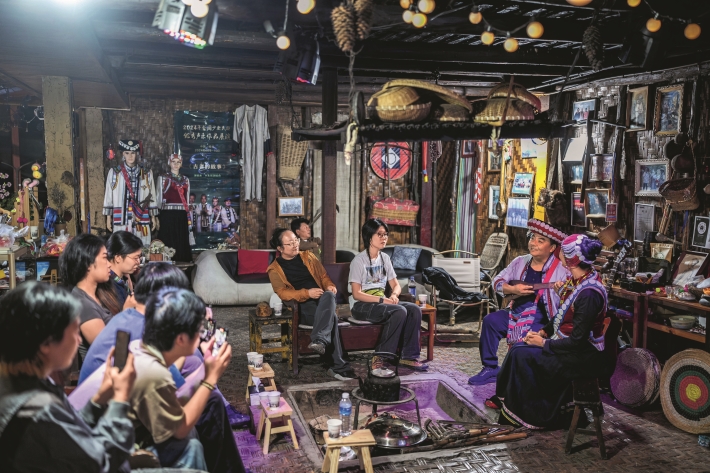
Two villagers (right) perform for tourists in Laomudeng Village, Fugong County, Nujiang Lisu Autonomous Prefecture, Yunnan Province, on 20 October 2025 (XINHUA)
A broader horizon
The popular G219 highway draws unprecedented traffic. In 2025, Nujiang received over 10 million visitors, generating total tourism revenue of 7.04 billion yuan ($1.03 billion). Twenty-one rural cultural-tourism villages hosted over 200,000 visitors during holidays, earning more than 7 million yuan ($1.02 million).
“What do tourists see? What do they eat? What do they take away?” Li asked rhetorically. “They see the Gaoligong Mountains and gorges, consume dishes seasoned with black cardamom, and take home the ‘taste of Nujiang.’”
He stressed that the development of rural tourism should be rooted in villages rather than turning them into scenic attractions. Tourism should serve rural revitalisation, preserving the everyday life and soul of the village.
In such mountainous terrain, roads remain a lifeline. “Building railways and civilian airports has been a dream for generations of Nujiang’s over 500,000 residents,” Li said. During the 15th Five-Year Plan, Nujiang aims to seize opportunities from the national transport strategy, advancing preparatory work for a new railway and airport.
In the end, Li reiterated, “Nujiang’s development is not a sprint; it is a marathon. We ran the poverty alleviation leg and are now racing on the rural revitalisation track.”
From the urgent push in 2019, through the early momentum in 2021, and to pursuing dreams in 2026, every pulse along the Nujiang Valley has connected thousands of households to a better life - and the roads are carrying them farther than ever.
| About Us | Contact Us | Advertise with Us | Subscribe |
| Copyright Beijing Review All rights reserved 京ICP备08005356号-5 京公网安备110102005860号 |


