| ChinAfrica |
| Paddy Pinnacle |
| A young entrepreneur turns black soil into a field of opportunity in northeast China |
| By Cui Xiaoqin | VOL. 18 April 2026 ·2026-03-26 |
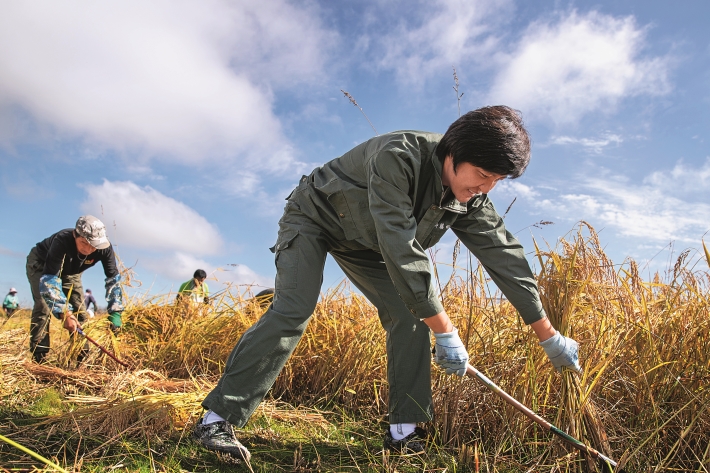
Chen Yujia harvests rice with fellow villagers in Shangguandi Village in Ning’an, Heilongjiang Province, on 21 September 2024 (XINHUA)
A subtle fragrance drifted through the halls of the Great Hall of the People in Beijing during this year’s Two Sessions in March. It was not perfume, but the aroma of freshly milled rice brought from northeast China by Chen Yujia.
A deputy to the National People’s Congress and secretary of the CPC Shangguandi Village Branch in Ning’an City, Heilongjiang Province, Chen arrived in Beijing carrying her hometown’s distinctive Shiban rice, along with photographs documenting the village’s transformation, illustrating how a single grain can redefine a community’s fortunes.
During the meetings, Chen was constantly on the move, her phone buzzing with messages. Her WeChat nickname “Rice-Growing Girl” and profile picture, a cartoon of herself in a rice field, reveal her strong attachment to rice farming. Ten years ago, she returned to her village with a modest aim: to help its rice to achieve fair market value. Today, she has transformed its worth and played a role in renewing the land from which it grows.
From hidden treasure to national brand
Shangguandi Village is located on a volcanic lava plateau near Jingpo Lake, where fertile black soil and a pristine environment support the cultivation of high-quality rice. Despite these natural advantages, life used to be difficult in the village. With little branding and limited market reach, its rice remained well regarded locally, but failed to gain wider recognition.
Chen became the first university graduate from her village to return home and start a business. Her decision to leave a city job and take up rice farming was met with doubt from friends and relatives, who viewed it as a bold and uncertain step.
She saw things differently. “The countryside offers vast opportunities, and agriculture holds great potential,” she said.
Her conviction was shared by her mother Chu Lijuan, who had established a cooperative in 2008 to promote large-scale rice cultivation. The two worked together to introduce Shiban rice to a larger market.
“Our rice grows in volcanic soils and is irrigated by meltwater from the mountains around Jingpo Lake,” Chen explained. “The quality is exceptional.”
To preserve that quality, Chen introduced organic farming practices, including soil testing, tailored fertilisation and duck farming to control weeds. Over time, modern technologies such as drones, solar-powered pest control systems and meteorological cloud platforms were adopted. Shangguandi has since been designated a national demonstration zone for standardised rice production and a base for women-led agricultural innovation.
What began as 3 hectares of organic cultivation has expanded to 120 hectares, with over 400 hectares of surrounding farmland incorporated through contract production. Annual rice sales now exceed 1,500 tonnes.
Yet production alone was not enough. “Even the finest wine fears a deep alley,” Chen said, reflecting on marketing challenges. In 2021, she joined a pilot project on “women’s ecological kitchen gardens” and began livestreaming as “Rice-Growing Girl.” Her efforts evolved into a team operation, bringing Shiban rice to consumers nationwide. A year later, her products entered the provincial Premium Black Soil-Grown Products brand, expanding market access and visibility.
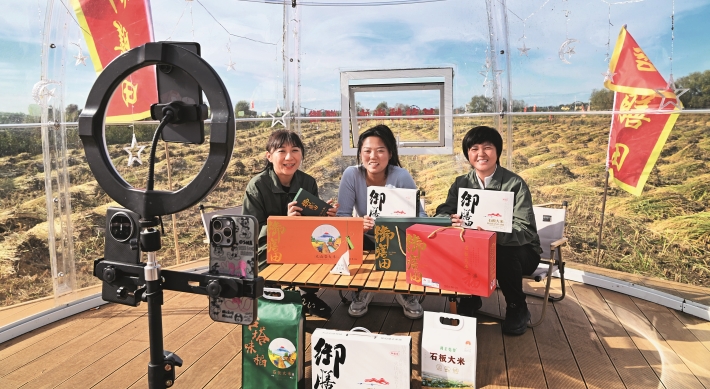
Chen Yujia (right) and fellow villagers promote Shiban rice through a livestream in Shangguandi Village, Ning’an, Heilongjiang Province, on 24 September 2024 (XINHUA)
Making agriculture ‘cool’
As the value of rice increased, so too did the vitality of the village. For Chen, rural revitalisation is not just about improving agricultural output, but also about unlocking new possibilities.
Last year, Chen launched an experimental “paddy field café” in the village’s rice park, where the aroma of coffee meets the breeze of rippling fields. Visitors can sit among the paddies, take in distant hills and enjoy the scent of fresh grain. Within months, the café became a popular attraction, especially among younger visitors.
The idea reflects Chen’s vision of making agriculture appealing to a new generation. “Farmers today must embrace new mindsets, new fields and new ways of life,” she said. The project has brought a sense of modernity to the village while showing that rural areas can support tourism, culture, and new professions alongside farming.
To broaden participation, Chen mobilised villagers to develop rural tourism. A village culture and tourism company was established, and more than 30 residents became certified guides. By combining farming experiences, educational programmes and local traditions, Shangguandi has built a rural tourism value chain.
Last year, the village received nearly 100,000 visitors, with collective income rising to almost 1 million yuan ($140,000). Today, returning young people are finding diverse opportunities, making the village more vibrant and confident.
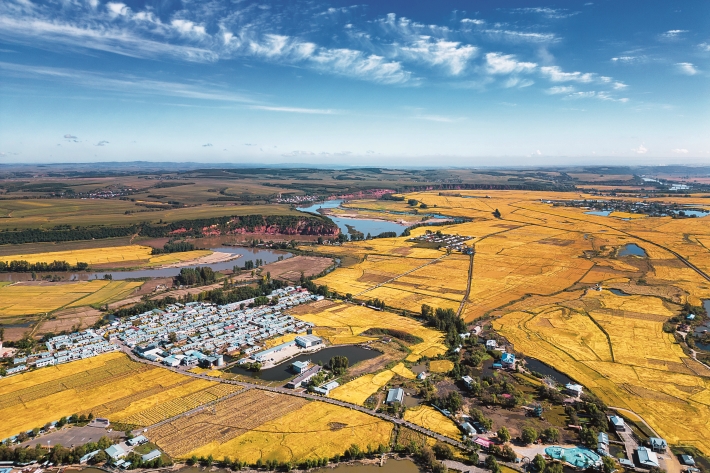
A view of Shangguandi Village in Ning’an, Heilongjiang Province, on 21 September 2024 (XINHUA)
‘Two Mountains’ vision
This year marks Chen’s fourth year as a national legislator and a new stage in her career. Recently elected secretary of the CPC Shangguandi Village Branch, she has moved from managing cooperative sales to leading the village as a whole.
“For me, this means both recognition and responsibility,” she said. “Rural revitalisation is not only about generating wealth, but also about giving people a sense of purpose, motivation and lasting well-being.”
China’s 15th Five-Year Plan (2026-2030) highlights the development of liveable, business-friendly and beautiful rural areas, a direction Chen finds encouraging. “Over the past decade, I have gone from returning home alone to working with a group of people committed to building our village,” she said.
This year, she plans to establish a “new farmers’ training camp,” a vocational base to share her experience with young people returning to the countryside.
During the Two Sessions, Chen also held a conversation in front of the Great Hall of the People with Wang Yucheng, secretary of the CPC Yucun Village Branch in Anji County, Zhejiang Province. Chen brought her Shiban rice products, while Wang shared ideas on coffee-based rural tourism. Their exchanges have led to a strategic cooperation agreement linking the strengths of the two regions.
“Yucun is the birthplace of the ‘Two Mountains’ concept,” Chen said, referring to the idea that “lucid waters and lush mountains are invaluable assets,” first proposed by President Xi Jinping in 2005. “Our task is to apply this concept to the black soil by protecting our fields and turning ecological strengths into development advantages.”
Chen’s journey reflects both speed and steadiness. Once a short-track speed skating champion at the municipal level, she now channels that drive into rural revitalisation.
“The countryside is not only a place of nostalgia,” she said. “It is also a land of opportunity.”
|
||||||||||||
| About Us | Contact Us | Advertise with Us | Subscribe |
| Copyright Beijing Review All rights reserved 京ICP备08005356号-5 京公网安备110102005860号 |


