|
||||||||||
| Home Top News Economy/Tech Culture/Sports China in Foreign Eyes Green Development Videos Intangible Cultural Heritages |
|
||||||||||
| Home Top News Economy/Tech Culture/Sports China in Foreign Eyes Green Development Videos Intangible Cultural Heritages |
| ChinAfrica |
| Cliffs of Contentment |
| From roads to Internet access, a remote mountainous village in Sichuan Province has transformed itself into a model of sustainablerural development and well-being |
| By Ma Li | VOL. 18 April 2026 ·2026-03-26 |
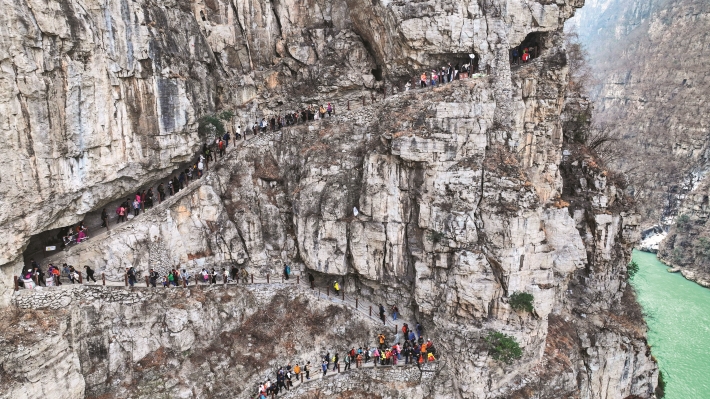
Tourists hike the mule track trail in Gulu Village, Hanyuan County, Sichuan Province, on 1 March (XINHUA)
Amid the lingering chill of a Beijing spring during China’s annual Two Sessions, Zheng Wangchun strode into the lounge after finishing the morning’s group discussion. The deputy to the National People’s Congress and secretary of the CPC Gulu Village Branch, better known as Cliff Village, in Hanyuan County, Ya’an City, Sichuan Province, was still dressed in his Yi ethnic waistcoat.
“When the Premier said in the Government Work Report this morning that people’s well-being comes first, I applauded hard,” he said as he sipped his tea. “I was especially moved when he mentioned rural eldercare and subsidies for services for elderly people with disabilities.”
His reaction went beyond courtesy. At this year’s Two Sessions, he submitted two proposals: one calling for stronger rural eldercare services and another urging faster renovation of unsafe rural homes.
“In the past, I thought every day about how to bring people back to the village,” Zheng explained. “But over the last two years, I have focused more on how to help those who remained to live better lives.”
Breaking through the mountains
Every story of Gulu Village begins with the mountain.
Clinging to the sheer cliffs of the Dadu River Grand Canyon in Hanyuan County, the Yi ethnic settlement is famous as “Cliff Village” or the “Village of Sky Ladders.” For generations, the only access was by climbing vine ladders bolted to the rock face. A single journey down the mountain could take half a day.
For years, the mountains were blamed for the village’s poverty. Zheng saw it differently. “The mountain will not move,” he said, “but the way we think about development can break through the barriers it creates.”
When he was first elected as a village official in 2002, Zheng focused on the most urgent problem: access. He sketched plans for a road to allow people and supplies to move freely.
The road was finally built. But people still left. That was when he realised a key truth: physical connectivity alone was not enough.
An incident in 2023 highlighted the problem vividly. A young villager set out to sell homemade cured pork via livestream. Holding his phone, he walked across the slopes searching for a signal. Finally, he had to climb to the highest rock on the ridge just to go online. Even then, the feed froze repeatedly and the audio cut out. After the exhausting effort, he had sold only a few orders.
That same year, newly elected as a deputy to the National People’s Congress, Zheng brought the issue of connectivity to the national stage. At the annual sessions in Beijing, he submitted a proposal calling for better Internet coverage in rural areas. The response was swift. The Ministry of Industry and Information Technology organised China’s three major telecom operators to conduct on-site research in Gulu Village. By 2024, the once-isolated cliffside community had full 4G and 5G coverage.
The change was immediate. Villagers began livestreaming from beside their household fire pits, and visitors could pay with a simple scan of a QR code. The village’s cured pork, once sold only locally, now reach customers across the country through online platforms.
“The mountain didn’t changed,” Zheng said with quiet reflection, “but when our thinking changed, the mountain stopped being an obstacle and became part of the landscape.”
With roads in place and Internet access established, visitors began to arrive in Gulu Village. Last year, tourism revenue surpassed 12 million yuan ($1.74 million). The figure may seem modest for a large city, but for a Yi village perched on a cliff with only a few hundred residents, it once felt almost unimaginable.
Yet Zheng never allowed the numbers to cloud his judgment. When tourism first began to grow, some suggested giving the village a more marketable identity by building artificial attractions or adding trendy projects to draw crowds. Zheng was unconvinced. “Visitors travelled all this way to see a real Yi village and experience real Yi life,” he said. “They were not coming to look at fake scenery.”
Authenticity did not mean roughness or neglect. The challenge was to present tradition in a way that was both genuine and welcoming. He summarised the approach simply: keep the core intact while improving the way it was shared. He often reminded villagers running guesthouses and farm stays of one rule: welcome guests the Yi way, with sincerity, warmth and honesty. To him, that authenticity remained the village’s most enduring advantage in rural tourism. “If we maintain that root, people will naturally come and once they come, they will want to return,” he said.
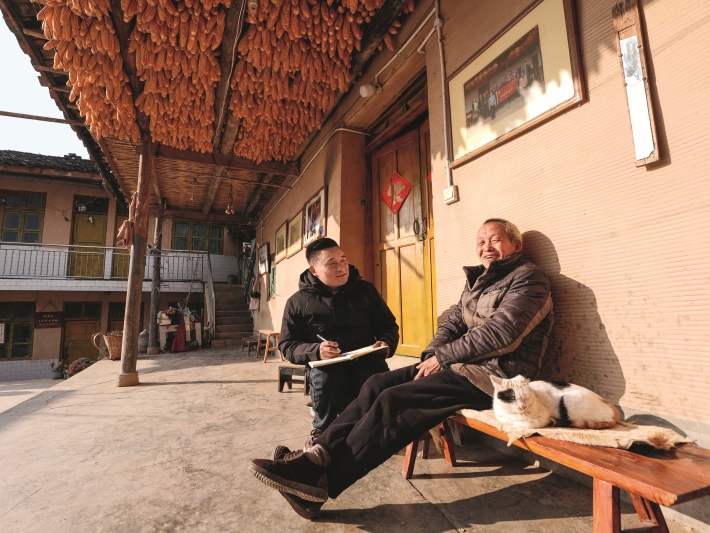
Zheng Wangchun (left) talks with a local resident in Gulu Village, Hanyuan County, Sichuan Province, on 28 January (XINHUA)
True prosperity for everyone
Zheng believes prosperity could not be measured by numbers alone. As he travelled to Beijing for the annual sessions, tourists were not the only people on his mind. “Last year, the revenue looked impressive,” he said. “But the families who benefitted most were those with the manpower and resources to run guesthouses or sell local products. What about villagers in their seventies or eighties? What about families living in old houses who wanted to renovate but could not afford to? Could they also enjoy the fruits of development?”
That is why this year he submitted proposals focusing on rural eldercare and the renovation of unsafe rural housing. “I hope that the next secret behind Gulu Village’s popularity is not the number of tourists but the sense of happiness among villagers,” he said. “When every villager, from a young person managing a guesthouse to an elderly resident resting in the sun by the wall, feels that life has promise, only then can the prosperity and beauty of Gulu Village rest on a real and lasting foundation.”
On 5 March, Zheng sat in the Great Hall of the People listening to the Government Work Report. When he heard the line about expanding inclusive eldercare services, he marked it carefully in his notebook. “As a grassroots representative, these words warmed my heart,” he said. “The country’s growing attention to rural eldercare gives village officials like us greater confidence in our work.”
From building roads to bringing Internet access, from attracting tourists to caring for villagers, every step has been guided by new ideas and ways of thinking. “In the end, ensuring that villagers live with peace of mind and dignity represents the village’s most enduring achievement,” Zheng said.
| About Us | Contact Us | Advertise with Us | Subscribe |
| Copyright Beijing Review All rights reserved 京ICP备08005356号-5 京公网安备110102005860号 |


