| ChinAfrica |
| Helping Hands |
| Humanoid robots change the way service industries operate |
| By WANG RUYING | VOL. 18 May 2026 ·2026-05-08 |
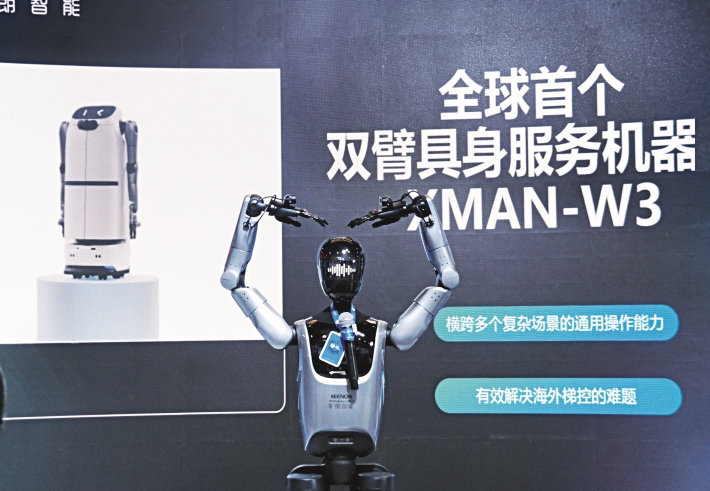
A KEENON humanoid robot poses in a “heart” position for visitors at the World Artificial Intelligence Conference in Shanghai on 27 July 2025 (CNS)
In Shanghai’s Jinqiao Economic and Technological Development Zone, Pudong New Area, KEENON Robotics, a national-level “Little Giant” – a name given to innovative small and medium-sized enterprises (SMEs) – is reshaping the service robots industry. At its exhibition space, a humanoid robot stands at a popcorn machine, scooping kernels, packing them neatly into a paper bag, and placing it on the table – each movement precise, fluid, almost human.
Meet the XMAN-R1, launched in March 2025. This embodied service robot, built for restaurants and hotels, handles complex tasks with ease while offering attentive service to guests. In the era of embodied intelligence, KEENON’s humanoid creations have quickly become the industry’s centrepiece.
For the Chinese SME, humanoid robots represent opportunity rather than replacement. By taking on repetitive, mechanical work, they free human staff to focus on service, emotion and experience – the irreplaceable elements that keep customers coming back.
Humanoid robots in service
Most of KEENON’s products fall under the category of service robots. Unlike industrial robots used in factories, these service robots are primarily applied in the service industry and daily life.
So, why did KEENON decide to focus their production on the service robot sector?
Li Tong, founder and CEO of KEENON, explained that the service industry is facing a labour shortage, and where there is demand, there is market potential.
“Take the catering industry as an example: a waiter in a restaurant walks over 30,000 steps a day. The work is repetitive and monotonous, offering little room for growth, making it difficult for restaurants to hire staff,” Li said.
To address this, KEENON developed delivery robots. In 2018, its delivery robots were first deployed in Haidilao’s smart restaurants in Beijing. Since then, an increasing number of restaurants have embraced robot-based food serving, generating substantial orders for KEENON. Simultaneously, the company expanded into other service sectors: entering the hotel robot market in 2021, followed by the medical and cleaning robot sectors in 2022 and 2023, respectively.
By 2025, embodied intelligence became a hot topic. It refers to intelligent agents interacting with the environment in real time through physical entities, integrating perception, cognition, decision-making and action. Simply put, it gives intelligent agents a physical form, which can be humanoid or other shapes.
But for all KEENON’s prior achievements in non-humanoid robots, why did it shift focus to humanoid robots as a primary R&D direction?
“Humanoid robots hold a unique place in robotics because our world is designed for humans – with tables, chairs, doors and other features of daily life all being tailored to human proportions and needs. Thus, humanoid robots adapt better to human environments than other forms of robots,” Li said.
As a global leader in the embodied service robot industry, KEENON launched its new humanoid embodied service robot, the XMAN-F1, in July 2025.
Craftsmanship and innovation
Designed for the service industry, KEENON’s robots encounter more complex scenarios compared to specialised robots used in industrial settings. “From a product development perspective, we’ve essentially chosen a ‘hard’ mode for ourselves,” said Tang Xuanlai, the company’s chief technology officer. “Firstly, service robots operate in highly dynamic environments. For instance, foot traffic in a restaurant is never constant, and the robots must reliably perceive these nuanced changes. Secondly, they need to interact with people, not primarily through language, but through actions and behaviour. This demands robust perception and decision-making capabilities in crowded, complex spaces.”
To ensure reliable performance, every robot undergoes extensive testing. In KEENON’s testing area, engineers simulate various real-world application scenarios to validate quality. These include different floor surfaces and slopes, mimicking potential challenges the robots might face.
“Testing primarily addresses issues encountered during actual operation,” explained Zhu Xiaojun, head of KEENON’s government affairs department. “For example, if a cleaning robot stops during operation, our data systems give feedback about the reason – it could be due to a slope angle, floor material or a hardware fault. By analysing vast amounts of returned data, we optimise algorithms and models, and sometimes make fine adjustments to the hardware.”
Overseas expansion
As one of the first Chinese commercial service robot companies to expand globally, KEENON is also the world’s leader in shipment volume for such robots, having delivered over 100,000 units to date. Currently, with five subsidiaries and offices overseas, its business spans more than 600 cities across over 60 countries, and its robots have completed over 1.23 billion service tasks worldwide.
Li noted that the ratio of exports to domestic sales for the company’s robots is approximately 1:1. “In the past, ‘Made in China’ products were often associated primarily with competitive pricing in the global market. In reality, many Chinese smart terminal products, including our service robots, not only outperform their foreign counterparts in functionality but also remain more affordable. Meanwhile, we benefit from significant supply chain and talent advantages. These are key factors that are enabling Chinese service robots to go global,” he said.
During its global expansion, KEENON has paid close attention to local market needs through thorough research. For example, since restaurants in Japan are often compact, robots destined for that market are designed to be smaller.
Regarding the question of whether robots might replace human jobs, Li has his own perspective: “Our philosophy is to let robots handle mechanical tasks, which can allow humans to focus on providing good services and creating unparalleled emotional experiences – that’s something irreplaceable. Our products in markets like Japan, Europe and the U.S. are meant to assist with repetitive foundational work, not to entirely replace human labour.”
|
||||||
| About Us | Contact Us | Advertise with Us | Subscribe |
| Copyright Beijing Review All rights reserved 京ICP备08005356号-5 京公网安备110102005860号 |


