| ChinAfrica |
| Classics at a Click |
| Digitisation, AI and new cultural experiences are breathing new life into ancient Chinese books and bringing them closer to readers |
| By LI XIAOYU | VOL. 18 May 2026 ·2026-05-08 |
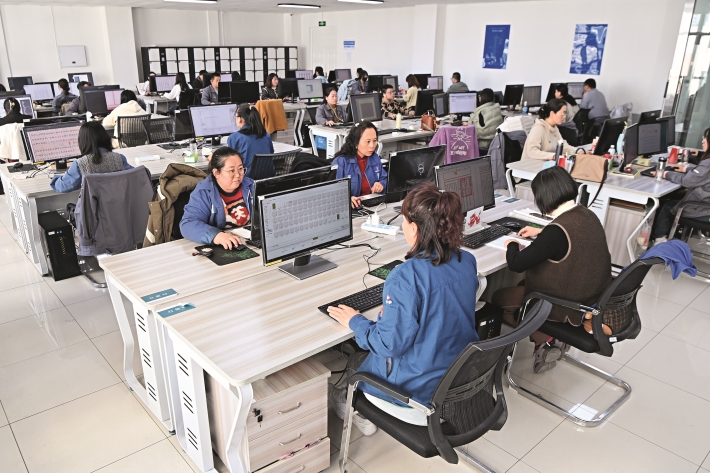
Workers digitalise ancient books at a publishing company in Lanzhou, Gansu Province, on 11 March 2024 (CNS)
Ancient Chinese books are far more than just written heritage: they are a repository of historical memory and the wisdom accumulated by Chinese civilisation over millennia. As major symbols of national culture, these texts bear witness to the evolution of knowledge, institutions and ways of thinking that have shaped China.
However, in the digital age, a central question arises: how can we revitalise these textual treasures so that they are no longer confined to library shelves and find their place in contemporary cultural life?
In recent years, China has launched a major initiative to digitise, restore and disseminate ancient books. Driven by digital technologies, this work has profoundly transformed how these documents are preserved and used. Ancient editions and manuscripts are no longer merely protected as precious relics; they are becoming valuable resources, accessible to both academic researchers and the general public. Thanks to these advances, works once kept “on the high shelves” of libraries are gradually making their way onto screens and into the public eye.
Digital revitalisation
Digitisation is the first essential step in revitalising classical works. It is estimated that China holds approximately 200,000 titles of ancient books, amounting to nearly 30 million volumes or items. From the perspective of long-term preservation of cultural heritage, their digital conversion is a strategic necessity.
Thanks to modern technologies such as high-definition scanning, optical character recognition and natural language processing, digitisation is no longer limited to the simple conversion of media. It now enables intelligent content use and in-depth exploration of the knowledge contained within texts.
The National Library of China is one of the pioneering institutions in this field. It has already completed the high-definition digitisation of over 130,000 ancient works, resulting in several major databases, including one dedicated to the Yongle Encyclopaedia. For the first time, complete images of this vast encyclopaedic compilation from the Ming Dynasty (1368-1644) are available online. Readers can explore the history of this monumental work, from its compilation by order of Emperor Yongle beginning in 1403 to the vicissitudes that marked its transmission, while accessing its content directly. Platforms of this kind ensure both the long-term preservation of the texts and their dissemination to researchers and the public.
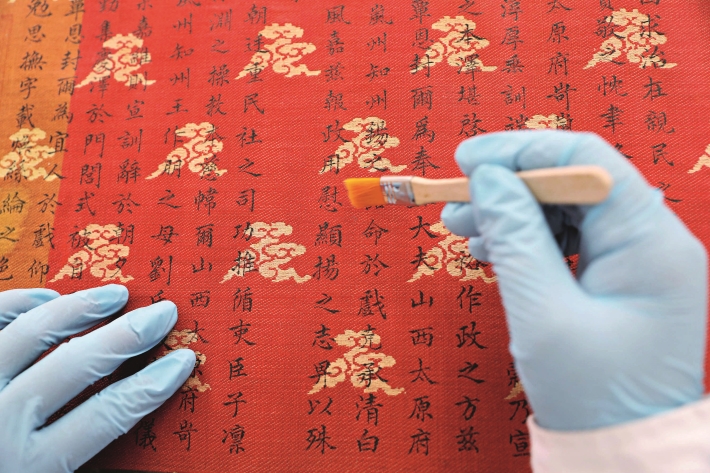
A worker preserves an ancient text at an archive centre in Jiaozuo, Henan Province (VCG)
With the help of AI
Beyond digitisation, advances in AI are now making these texts more intelligible and accessible. A prime example is the Shidian Guji platform, developed jointly by Peking University and the technology company ByteDance.
Launched in March 2022, the database has expanded dramatically, growing from just 390 ancient works to now around 59,000. Users can switch between text and page images, search expressions via lexical segmentation, switch between traditional and simplified Chinese, and access classical vocabulary explanations.
Even more innovative is an AI-based assistant capable of analysing the meaning of texts and responding to users’ questions. Chen Jingshou, the project lead, explained that the system’s unique feature lies in the rigour of its sources. Unlike many AI tools that can generate erroneous responses, this assistant consults only the works contained in the database, greatly lowering the risk of “hallucinations” and ensuring trustworthy information.
Such initiatives are expanding across the country. In December 2025, the Jiangxi Provincial Library unveiled a digital database of Jiangxi’s historical documents. This platform now allows rare editions to be freely accessed online, significantly enhancing public access to the province’s cultural heritage.
For Chen Yuling, a university professor specialising in local history, the change has been revolutionary. Previously, researchers would spend entire days in the library, carefully handling fragile volumes in search of specific information. Today, full-text and keyword search functions allow them to locate relevant passages instantly.
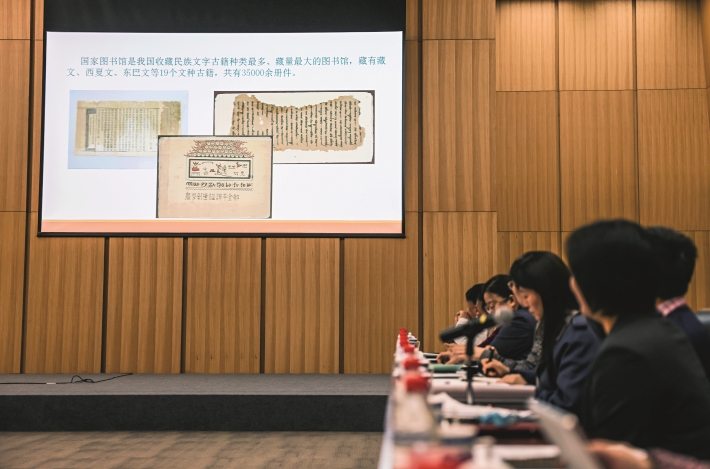
A roundtable discussion on the publication of digital resources for ancient books is held at the National Library of China, Beijing, on 26 January 2024 (VCG)
From preservation to immersive experience
However, digitisation is more than simply converting texts into digital form. The key is to revive the cultural significance of old books by linking them to today’s experiences, fostering innovation across cultural tourism, education and the creative sectors.
The convergence of written heritage and cultural tourism represents one of the most promising directions for innovation. In 2025, the Shaanxi Provincial Library launched a cultural initiative titled “Exploring Chang’an Through Ancient Books.” Drawing inspiration from a renowned travelogue of the Northern Song Dynasty (960-1127), the project provided an immersive exploration of historical sites in the southern section of the ancient imperial capital.
Over 80 participants traced an itinerary drawn from the text, visiting monuments, steles and archaeological sites while comparing ancient accounts with modern historical knowledge. Thanks to digital technology and online sharing, the event captured wide public interest, with videos linked to the project reaching more than 160 million views across social media platforms.
According to Zhang Yuqing, a librarian in the Historical Documents Department of the Shaanxi Provincial Library, such projects turn reading into a vivid journey, reviving both the stories and historical contexts embedded in ancient texts.
Immersive technologies are bringing classical works closer to the general public. At the Beijing Library, visitors can use smart interactive tables to explore medicinal plants described in the 16th-century pharmacopoeia Compendium of Materia Medica, which has been listed on UNESCO’s “Memory of the World” Register since 2011. The plants are presented as interactive 3D models that can be viewed without the need for special glasses.
Users can explore objects in 3D, interact with virtual characters, or identify medicinal plants via image recognition. This interactive approach revitalises the way traditional Chinese medical culture is shared with the public.
The digital restoration of ancient Chinese books illustrates the fruitful encounter between tradition and innovation. By freeing these texts from their physical constraints, digital technologies offer them new visibility and fresh perspectives for interpretation. For a civilisation with a written history spanning thousands of years, this renaissance opens up a new horizon: that of a tradition reinventing itself and continuing to shine in the contemporary world.
|
||||||
| About Us | Contact Us | Advertise with Us | Subscribe |
| Copyright Beijing Review All rights reserved 京ICP备08005356号-5 京公网安备110102005860号 |


