| ChinAfrica |
| Connecting Cultures |
| Fostering understanding between China and Africa through dialogue and exchanges |
| By Li Yin | VOL. 17 December 2025 ·2025-11-25 |
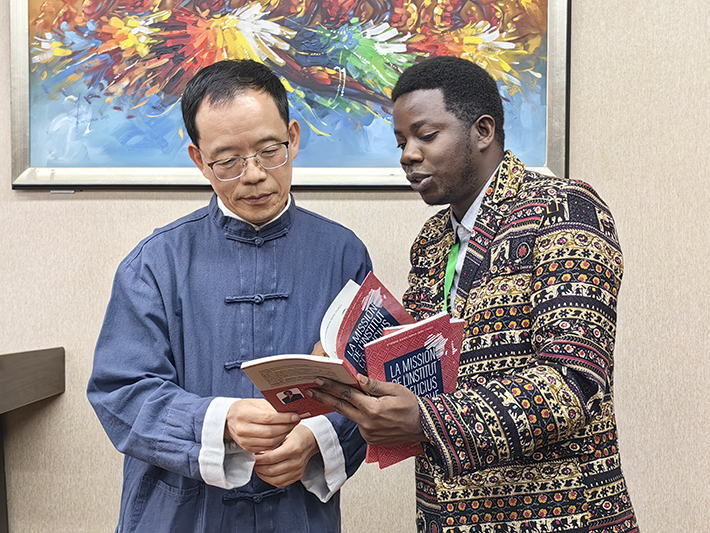
Etienne Bankuwiha presents his book as a gift to Professor Liu Hongwu from Zhejiang Normal University on 17 April (COURTESY)
Etienne Bankuwiha, a young sinologist from Burundi and a doctoral student at Nanjing University, received on the afternoon of 13 November the message he had been eagerly awaiting - a reply from Chinese President Xi Jinping. He was among 61 young sinologists from around the world attending the 2025 World Chinese Language Conference in Beijing.
Before the conference, the group had jointly written to President Xi, sharing their research experiences and expressing their aspirations to deepen their understanding of China and serve as bridges of cultural exchange.
In his response, President Xi praised the scholars for their contributions to the development of Sinology and the promotion of mutual learning among civilisations.
For Bankuwiha, the moment carried profound significance. “To have our thoughts read and acknowledged by President Xi means a lot,” he said. “I will continue my mission, bringing what I have witnessed and learned in China back to my homeland to help to advance our nation’s progress.”
Just a day earlier, on 12 November, Bankuwiha, also known by his Chinese name Ban Chao, took part in the International Forum of the Overseas Studies on Xi Jinping Thought on Socialism with Chinese Characteristics for a New Era in Beijing. He delivered a presentation on President Xi’s quoting of Chinese and African proverbs, and how it weaves together the traditional wisdom of both cultures, revealing a deeper dynamic of civilisational dialogue.
In June, he attended the ninth World Conference on Sinology, where he presented, in fluent Chinese, a paper on cultural hybridity between China and Africa, using Burundian kungfu–themed films as an entry point to highlight his unique perspective as a scholar deeply familiar with both cultures.
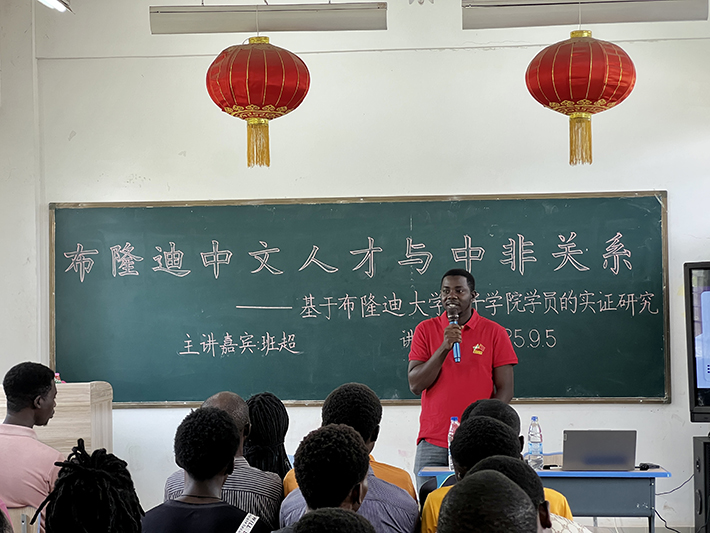
Etienne Bankuwiha delivers a lecture at the Confucius Institute at the University of Burundi on 5 September (COURTESY)
A determined learner
Bankuwiha has had a vibrant and productive academic career so far. He vividly remembers the beginning of his passion for Chinese 13 years ago. “It all began with a strong curiosity for Chinese food,” he told ChinAfrica laughingly.
In 2012, while studying mathematics at the University of Burundi, he enrolled in his first Chinese language course at the newly established Confucius Institute. “Everyone said Chinese was the hardest language in the world,” he recalled, “so I thought, why not give it a try?” Though the class had little to do with cuisine, it unexpectedly ignited a passion that would shape the course of his life.
Through the language, he encountered a culture that emphasised harmony, respect, and collective well-being, values that resonated deeply with his African heritage.
His academic progress earned him a scholarship to study in China. Once in China, he immersed himself in everyday life, which helped him understand China beyond textbooks. Through encounters with people and traditions, he grasped the shared aspirations of a rapidly modernising society.
Inspired by this experience, he went on to pursue a master’s degree in Teaching Chinese to Speakers of Other Languages, believing that language could unlock new doors for cross-cultural exchange.
Sharing culture
Although the Burundian government supports Chinese-language education, qualified teachers remain scarce. Drawing on his academic training and firsthand experience, Bankuwiha became a beacon of hope for Burundian youth. His stories, cultural insights, and personal experiences inspired many to explore Chinese culture with enthusiasm.
In 2020, he extended his reach beyond the classroom by teaching through a local television programme, bringing Chinese learning to a wider audience. This groundbreaking initiative became Burundi’s first nationwide remote Chinese-language teaching effort and provided valuable experience during the pandemic.
Building on his teaching experience, he also spearheaded the compilation of the bilingual Chinese-French textbook I Love Learning Chinese, directly contributing to the growth of Chinese-language education across Africa.
For Bankuwiha, language and culture are inseparable. Besides teaching, he started a Chinese paper-cutting club, using this accessible art form to introduce local communities to Chinese culture.
A scholar with a mission
After more than three years of teaching Chinese back in Burundi, Bankuwiha packed his bags once again for China, this time to pursue a doctorate at Nanjing University.
In 2024, he published his first monograph, The Mission of the Confucius Institute in Africa, the first scholarly work in Burundi dedicated to Chinese studies.
The book offers a nuanced exploration of the Confucius Institute’s role in Africa, presenting it not only as a centre for language learning and cultural exchange but also as a driver of social and economic cooperation. Drawing on his own experiences, first as a beneficiary of the programme and later as an educator, he provides an insider’s perspective.
Through careful research and interviews, he aims to dispel misconceptions, showing how these institutions nurture young people who are familiar with both China and Africa, foster educational and cultural collaboration, and create platforms for China-Africa engagement.
Reflecting on more than a decade of studying Chinese language and culture, Bankuwiha says he has been continually inspired by President Xi’s emphasis on cultural exchange and mutual learning among civilisations. He was especially moved by Xi’s words in the reply letter: “Sinology originates in China, but it belongs to the world.” To Bankuwiha, this embodies China’s commitment to openness and its vision of creating a broad, inclusive platform for cultural dialogue.
From a curious student in a modest classroom to a scholar of international influence whose ideas reach major academic platforms, Bankuwiha’s journey reflects the evolving spirit of China–Africa relations, rooted in respect, enriched by learning, and propelled by shared aspirations for the future.
| About Us | Contact Us | Advertise with Us | Subscribe |
| Copyright Beijing Review All rights reserved 京ICP备08005356号-5 京公网安备110102005860号 |


