|
||||||||||
| Home Top News Economy/Tech Culture/Sports China in Foreign Eyes Green Development Videos Intangible Cultural Heritages |
|
||||||||||
| Home Top News Economy/Tech Culture/Sports China in Foreign Eyes Green Development Videos Intangible Cultural Heritages |
| ChinAfrica |
| Ideas in Motion |
| Xi Jinping: The Governance of China sparks fresh reflections on Africa’s development pathways |
| ChinAfrica | VOL. 18 January 2026 ·2025-12-31 |
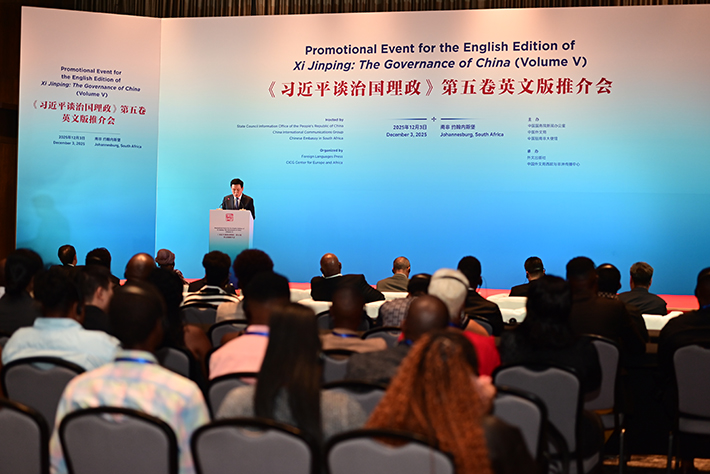
The Promotional Event for the English Edition of Xi Jinping: The Governance of China (Volume V) is held in Johannesburg, South Africa, on 3 December 2025 (XINHUA)
Governance debates gained strong momentum in Africa in early December 2025 as the China-Kenya Readers Forum on Xi Jinping: The Governance of China convened in Nairobi on 1 December 2025, followed by a promotional event for the English edition of the book’s fifth volume on 3 December 2025 in Johannesburg, South Africa. The two gatherings brought together leading figures from African political and academic circles, who shared insights on modernisation, poverty reduction and global governance. Below are excerpts from their remarks at these events.
Learning from China’s SOE reform journey
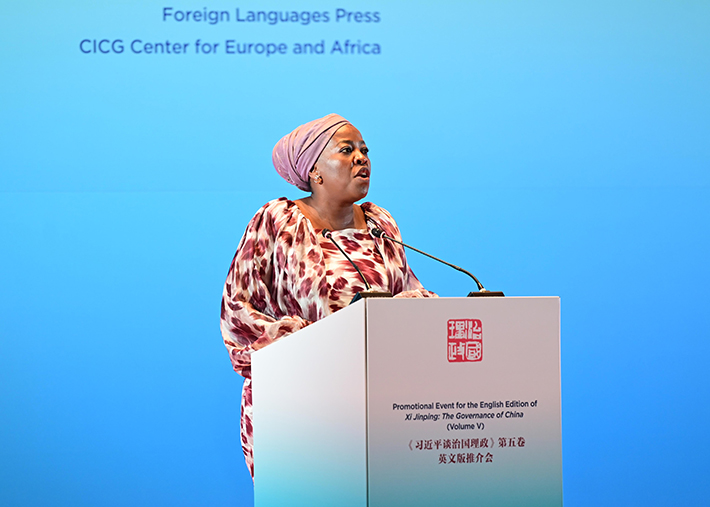
Maropene Ramokgopa, Minister in the Presidency for Planning, Monitoring and Evaluation of South Africa
At a time when developing countries face tightening fiscal space, rising inequality, and the realities of climate change, platforms that foster intellectual exchanges are very essential. Books such as this one that we are launching here today contribute to global discourse on development policy, sovereignty, stability and shared prosperity. This book shows that conversations on theories and governance are insufficient and incomplete without the perspective of the realities of the Global South. Conversations and undertakings on the global economy, pandemic preparedness, the debt burden of nations, social protection flaws, infrastructure development and education, as well as climate change, can never be effective without the voice and perspective of what we stand for.
The book provides unique insights and reflections on China’s approach to the long-term planning, as well as its responsive and adaptable approach to realising a clear vision and developmental path. Last year, I had the honour of leading a South African delegation to Beijing to gain insight into how China has transformed its state-owned enterprises (SOEs) to become effective market players while fulfilling its developmental mandate. It was admirable to get a detailed account of China’s commitment to reforming its SOEs over the course of around 40 years, and how it enhanced its efficiency and vitality, which has never veered from national development. We are so lucky because we don’t have to start from scratch; instead, we can take the lessons of China and ensure that we become successful in our own journey of reforming our SOEs.
The lessons we learned during this visit have greatly inspired South Africa’s SOE National Bill, which is now undergoing parliamentary processes. China’s developmental trajectory provides important lessons for us on strategic persistence, coherence in national objectives and deepening state capacity. Our shared commitment to national development and strengthening state capacity is an important driver of South Africa-China partnership and cooperation. This is evident in our continued efforts to align China’s Belt and Road Initiative with South Africa’s National Development Plan 2030 to achieve mutually beneficial developmental outcomes.
Lessons for the Global South
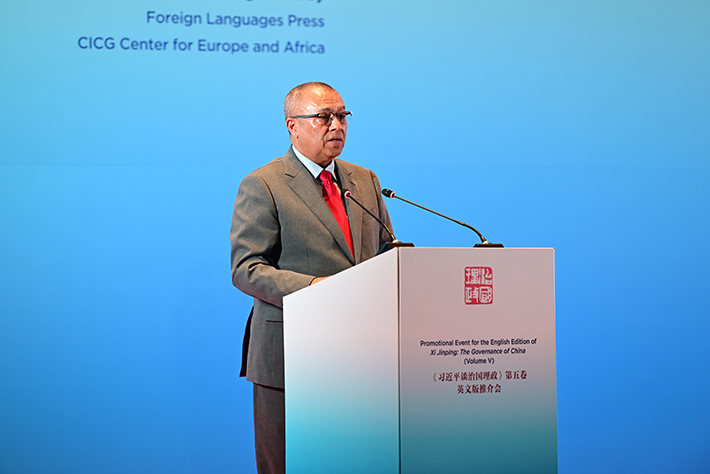
Cedric Frolick, National Assembly House Chairperson, South Africa
Three years ago, I was honoured to attend a seminar on Xi Jinping: The Governance of China (Volume IV) in Cape Town. At the time, the 20th National Congress of the Communist Party of China was about to be held and there were high expectations. The outside world, of course, was very curious to see what the outcomes of the congress would be. Some were very suspicious and others were very doubtful about China’s future. Since then, we have seen China’s economic resilience, its potential and its creativity. The world has also seen the leadership role of China in making accurate judgments on international situations, and its strong determination in implementing its predefined goals.
We live in a world where uncertainty, instability and irrationality are on the increase. China, however, maintains rapid and high-quality development under the visionary leadership of President Xi Jinping, and it is a key engine for global economic development that is progressive, reliable and trustworthy. So, our relationship is built on mutual friendship. We trust one another and we believe in human solidarity.
I hope all people who want to participate in South Africa-China cooperation in various sectors take time to read the book. I believe the recipe for China’s success is revealed in this series of books. It’s not a secret; it’s there for people to read and to interpret. The book is a continuation of the philosophy that appears from volume one right up to volume five, and the key themes and words that emerge are people-centred governance, reform and innovation, common prosperity, green and sustainable development, importance of having a strong party, inclusive cooperation, a community with a shared future for humanity, and a higher level of governance.
One key concept is Chinese modernisation. This is a new model, different from Western modernisation, and it has successfully enabled 1.4 billion Chinese people to live with dignity, free from absolute poverty. For the Global South countries, Chinese modernisation is not about teaching and prescribing what to do as if there’s no other developmental path; but it is helping other countries to work together to achieve modernisation. Just like President Xi said, if China can make it, other developing countries can also make it.

Copies of Xi Jinping: The Governance of China are presented at a promotional event for the English edition of the fifth volume of the book in Johannesburg, South Africa, on 3 December 2025 (XINHUA)
Learning together for a modern Kenya
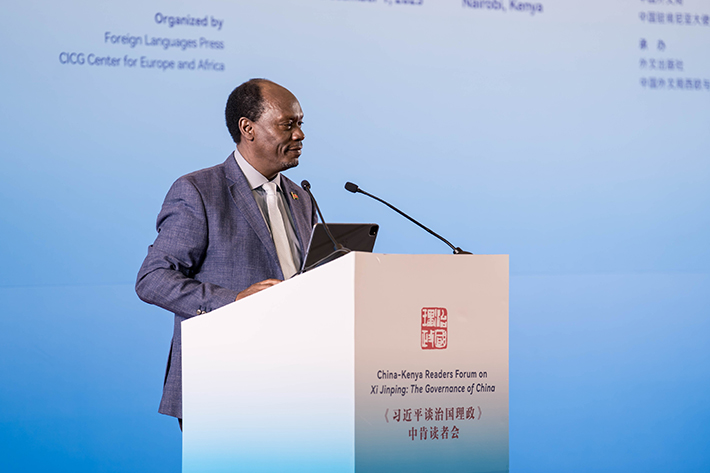
William Kabogo Gitau, Cabinet Secretary, Ministry of Information, Communications and the Digital Economy, Kenya
The newly released fifth volume of Xi Jinping: The Governance of China offers insight into how China views its journey of modernisation, reform and global engagement. It places people firmly at the centre of governance, captured clearly in the statement that “the people’s wish for a happy life is our mission.” This is a principle that resonates deeply with our own aspirations as Kenyans. Under the bottom-up economic transformation agenda, we are committed to expanding opportunity, strengthening public service, and improving the welfare of every Kenyan household.
China’s journey reminds us that meaningful progress requires constant reform and adaptation. Chinese President Xi Jinping reminds us that “reform and opening up is always an ongoing task and will never end.” Kenya shares this understanding. We are modernising institutions, digitising government services, expanding connectivity, rebuilding our digital superhighway, and preparing our youth for the opportunity of the digital economy. As the book observes, without promoting IT application, we cannot realise modernisation. We see this every day as technology becomes central to service delivery, economic growth and national competitiveness.
Our partnership with China continues to grow across many sectors. The recent state visit by President William Ruto to China shared commitment and set out new areas of cooperation that are now being actively implemented. But beyond infrastructure, digital development and trade, we also recognise the importance of deepening cultural and intellectual ties. It is in this regard that Kenya is keen to expand exchanges between scholars, writers, journalists, and the creative industries. We welcome opportunities for joint translation and publishing, academic and youth fellowships, and media placements between Kenyan and Chinese newsrooms, and collaboration in digital storytelling and cultural research. These exchanges build mutual understanding and allow young people to appreciate the richness of each other’s cultures.
We also see cultural tourism as an emerging front in our cooperation. Kenya’s heritage - our music, food, crafts and diverse traditions - offers us tremendous potential for cultural engagement with Chinese audiences. We would be pleased to work with our partners to promote cultural itineraries, festivals, film tourism and heritage exhibitions.
In this connection, we should explore the idea of a Kenya Village, with our cultures being showcased in major cities in China. This would be a space where visitors can experience Kenya’s cuisine, crafts, music and stories, while learning about tourism destinations and creative industries. Beginning as a pop-up cultural week and later evolving into a permanent centre, it will deepen people-to-people ties and promote tourism in both directions.
The purpose of reading, reflecting and interacting is not to imitate another country’s journey, but to understand it. Every nation’s path is shaped by its history, institutions and people. By studying different experiences, we enrich our own thinking and open the door to more meaningful cooperation. As we reflect on the ideas contained in Xi Jinping: The Governance of China, let us engage with curiosity and respect. Let us draw insights that speak to Kenya’s context while recognising the value of continued dialogue between our peoples.
Knowledge is the engine of progress, and that engine is driven by reading - reading is the fuel. That’s what I take away from here.
Participants attend the Promotional Event for the English Edition of Xi Jinping: The Governance of China (Volume V) in Johannesburg, South Africa, on 3 December 2025 (XINHUA)
Deepening shared governance
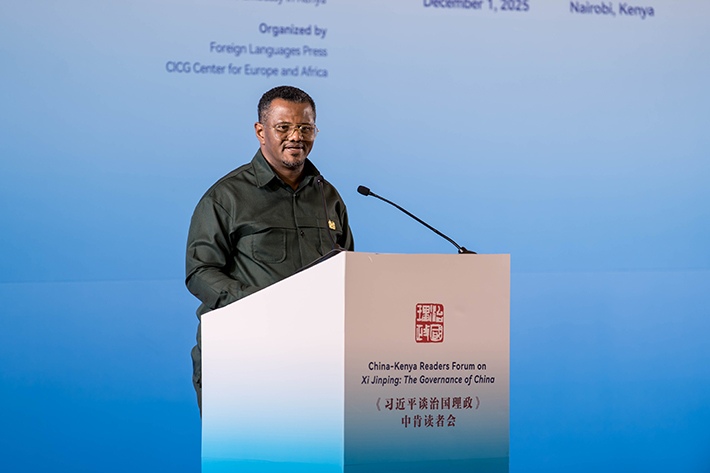
Hassan Omar Hassan, Secretary General, United Democratic Alliance, Kenya
Xi Jinping: The Governance of China is not merely a compilation of speeches and policy statements; it is a comprehensive intellectual framework that articulates the philosophical foundations and practical principles of socialism with Chinese characteristics. Kenya faces many challenges in its development journey. We have long attempted to adopt Western models, yet these efforts have often proved ineffective. This work offers valuable Chinese perspectives and guidance that can inspire us to explore a governance approach grounded in Kenyan realities and Kenyan characteristics.
One thing I came to understand during my visit to China is that it is the party that leads the state, rather than a government that merely supports a party. China’s model is built on foundational pillars such as disciplined and accountable political leadership, long-term strategic planning, ecological civilisation, poverty alleviation, technological innovation, and an unwavering commitment to building a community with a shared future for humanity. Alongside our development agenda, the Global South must now strengthen its strategic security. Among developing countries, China stands out as one that has significantly advanced its security capabilities, offering an important reference for other nations seeking to enhance their own strategic security frameworks.
The successive editions of the book have been translated into multiple languages, including Swahili, reflecting China’s intention to engage the world not only through trade and investment, but also through the exchange of ideas and the sharing of governance philosophy. For Kenya and other African countries, this intellectual dialogue offers an important opportunity to reflect on the principles behind China’s “development miracle” and to draw lessons that can strengthen our own systems of economic governance.
As we pursue our development agenda, we must work together, not only in building roads and other critical infrastructure, but also in forging a shared understanding of development and deepening strategic cooperation across the Global South. Our prosperity depends on inclusive partnerships and a collective commitment to common progress.
Each volume of the book highlights essential insights: development as the ultimate measure of governance, innovation as the driving force of growth, infrastructure as the backbone of economic transformation, and prosperity that remains inclusive and people-centred. These ideas resonate strongly with Kenya’s Vision 2030 and our commitment to building an equitable, empowered and forward-looking society.
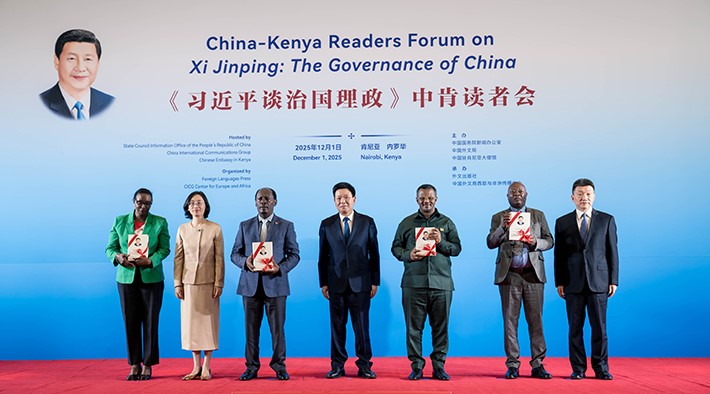
Guests at the China-Kenya Readers Forum on Xi Jinping: The Governance of China are presented with copies of the book in Nairobi, Kenya, on 1 December 2025 (XINHUA)
Walking East: Kenya-China partnership drives change
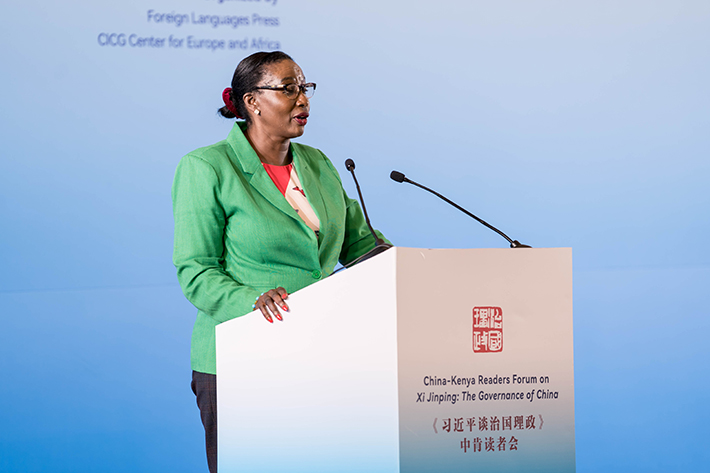
Beatrice Elachi Kadeveresia, Member, National Assembly, Kenya, and Secretary General, Kenya-China Friendship Association
The perspectives presented in Xi Jinping: The Governance of China offer important insights that bear direct relevance to Kenya’s own policy direction. It is important to acknowledge the milestones we have achieved as a country by embracing China as a key partner in our development journey within the global landscape.
When we look at China today, it is important, especially for young people, to understand that China has historically achieved poverty reduction on a scale unmatched by any other country. This is why, during his tenure, the late President Mwai Kibaki believed that if Kenya aspired to transform itself, it needed to look East.
This marked the beginning of our engagement and the launch of Vision 2030. Vision 2030 is designed to drive growth for our country, and I believe we drew heavily from China’s development model. It aims to elevate Kenya to a middle-income country, providing a high quality of life to all citizens by 2030.
For our relationship to remain strong, balanced and rooted in mutual respect - echoing President Xi’s people-centred development philosophy - we must address challenges in governance, political commitment, and long-term planning. China’s success is grounded in clear coordination and planning within government, something Kenya must strive to emulate. Many Kenyans wonder how China accomplishes this. Discipline and order are key elements we must adopt if we are to reach the aspirations outlined by our president.
China’s development experience offers real hope. It shows that with persistence and coordinated strategies, developing countries, even those with large populations, can significantly reduce poverty through international cooperation, investment, technology transfer, infrastructure and capacity building. Kenya has already benefitted greatly from the Belt and Road Initiative and Forum on China-Africa Cooperation.
I want to thank the Chinese government for supporting Kenya by training our public officers and helping to develop the comprehensive 2025-2040 poverty reduction roadmap. Going forward, a critical area for partnership is the development of county industrial parks for agro-processing - maize, milk, tea, fruits - as well as textiles, leather, building materials, and other light industries that can drive Kenya’s growth.
We must also continue urbanisation efforts and advance smart city development. Our push for affordable housing is part of our commitment to eliminating slums and restoring dignity to our people.
But these goals can only be realised if our long-standing relationship with China continues to be implemented effectively. If we remain committed, I am confident that by 2040, we will begin seeing real results. The training, the exchanges, and the benchmarking visits must now translate into practice. As our officers travel to China and return with lessons, let us implement what we learn. By doing so, and by fulfilling the commitments agreed upon with President Xi, Kenya can truly become a country that others in Africa look to and say, “We walked East, and we transformed the lives of our people.”
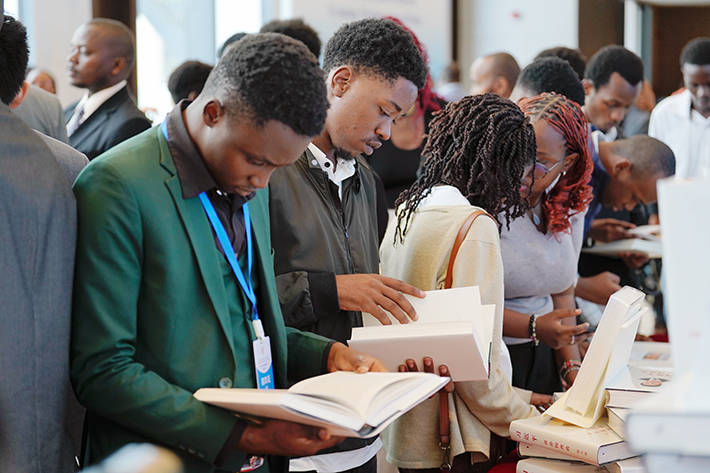
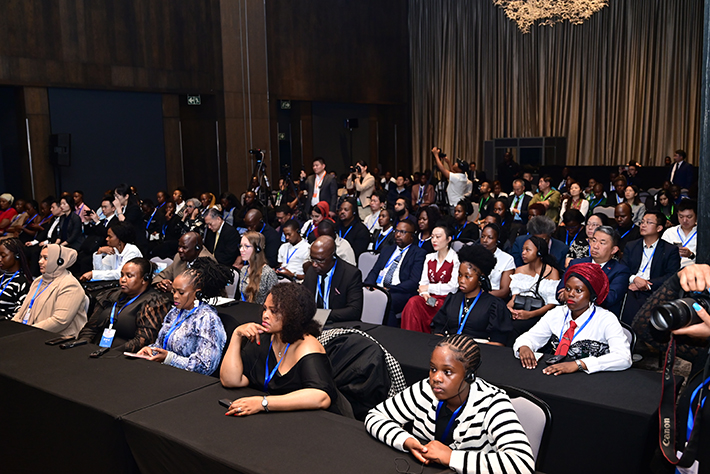
Participants of the China-Kenya Readers Forum on Xi Jinping: The Governance of China read the book in Nairobi, Kenya, on 1 December 2025 (XINHUA)
| About Us | Contact Us | Advertise with Us | Subscribe |
| Copyright Beijing Review All rights reserved 京ICP备08005356号-5 京公网安备110102005860号 |


