| ChinAfrica |
| Tailored Path for Development |
| China’s pragmatic development strategy could offer new possibilities for the Global South |
| By Justin Yifu Lin | VOL. 18 June 2026 ·2026-06-02 |
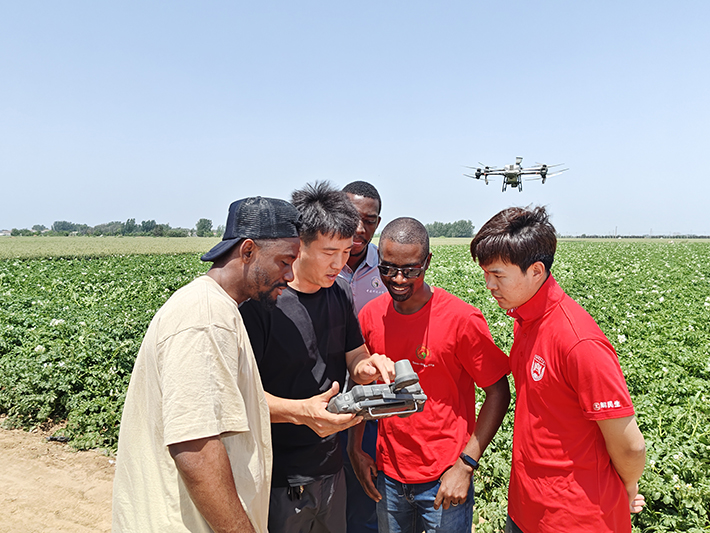
Malawian students study drone-based crop protection techniques in Quzhou, Hebei Province, on 13 May 2024 (CNS)
People often ask me what the secret of Chinese modernisation is. My answer has always been “seeking truth from facts.” This is not merely a philosophical slogan but the foundation of my lifelong academic research. It is an economic methodology that can be tested and learned. As the Western-dominated “Washington Consensus” has failed in many places and many developing countries continue to struggle with stagnation, China’s successful practice may offer the world an alternative path.
After World War II, many developing countries hoped to advance their modernisation by drawing on the theories and development models of advanced economies. Yet most became trapped in slow growth and weak development momentum. This global dilemma highlights the distinctive value of China’s approach to modernisation. It not only serves China’s development but also offers countries of the Global South a new methodology for pursuing development based on their own realities rather than on Western-centred assumptions.
The fundamental reason many developing countries have struggled with modernisation lies in blindly copying Western paradigms that do not match their stage of development or resource endowments. These paradigms often ignore the realities of developing economies, advocating sweeping institutional reforms and rapid market liberalisation. The result is frequently a mismatch: policies that do not fit local contexts, leading to unintended consequences.
A pragmatic route
New Structural Economics provides a systematic economic interpretation of the principle of “seeking truth from facts” in development. Its core proposition is that a country’s development must be grounded in its most fundamental endowments - the relative abundance of labour, natural resources, capital and other factors of production - and that industries consistent with those comparative advantages should be prioritised.
This development path differs fundamentally from the “shock therapy” or “big bang” reforms favoured by mainstream Western theories. China chose a gradual and pragmatic route: beginning with labour-intensive industries with lower entry barriers, steadily accumulating capital, cultivating talent and improving technology before upgrading step by step towards more capital- and technology-intensive industries. In this process, the market plays the decisive role in resource allocation, while the government acts by guiding development in line with evolving conditions - addressing gaps in infrastructure and institutions and supporting industries aligned with comparative advantages. This complementary relationship between market and government has been repeatedly validated in China’s industrialisation and modernisation.
The essence of China’s experience is not that other countries should copy specific industrial policies. Rather, it provides a development logic of broader relevance: start from comparative advantage, and rely on a proactive government to create a supportive environment for market actors. Each country should apply this logic in light of its own resources, history and culture, charting a development path suited to its national conditions.
Under this development logic, poverty reduction and common prosperity become natural outcomes of economic growth. Labour-intensive industries generate large numbers of jobs, enabling low-income groups to increase their incomes through work. As industries upgrade, worker productivity and wages rise, promoting greater income equality from the very first stage of distribution.
Sharing experiences
As China has developed rapidly and Chinese modernisation has achieved visible results, some scepticism and misunderstandings have emerged along the way. To address them, we must return to the logic of development and the evidence of practice, clarifying misconceptions and redefining the real issues.
Industrial policy itself is not the problem; policies that ignore comparative advantages are. China’s experience with a “proactive government” lies in respecting development laws, applying policies precisely, and knowing when to act and when not to. In the early stages of development, when market mechanisms are still incomplete, government policies should be grounded in the country’s comparative advantages and focused on overcoming market failures and improving development conditions. This differs fundamentally from the radical liberalisation advocated by some Western theories and helps to avoid the deindustrialisation and economic instability experienced by some developing countries pursuing overly aggressive reforms.
There is also the so-called “China manufacturing shock.” I prefer to view this issue through the lens of global division of labour. China’s industrial upgrading follows a gradual, step-by-step principle. As China moves up the industrial and value chains, it creates space for other developing countries to receive transferred industries and expand their own economies.
Finally, we return to the classic question: “Can China’s model be replicated?” My answer is clear. There is no universal template for modernisation that fits every country. The global significance of Chinese modernisation does not lie in providing a ready-made institutional blueprint. Rather, its value lies in demonstrating through practice that developing countries can pursue modernisation independently based on their own national conditions, breaking the narrative that modernisation equals Westernisation.
In the end, it comes back to the principle of seeking truth from facts. Every country should identify its own comparative advantages and follow its own path. The best way to respond to international prejudice is through pragmatic development and openness. China will continue to advance high-level opening up and deepen global partnerships, especially South-South cooperation. China does not export its development model, but it is willing to share the experience of “seeking truth from facts and adapting to local conditions,” which is the most valuable insight Chinese modernisation offers the world.
The author is Former Chief Economist, World Bank and Dean, Institute of New Structural Economics, Peking University
| About Us | Contact Us | Advertise with Us | Subscribe |
| Copyright Beijing Review All rights reserved 京ICP备08005356号-5 京公网安备110102005860号 |


