|
||||||||||
| Home Top News Economy/Tech Culture/Sports China in Foreign Eyes Green Development Videos Intangible Cultural Heritages |
|
||||||||||
| Home Top News Economy/Tech Culture/Sports China in Foreign Eyes Green Development Videos Intangible Cultural Heritages |
| ChinAfrica |
| Rural Revitalisation, Ground Up |
| Nine years across 60 villages shows that China’s poverty alleviation is not a miracle - it is a deliberate, people-centred strategy |
| By Joseph Olivier Mendo’o | VOL. 18 June 2026 ·2026-06-02 |
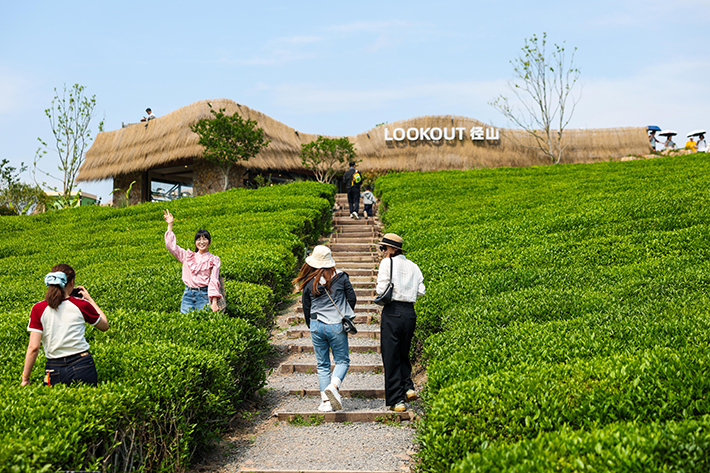
Tourists visit a tea garden in Xiaogucheng Village, Hangzhou, Zhejiang Province, on 26 April (XINHUA)
How did China lift hundreds of millions of people out of poverty in just a few decades? Is China’s poverty alleviation success merely a collection of impressive statistics? Or just another development slogan? Neither, I would argue.
Over the past nine years, I have been to more than 60 villages in China, from cave dwellings on the Loess Plateau to tea gardens in the water towns of south China, from Miao villages in the southwestern mountains to oases of the northwestern Gobi Desert. I have lived with villagers, worked side by side with grassroots cadres and witnessed the vivid practice of China’s rural transformation. What I saw was not a miracle, but a systematic, people-centred and deeply rooted approach to development.
In 2017, the 19th National Congress of the Communist Party of China formally proposed the rural revitalisation strategy, which has since become the central focus of work related to agriculture, rural areas and farmers. After years of practice, China has devised a rural development strategy with Chinese characteristics. It has achieved a comprehensive victory in the poverty alleviation battle: all of the country’s 832 poor counties have been lifted out of poverty. Today, China is steadily advancing towards the goal of a strong agricultural sector, beautiful countryside and prosperous farmers.
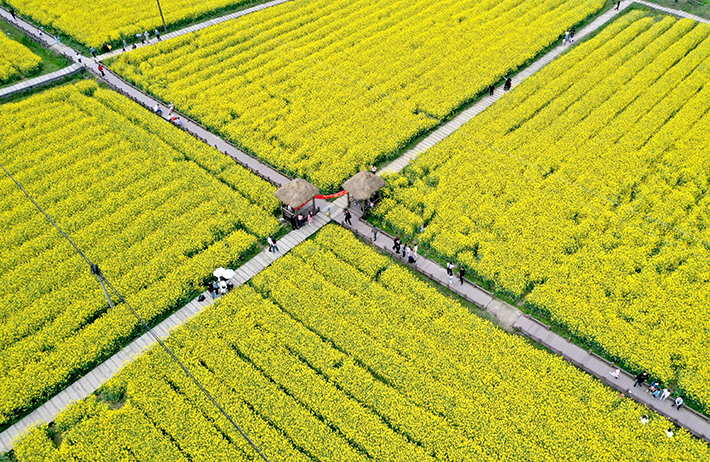
Tourists visit rapeseed flower fields in Huamao Village, Zunyi, Guizhou Province, on 23 March 2024 (XINHUA)
People-centred approach
The fundamental reason for the success of China’s rural development lies in consistently adhering to a people-centred development philosophy. This philosophy underpins the entire process of rural development and is reflected in the formulation and implementation of every policy. The Chinese government has always puts the interests of the people first; the starting point and goal of all work is to meet people’s aspirations for a better life.
In Huamao Village, Zunyi City, Guizhou Province, I witnessed firsthand the tremendous changes brought about by the relocation policy. Villagers who once lived deep in the mountains have moved to communities with spacious houses, schools and clinics. I visited several relocated families. One villager said, “In the past, children had to walk more than two hours on mountain roads to get to school. Now the school is right at their doorstep. In the past, when you fell sick, you just had to endure it. Now there is a health clinic in the village.” The case of Huamao Village vividly illustrates the people-centred philosophy. The Chinese government did not simply move villagers out of the mountains, but simultaneously addressed employment, education and medical care, enabling relocated people to move out, settle down and become prosperous.
Beyond relocation, Huamao Village has developed rural tourism and speciality agriculture, adopting an integrated approach across primary, secondary and tertiary industries. The village has created the “Huamao Renjia” brand, developed handicrafts such as pottery and rattan weaving, and attracted tourists for both sightseeing and hands-on experiences. Organic vegetables and fruits are grown and sold nationally through e-commerce platforms. Today, Huamao Village receives more than 1 million tourists annually, and per-capita annual income has risen from under 5,000 yuan ($734.23) in 2014 to over 30,000 yuan ($4,405.38) in 2025.
Huamao’s experience shows that rural revitalisation cannot rest on a single industry. Extending the industrial chain and increasing added value through integrated development is key. African countries, rich in natural resources and cultural heritage, can draw on Huamao’s experience to develop rural tourism, speciality agriculture and other industries, and build more diversified economies.
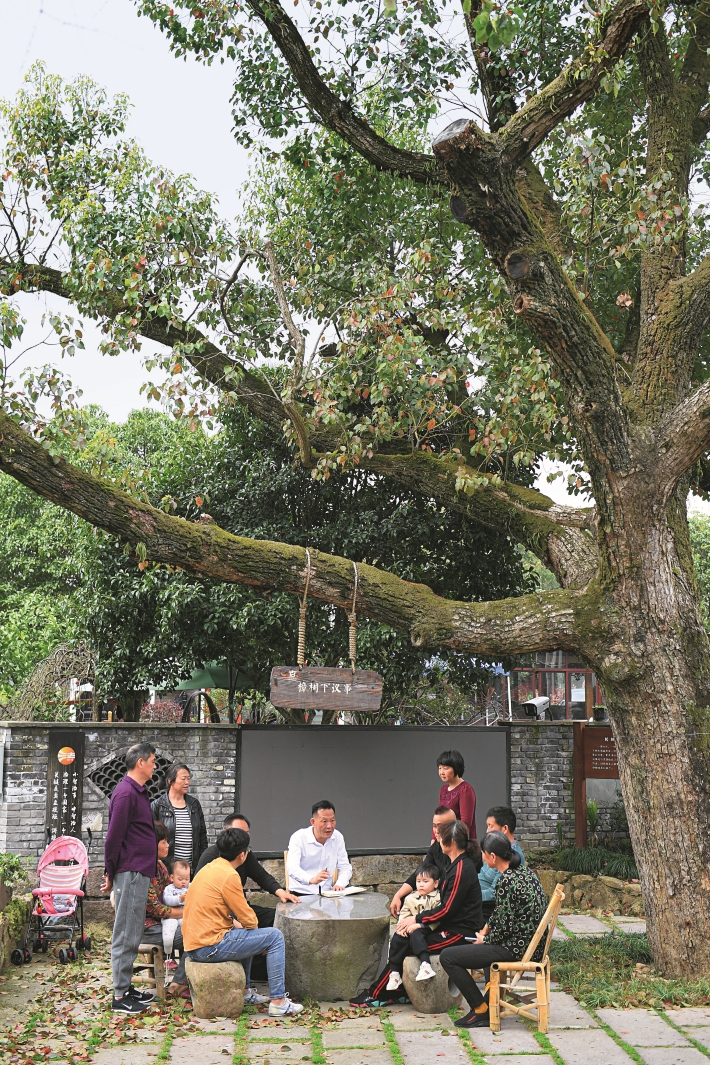
Villagers discuss local a airs beneath a camphor tree in Xiaogucheng Village, Yuhang District, Hangzhou, Zhejiang Province, on 14 March 2022 (XINHUA)
Adapting measures to local conditions
China has a vast territory, with great variation in natural conditions, resource endowments and cultural traditions from place to place. In promoting rural revitalisation, China avoids a one-size-fits-all approach and instead develops distinctive models suited to each area’s actual circumstances.
In July 2021, I visited Shahao Village in Xingxian County, Luliang City, Shanxi Province. This once deeply impoverished village has been transformed by an ancient intangible cultural heritage skill: papercutting. Throughout the village, women from nearly every household were busy at work. Their designs ranged from traditional flowers, birds, fish and insects to scenes of modern life. The resident village cadre told me that, through a “cooperative plus farmer” model, Shahao Village has unified training, design and sales, improving both the quality of the products and the breadth of sales channels. The papercutting industry now generates an annual output value exceeding 5 million yuan ($734,230), supporting the livelihoods of more than 200 women in the village.
What struck me most was an elderly woman, over 80 years old, who still cut paper every day. She told me: “In the past, papercutting was just for decoration during the Spring Festival. I never expected to make a living from it.” In Shahao Village, I saw clearly what “building capacity” rather than simply giving aid looks like in practice. The Chinese government did not hand out money and goods, but created opportunities for development based on local strengths. I visited Xiaogucheng Village in Yuhang District, Hangzhou City, Zhejiang Province, as a “Power Village Chief Trainee.” Under the century-old camphor tree at the village entrance, villagers gathered to discuss issues large and small. This is the famous “Camphor Tree Council,” a form of democratic consultation through which villagers actively participate in village governance and collectively work through problems.
What impressed me further was the village’s green development model. Xiaogucheng has adopted technologies such as “tea-light complementary” and “fishery-light complementary” systems, installing photovoltaic panels above tea gardens and fish ponds. These generate electricity without affecting agricultural production. The village’s photovoltaic power station now generates more than 1 million kwh annually. Xiaogucheng brings to life the principle that “lucid waters and lush mountains are invaluable assets.” Rural transformation in China no longer comes at the expense of the environment, but pursues a balance between economic growth and ecological protection.
This nine-year journey of grassroots investigation across China has been among the most valuable experiences of my life. It has not only deepened my understanding of China, but also given me a clearer sense of what is possible for Africa’s development. China’s rural development experience is not a rigid formula, but a set of development concepts and practical methods that can be adapted to different national circumstances. African countries should not replicate China’s model wholesale, but instead draw wisdom and strength from it and chart a path suited to their own conditions.
The success of China’s rural revitalisation reflects strong Party leadership, a people-centred philosophy, the principle of adjusting measures to local conditions, and the active participation of ordinary people. This model has produced a rich and varied set of practices across the country.
The author is co-founder of China-Africa Youth Federation
|
||||||||||||
| About Us | Contact Us | Advertise with Us | Subscribe |
| Copyright Beijing Review All rights reserved 京ICP备08005356号-5 京公网安备110102005860号 |


