|
||||||||||
| Home Top News Economy/Tech Culture/Sports China in Foreign Eyes Green Development Videos Intangible Cultural Heritages |
|
||||||||||
| Home Top News Economy/Tech Culture/Sports China in Foreign Eyes Green Development Videos Intangible Cultural Heritages |
| ChinAfrica |
| From Filth to Flame |
| China’s waste-to-energy revolution is turning yesterday’s waste into tomorrow’s foundation |
| By Yuan Yuan | VOL. 18 June 2026 ·2026-06-02 |
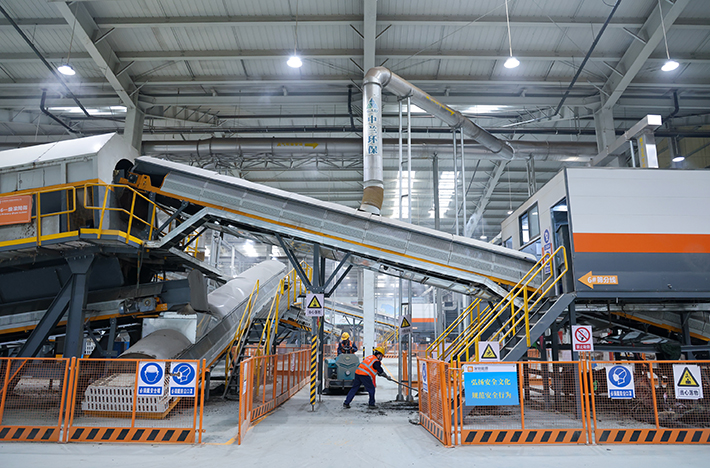
Intelligent screening equipment separates waste into humus soil, light materials and inorganic aggregates inside the screening workshop of the Yulong Landfill Environmental Remediation Project in Shenzhen, Guangdong Province, on 30 January (XINHUA)
A landfill that has been dormant for more than 20 years is finally stirring. Looming over Shenzhen, Guangdong Province, the Yulong Landfill is a titan of a bygone era. It holds a staggering 2.5 million cubic metres of waste, a volume enough to fill 1,000 Olympic-sized swimming pools. For decades, this 50-metre-high mountain of refuse lay silent - a stark, grim monument to the city’s raw industrial beginnings.
Built in 1983, decommissioned in 1997, and officially capped in late 2005, the site has, for more than two decades, been a festering sore on Shenzhen’s landscape. “When the landfill was first built, it was still on the city’s fringe. But as the city grew, this site has gradually evolved from desolate wilderness to what is now the urban core,” Cao Yongmin, lead designer of the Yulong Landfill Environmental Remediation Project, told CCTV News.
In late 2024, local authorities officially launched the environmental restoration of the Yulong landfill, embarking on a full-scale excavation, relocation and treatment of the massive site. Cao said the most important factor enabling the cleanup is that today’s waste treatment technology has finally reached a level capable of eradicating this stubborn environmental blight at its root.
Scar to launchpad
The entire excavation has been operating under a colossal canopy. With a maximum span of 280 metres, it is the largest canopy system in China. It acts like a giant tent, shielding the gritty reality of the landfill from the public eye. Inside, an integrated misting system silently neutralises odours and dust, ensuring that while a mountain is being moved, the city barely catches a scent of its past.
Just 500 metres away, the sorting facility hums with mechanical precision. Six massive conveyor belts, resembling industrial slides, move 6,000 tonnes of waste every day - the most ambitious sorting operation in the country. Here, the mountain of trash is meticulously separated into three distinct streams: organic waste for composting or refining, inorganic aggregates for recycling, and light combustibles destined for the furnace.
The journey of this “golden fuel” ends a few dozen kilometres away at a state-of-the-art waste-to-energy plant. Inside the belly of the furnace, the waste is subjected to a 1,100-degree-Celsius inferno for two hours. But the real scientific triumph happens at 850 degrees Celsius: by maintaining this heat for at least two seconds, dioxins - the most feared toxic byproducts - are systematically obliterated.
“Our emission levels aren’t just low; they are virtually undetectable,” Zhao Lichao, project manager at Shenzhen Energy Environment, a leader in high-tech waste solutions, told Xinhua News Agency. While the national limit is 0.1 nanograms per cubic metre, this facility operates at just 0.004.
This is about more than just disposal; it’s about power. Zhao said the plant, using a self-developed, seven-stage filtration system that is entirely domestically manufactured, processes 5,100 tonnes of trash daily. Estimates show that the landfill will yield approximately 330,000 tonnes of light combustible materials through screening, which are expected to generate 100 million kwh of electricity, enough to power 26,000 households for a full year.
Even the leftover slag (bottom ash) finds a second life. Instead of returning to a hole in the ground, it is transported to a specialised factory and compressed into “eco-bricks.” These bricks are tougher and cheaper than traditional clay, forming the foundation of Shenzhen’s roads and infrastructure. If they break, they can simply be recycled again.
Overseeing this entire “industrial ballet” is a digital watchdog. Every furnace is equipped with automatic sensors linked directly to environmental authorities, providing real-time, traceable data to ensure the process remains transparent and safe.
The project is set to be completed late this year. Once the land is restored and the last of the trash is transformed, this site will become a launchpad. In place of the landfill, a new ecosystem of AI, life sciences and the digital economy will rise.
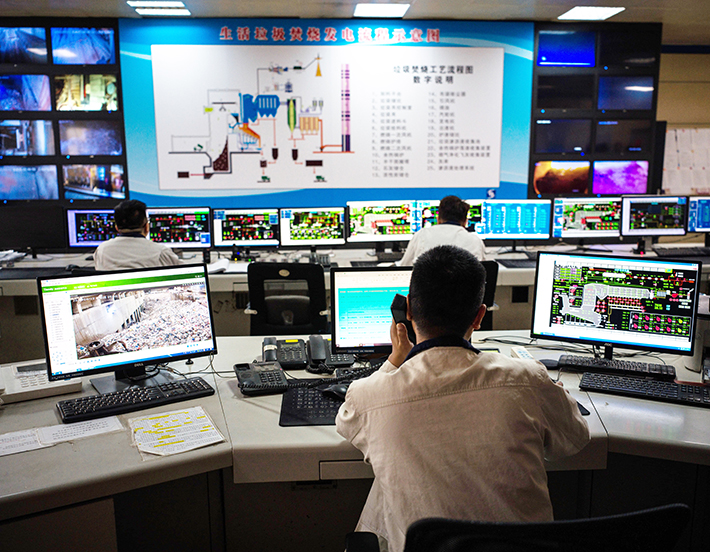
The control room of a waste-to-energy incineration plant in Tianjin on 23 April (XINHUA)
Beyond the furnace
The excavation currently underway in Shenzhen is far from a solitary endeavour. Over the past two years, several other Chinese cities have begun unearthing landfills that have sat dormant for decades, reclaiming aged waste, which will be repurposed and recycled.
Across China, a quiet transformation is turning waste into valuable resources. In a striking reversal, yesterday’s filth has been rebranded as “golden fuel,” a leap driven by the technological evolution of waste-to-energy incineration.
This journey has not been without its hurdles. In the 1980s, China began importing foreign incineration equipment, but the high costs and technical mismatches posed problems. “Western garbage is ‘dry’ and burns like a cracker. But Chinese garbage is ‘wet,’ mixed with large amounts of leftover food,” Yan Jianhua, a professor at Zhejiang University’s College of Energy Engineering, told Zhejiang Daily.
In an era before widespread sorting, the waste entering Chinese incinerators had a moisture content of over 50 percent. For imported equipment, burning such waste was essentially like “boiling water.” To maintain the critical 850-degree-Celsius threshold, early incineration plants had to pour tonnes of diesel fuel into their furnaces as a supplement, driving up costs and defeating the purpose.
To overcome this challenge of “technological indigestion,” Chinese scientists, including Yan, began a drive for localisation in the 1990s. Yan led his team to develop a heterogeneous circulating fluidised bed incineration technology specifically tailored to China’s high-moisture waste.
By re-engineering the furnace structure, they ensured that even damp refuse could burn stably and trigger the critical two-second window of high-temperature combustion that destroys toxic substances, without requiring massive amounts of external fuel.
Thanks to decades of research and development by these scientists, China’s waste-to-energy technology and equipment are now entirely domestically produced, driving down costs. Over the past decade, supported by policies like electricity subsidies, the industry has grown into a complete industrial chain with a mature commercial model.
China’s independently developed waste-to-energy technology is currently supporting several partner countries under the Belt and Road Initiative. According to data from the All-China Environment Federation, as of May 2025, Chinese enterprises were involved in 79 overseas waste incineration projects, including those already under contract.
“Waste is simply a resource that has been put in the wrong place,” Du Xiangwan, former vice president of the Chinese Academy of Engineering and a key figure in the Waste-Free City initiative, told Guangming Daily.
He added that despite the sophistication of modern incineration, front-end waste sorting remains far from obsolete. Separated kitchen waste can undergo anaerobic digestion, a natural process where microorganisms break down organic matter (including food waste) in an oxygen-free environment, to produce biogas, while recyclables can be reintegrated into industrial production chains. Only the true remnants that have no other destination should be destined for the flames.
The core of the Waste-Free City initiative is not about building more furnaces; it is about waste reduction at the beginning of the cycle, he emphasised. “We are aiming to build a closed loop of resource circulation, not merely a sophisticated discharge point for waste,” he said.
|
||||||||
| About Us | Contact Us | Advertise with Us | Subscribe |
| Copyright Beijing Review All rights reserved 京ICP备08005356号-5 京公网安备110102005860号 |


