|
||||||||||
| Home Top News Economy/Tech Culture/Sports China in Foreign Eyes Green Development Videos Intangible Cultural Heritages |
|
||||||||||
| Home Top News Economy/Tech Culture/Sports China in Foreign Eyes Green Development Videos Intangible Cultural Heritages |
| ChinAfrica |
| Green Bus Boom |
| Uganda’s electric bus industry takes off with commissioning of the modern Jinja manufacturing plant |
| By Godfrey Olukya | VOL. 18 June 2026 ·2026-06-02 |
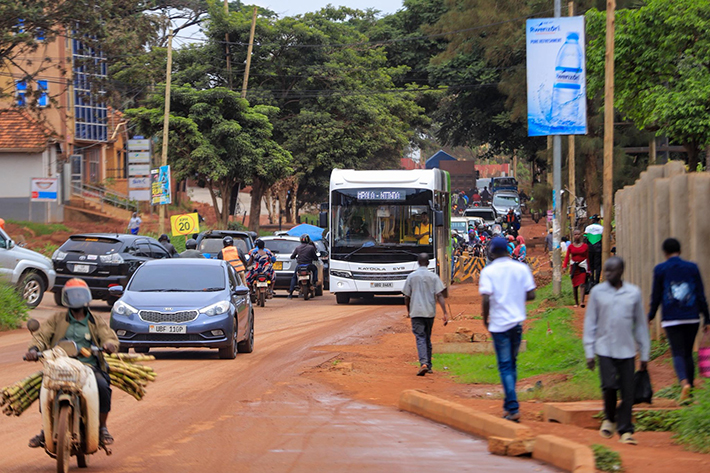
A Kayoola electric bus travels along a road in Uganda (GOVERNMENT OF UGANDA)
Uganda has started manufacturing electric buses after getting assistance from China, with the first 100 buses having rolled off the factory floor. The development is taking place in the industrial city of Jinja, where Ugandan electric vehicle company Kiira Motors Corp. (KMC) has opened a new factory.
The country’s Minister of Science, Technology and Innovation Monica Musenero said this project could not have been possible without support from Chinese engineers and companies.
“The country has started making buses and using some of them locally, while also marketing them to other African countries. Recently, to show those who doubted the buses’ capability, they were successfully driven from Uganda to South Africa and back,” said Musenero.
James Katwire, one of those who travelled on an expedition of over 13,000 km from Uganda through Tanzania, Zambia, Botswana and Eswatini, ending in Cape Town, South Africa, and back to Uganda in a luxury Kayoola E-Coach 13M at the end of 2025, said: “The bus I travelled in from Uganda to South Africa passed through several countries and reached its destination without any problem. Even the journey back was covered without any issues.”
Bus manufacturing journey
According to Musenero, Uganda’s journey to manufacturing electric buses began with the Kiira Electric Vehicle Project in 2011, which developed an electric saloon vehicle. This project laid the groundwork for KMC, a state-owned enterprise established to champion Uganda’s automotive industry. In 2014, KMC developed its first vehicle, the Kiira EVS, and in 2022, it produced electric buses called Kayoola.
KMC’s massive Kiira Vehicle Plant in Jinja began construction in 2020 and was officially commissioned in 2025 by Ugandan President Yoweri Museveni, with an initial production of 2,500 electric vehicles annually and a capacity to produce 10,000 in the mid-term.
KMC CEO Paul Isac Musasizi confirmed that the Kayoola buses are suitable for African conditions. “Our buses were designed for African environments, and boast impressive features including zero carbon emissions,” he said. The buses’ operating costs are significantly lower compared to their diesel counterparts, running at only 320 Uganda shillings ($0.09) per km. Of the materials used in the buses’ production, 21 percent are sourced locally, hence supporting Uganda’s economy. The buses will be marketed across Africa, with a 450-bus deal already inked in Johannesburg, South Africa, during the six-country expedition late last year.
President Museveni played a pivotal role in Uganda’s electric bus manufacturing journey. According to Bob Karebi, an engineer in the Ministry of Trade, Industry and Cooperatives, it is Museveni who came up with the original idea for the country to start manufacturing electric buses. “In early 2020, Museveni came up with the idea of Uganda getting a vehicle assembly plant, and after Makerere University produced a small electric vehicle, Museveni suggested that the country should start manufacturing electric vehicles, especially buses,” he said.
According to Karebi, Museveni made sure that enough resources were provided to a team of scientists who were selected to carry on the project. His advisors brought in Chinese companies and engineers to help in fulfilling the dream. Museveni has always been keen to reduce Uganda’s vehicle import bill, create jobs and contribute to the country’s net-zero carbon emission target by 2050.
Uganda’s Prime Minister Robinah Nabanja said that China played a significant role in the development of KMC, primarily through a technology transfer partnership with China’s CHTC Motor.
Chinese investment
While designed by Ugandans, the first Kayoola electric bus was jointly built in China, with subsequent units assembled locally in Uganda using Chinese components and expertise.
China assisted Uganda in manufacturing electric buses primarily through technology transfer, training and supply chain support, partnering with KMC. CHTC Motor supplied key components and provided technical expertise, allowing Ugandan engineers to assemble the Kayoola electric vehicles locally while using Chinese drivetrains, batteries, motor technology and components.
CHTC Motor provided knockdown kits for the electric buses, while also assisting in the design and production of key electrical components and vehicle assembly. China also transferred skills to Ugandan engineers, enabling them to lead the assembly and design work in Uganda. Infrastructure development was another area where China gave assistance.
Wang Li, one of the Chinese engineers on the team who helped in manufacturing the electric buses in Uganda, told ChinAfrica that the partnership supported the construction of a vehicle plant in Jinja, aimed at producing 30,000 buses annually by 2030.
“While critical components like motors and batteries were imported from China, the body moulding and final assembly were handled in Uganda,” said Wang.
The new, most popular Kayoola electric bus is a 12-metre low-entry city bus with capacity for 90 passengers (49 seated and 41 standing).
Some government institutions in Uganda have already started buying the buses. Among the first was the Uganda Civil Aviation Authority.
“The buses made in Uganda, with help from China, are at the moment the best buses in the country. They are stable on the road and have comfortable seats. The Chinese have done a lot for Uganda especially in assisting with the manufacture of these buses. I bought one for my school, which I have had no problems with as it is easy to maintain,” said local businessman and educator Yasini Gulemye.
William Kintu, a secondary school teacher who nowadays often travels in these buses on his daily commute, said that he and many Ugandans are proud of the buses.
“We thank China for supporting us in making these buses. Apart from being comfortable with huge windows and other facilities, it is affordable to travel in them. They charge us almost half of what we are charged when travelling in buses that use diesel fuel,” he said.
|
||||||||||||
| About Us | Contact Us | Advertise with Us | Subscribe |
| Copyright Beijing Review All rights reserved 京ICP备08005356号-5 京公网安备110102005860号 |


