|
||||||||||
| Home Top News Economy/Tech Culture/Sports China in Foreign Eyes Green Development Videos Intangible Cultural Heritages |
|
||||||||||
| Home Top News Economy/Tech Culture/Sports China in Foreign Eyes Green Development Videos Intangible Cultural Heritages |
| ChinAfrica |
| Harvesting Opportunity |
| China’s zero-tariff policy gives farmers a golden opportunity to put their best produce forward |
| By Problem Masau | VOL. 18 June 2026 ·2026-06-10 |
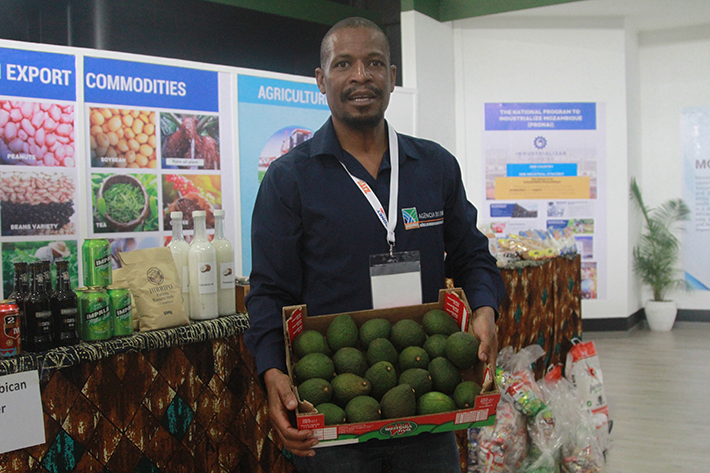
A Mozambican exhibitor showcases avocados at the Zimbabwe International Trade Fair in Bulawayo on 23 April (XINHUA)
China’s newly implemented zero-tariff policy has opened the vast Chinese consumer market to Zimbabwe’s smallholder farmers, spurring rural industrialisation and job creation.
The landmark policy, effective 1 May, grants duty-free access to all products from 53 African countries with diplomatic ties to China, placing Zimbabwe among 20 non-least-developed nations in Africa now enjoying duty-free access to the world’s second-largest economy. Least-developed African countries have enjoyed the same access since December 2024.
Trade data from the Chinese embassy in Zimbabwe shows that bilateral commerce between China and Zimbabwe reached approximately $4.4 billion in 2025, a year-on-year increase of 15.2 percent and a record high. Zimbabwe exported about $2.57 billion in goods and posted a trade surplus of roughly $0.74 billion.
Chinese Ambassador to Zimbabwe Zhou Ding told ChinAfrica that the comprehensive tariff elimination represents a significant moment for bilateral trade and will deliver real benefits to key export sectors. “Effective 1 May, Zimbabwean products enjoy duty-free access to the Chinese market. This unlocks tangible advantages for Zimbabwe’s key industries,” Zhou said.
“The zero-tariff policy also reflects China’s long-standing philosophy of cooperation with Africa – one based on sincerity, real results, amity and good faith. This unilateral tariff elimination connects China’s vast market with Africa’s development potential, and will inject strong impetus into China-Africa trade and investment cooperation as well as Africa’s economic modernisation,” he said.
A big boost to agriculture
Zhou identified high-value agricultural products as prime candidates for export growth. “China’s avocado imports have been growing at an average annual rate of more than 20 percent. Combined with Zimbabwe’s favourable growing conditions, zero-tariff access creates an unprecedented opportunity for Zimbabwe to penetrate China’s premium fresh produce market,” he noted.
A wide range of products, including citrus, macadamia nuts, blueberries, flowers, processed foods, essential oils, leather goods and cotton textiles, will now enjoy full duty-free access, helping Zimbabwe to diversify its export basket and reduce dependence on a limited range of commodities.
Speaking at the 2026 International Business Conference on the sidelines of the Zimbabwe International Trade Fair in Bulawayo in April, Vice President Constantino Chiwenga placed the Chinese market opportunity within Zimbabwe’s broader drive for industrial modernisation.
“We are laying a strong foundation to lead Africa into the Fourth Industrial Revolution through targeted policy reforms and industrial modernisation,” Chiwenga said.
He added that the government is drawing on the National Development Strategy 2 to promote macroeconomic stability and a predictable business environment, in the context of the new zero-tariff access to China.
Economic analysts say the zero-tariff policy’s most immediate impact will be felt in the horticulture sector, where smallholders have historically been locked out of export markets by prohibitive tariff costs.
Dereck Goto, a Zimbabwean analyst, said the policy would increase the competitiveness of Zimbabwean exports, particularly horticultural products, in the Chinese market.
He cautioned, however, that market access alone would not guarantee success.
“Zimbabwe must ensure supply-side readiness. Exporters must meet Chinese phytosanitary standards, quality requirements and logistical demands. Without a coordinated industrial policy and export support, the opportunity could remain underutilised,” Goto said.
Under Zimbabwe’s old tariff regime, smallholders producing crops such as sugar snap peas for export to China faced cost structures where duties could erode up to 20 percent of final sale value, before accounting for airfreight, cold chain logistics and broker margins.
Rumbidzai Moyo, a 47-year-old farmer from Mutasa District in Manicaland Province who cultivates peas and fine beans on a 5-hectare farm, said the new policy is a game-changer. “Every year, I lose perhaps a third of my crop because I wait too long for a price confirmation.
By the time the broker arrives, the peas have moved past their prime tenderness. With the zero-tariff policy, I can export directly to China through ZimTrade,” Moyo said.
ZimTrade, the country’s trade promotion agency, said in its April newsletter that the zero-tariff policy marks a historic shift in regional commerce and is a strategic initiative that will boost trade between China and Africa.
A game-changer
Zhou highlighted the developmental dimension of the policy, linking improved market access to industrial upgrading.
“Zero tariffs will lower the cost of Zimbabwe’s mineral and processed mineral products in China, boosting profit margins and global competitiveness,” he said.
“This will attract increased domestic and international investment, facilitate technology transfer, enhance skills development, create jobs and turn Zimbabwe’s natural resource endowment into sustainable and inclusive economic growth,” he said.
Zhou noted that the China-Zimbabwe economic relationship currently sustains about 1 million jobs and contributes significantly to national revenue, with cumulative Chinese investment reaching approximately $10 billion.
Addressing business leaders at a separate event in Harare ahead of the policy’s implementation, Zhou described the measure as unprecedented in global trade.
“No major global economy has ever granted unilateral, full-coverage zero-tariff market access to the African continent,” he said. “For Zimbabwe, it means more products reaching China’s vast market tariff-free and real opportunities for entrepreneurs who are ready to move.”
ZimTrade further noted that the policy provides long-term stability for a sector previously hindered by high market entry costs, a consideration especially important for perennial crops such as citrus and macadamia, which demand years of investment before the first harvest.
For Moyo, the picture was clear.
“The problem of taxes making our products too expensive for the Chinese market has been removed. Now it is about our quality, our consistency and our organisation.”
| About Us | Contact Us | Advertise with Us | Subscribe |
| Copyright Beijing Review All rights reserved 京ICP备08005356号-5 京公网安备110102005860号 |


