|
||||||||||
| Home Top News Economy/Tech Culture/Sports China in Foreign Eyes Green Development Videos Intangible Cultural Heritages |
|
||||||||||
| Home Top News Economy/Tech Culture/Sports China in Foreign Eyes Green Development Videos Intangible Cultural Heritages |
| ChinAfrica |
| Living the Story |
| Luoyang is turning cultural heritage into an immersive tourism economy |
| By Cui Xiaoqin | VOL. 18 June 2026 ·2026-06-10 |
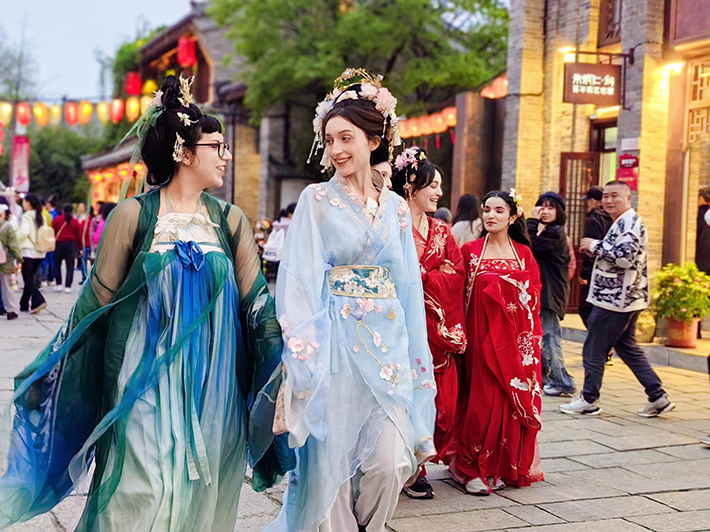
Visitors experience wearing hanfu in Luoyang, Henan Province, on 7 April (COURTESY)
Standing in Luoyi Ancient City, dressed in hanfu (traditional Chinese clothing), the wide sleeves catching the spring air, Mwisha Kabatsi Stephie from the Democratic Republic of the Congo found herself somewhere she hadn’t quite anticipated. “Walking through the ancient city in traditional Chinese clothing, I felt like a traveller from the Tang Dynasty (more than 1,000 years ago),” she said. “It was far more exciting than ordinary sightseeing.”
She was not alone in that feeling. Across Luoyang this year, growing numbers of visitors, most of them young, are choosing to step inside history rather than stand at its edges. They wear hanfu, join immersive performances, and wander streets that have been walked for centuries. The ancient capital is no longer a place you simply pass through.
During this year’s International Workers’ Day holiday from 1 to 5 May, Luoyang’s tourism market saw strong growth. According to local authorities, the city received 7.8 million visitors and generated over 7 billion yuan ($1.03 billion) in tourism revenue, up 5.7 percent and 9.2 percent year on year respectively.
In recent years, this ancient capital of 13 dynasties has built a tourism ecosystem combining floral spectacles, historical settings and hands-on cultural experiences. By turning its heritage into something visitors can participate in rather than just look at, Luoyang has found a new path for culture-driven economic development - taking tourists from simply “viewing flowers” to fully “living the story.”
The appeal of peonies and hanfu
The peony remains Luoyang’s most recognisable cultural symbol, and this year marked the 43rd edition of the city’s Peony Cultural Festival. According to Zhao Xuedong, deputy secretary general of the Henan Provincial Government, the festival has evolved beyond a traditional flower-viewing event into a broader cultural tourism platform that promotes city branding, stimulates consumption and expands international visibility.
Centred around the peony, Luoyang has integrated flower-viewing with the wider tourism economy, linking dining, accommodation, transport, shopping and entertainment into a unified experience. Major scenic areas now host live performances, traditional-style parades and poetry gatherings among the blossoms, extending the short flowering season into sustained tourism activity.
This year’s festival further reflected the city’s shift from sightseeing to immersive participation. The month-long event attracted more than 18 million visitors and generated tourism revenue exceeding 15 billion yuan ($2.2 billion). During the first 17 days alone, Luoyang welcomed 11.32 million visitors and recorded tourism revenue of 9.3 billion yuan ($1.4 billion), up 2.95 percent and 5.37 percent year on year respectively.
The faster growth in revenue than visitor numbers points to rising per-capita spending.
One of the clearest signs of this shift can be seen on Luoyang’s streets. Young people dressed in colourful hanfu can now be found throughout the city, particularly at historical landmarks such as Yingtian Gate and Luoyi Ancient City, adding to the atmosphere of the millennia-old capital.
According to the China Business Journal, the number of hanfu experience stores in Luoyang’s old city area surged from just 18 at the end of 2022 to more than 1,300 today. The industry has developed into a complete business chain covering costume rental, styling and travel photography, further amplified through social media. Hanfu has become another distinctive cultural symbol of the ancient capital.
Luoyang is not alone in this transition from traditional sightseeing to immersive tourism. As visitors increasingly seek deeper engagement with local culture and history, China’s tourism market is embracing new forms of experience-based consumption and revitalised cultural tourism.
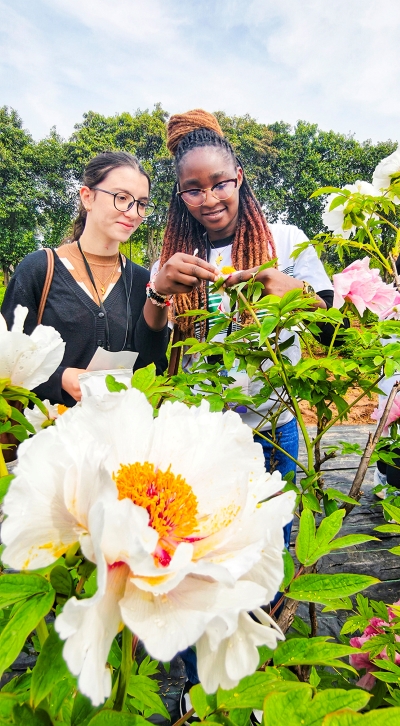
Visitors examine peonies in Luoyang, Henan Province, on 9 April (COURTESY)
Immersive cultural experiences
During the holiday, 52 key monitored retail, catering and accommodation enterprises in Luoyang recorded combined sales exceeding 160 million yuan ($23.6 million), up 4.7 percent year on year. Immersive performances and night-time consumption have become important drivers of new spending growth.
At the Sui-Tang Luoyang City scenic area, actors performed as “non-player characters,” bringing the grandeur of the Tang Dynasty (618-907) out of history books and into interactive reality.
The scenic area also staged immersive programmes featuring Tang Dynasty palace culture, allowing visitors to experience the elegance of the era through classical music, dance and theatrical performance.
For the holiday period, the site launched a creative recruitment campaign inviting visitors nationwide to be “workers” of the ancient capital. Participants could take on roles such as gatekeepers at Yingtian Gate, the main southern gate of Luoyang’s imperial palace complex during the Sui (581-618) and Tang dynasties, or scholars at the Mingtang and Tiantang complex, which recreates the political and ceremonial heart of the city during that era. In return, participants received free admission while experiencing “a day in the life” of a resident of the Sui and Tang dynasties.
Meanwhile, the large-scale cultural and commercial tourism complex Shendu Shisanfang introduced combined peak-season tickets covering two major attractions: the immersive epic performance Hetu Luoshu and a Tang-themed interactive park.
Hetu Luoshu draws inspiration from the nationally recognised intangible cultural heritage legend of the Hetu (Yellow River Chart) and Luoshu (Inscription of the River Luo). “Many people recommended it to me on Rednote (short video app) before I came to Luoyang,” said a tourist from Fujian Province who gave his surname Huang, describing the performance as “truly breathtaking.”
From 30 March, Luoyang officially launched its “Night Tour of Longmen Grottoes” project, illuminating the thousand-year-old Buddhist site and attracting large crowds. The “Boating on the Yi River” programme, meanwhile, transformed sightseeing boats into floating photography spaces, allowing visitors to admire both the Longmen Grottoes and blooming peonies while cruising along the river.
Museums across the city also cancelled Monday closures and extended opening hours into the evening. The Luoyang Museum introduced new night-time programmes, enriching visitors’ cultural experiences while boosting the city’s night-time economy.
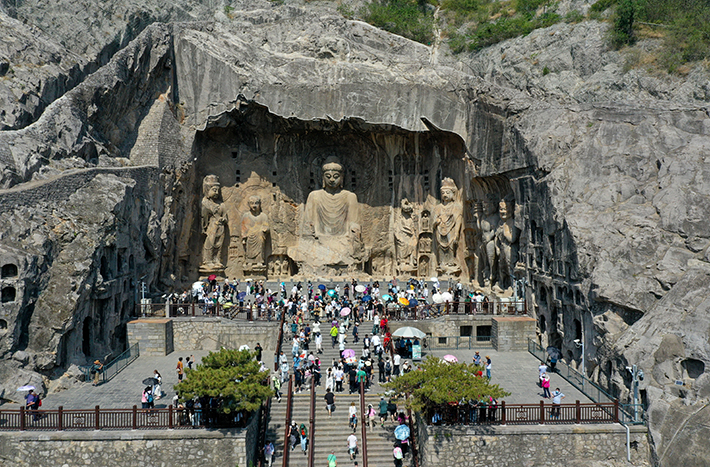
Tourists visit the Longmen Grottoes in Luoyang on 20 May 2025 (XINHUA)
Data from travel platform Ctrip showed that attendance at domestic performances and events during the International Workers’ Day holiday increased by 30.6 percent year on year, with Luoyang ranking among the top 10 destinations.
When a city no longer relies solely on natural scenery to attract visitors, but offers carefully designed cultural experiences that give them reason to stay, the value of its tourism economy begins to change.
“This is a beautiful city and definitely worth visiting. It has preserved so much of its ancient character,” said Mbinda Kibambe Ange, another student visitor from the Democratic Republic of the Congo, who was visiting Luoyang for the first time. Standing beside the Luo River, he happily sang a Chinese song, drawing a crowd of onlookers.
Ange said he was especially struck by the warmth and openness of Luoyang’s residents. “I saw a city that is both ancient and full of vitality,” he said.
From “viewing flowers” to “living the story,” Luoyang has found a way to bring its historical culture back to life. In doing so, it offers a noteworthy example of how China’s historic cities are reshaping cultural tourism through immersive experiences.
| About Us | Contact Us | Advertise with Us | Subscribe |
| Copyright Beijing Review All rights reserved 京ICP备08005356号-5 京公网安备110102005860号 |


