|
||||||||||
| Home Top News Economy/Tech Culture/Sports China in Foreign Eyes Green Development Videos Intangible Cultural Heritages |
|
||||||||||
| Home Top News Economy/Tech Culture/Sports China in Foreign Eyes Green Development Videos Intangible Cultural Heritages |
| ChinAfrica |
| A Quiet Connectivity Revolution |
| Xinjiang’s roads, rails and digital links are opening new horizons |
| By Donatien Niyonzima | VOL. 18 June 2026 ·2026-06-10 |
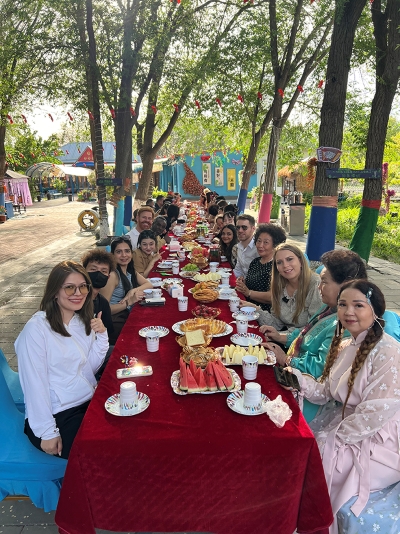
International visitors enjoy local food at a manor in Tacheng, Xinjiang Uygur Autonomous Region, on 8 May (COURTESY)
t first sight, the road heading west from Urumqi seems like any other in China: wide, efficient and smooth. But as the convoy moves towards the Tianshan range, the terrain begins to dictate the story. Snow-capped peaks rise sharply, and the vastness of the landscape becomes impossible to ignore. Deep within these mountains, one of Xinjiang’s most consequential infrastructure projects is reshaping both the region’s geography and its economic prospects.
On 26 December 2025, the 22.13-km Tianshan Shengli Tunnel, certified by Guinness World Records as the longest expressway tunnel on Earth, opened to traffic. As part of the G0711 Urumqi-Yuli Expressway, it cut the journey across the central Tianshan Mountains from roughly three hours to just 20 minutes and reduced the drive from Urumqi to Korla from seven hours to about three and a half. Speaking to ChinAfrica, Chen Xiao of Xinjiang University described the corridor as a development artery with strategic significance, a key project for Xinjiang to consolidate its foundation, expand its reach and enhance its capabilities in the new phase of westward opening up and modernisation.
Highways and hubs
Chen said that the highway has reshaped north-south linkages across the Tianshan Mountains. For a long time, connections were concentrated on a handful of corridors, creating structural constraints. The completion of this highway has shifted the network from reliance on a single main corridor to a more diversified transport network, helping to break the relative marginalisation of southern Xinjiang and embedding it more deeply into the economic circulation system of the entire region, and indeed the entire country. This spatial reorganisation, he added, is not merely connectivity in a transport sense; it is a redistribution of development opportunities and resources.
Economically, the highway has significantly reduced logistics and travel costs, improving conditions for development in southern Xinjiang. The time and cost of transporting bulk energy, minerals and agricultural products have fallen sharply, enabling larger-scale movement of coal, oil, gas and specialty crops. Improved accessibility also supports industries such as agricultural processing, on-site energy conversion and modern logistics. As a corridor connecting industrial parks, the highway boosts efficiency, lowers transaction costs and encourages cross-regional cooperation.
Beyond industry, the highway is reshaping how the world experiences Xinjiang. Chen said the marked improvement in travel conditions has greatly enhanced accessibility between the key tourism resources of Bayingolin Mongolian Autonomous Prefecture and the Urumqi metropolitan area, helping to turn its grasslands, deserts, poplar forests, rivers, lakes and wetlands into major tourist attractions. For young entrepreneurs, the road offers a reason to return home. Chen argued that this connectivity supports boutique tourism and self-drive tours while stimulating accommodation, catering and cultural services, shifting southern Xinjiang from a stopover destination into a place where visitors stay longer and spend more.
Xinjiang’s role in China’s broader strategy is unique. Bordering eight countries, it has long served as a gateway between China and Central Asia. Today, that function is being redefined through infrastructure, logistics and industrial development. Nowhere is this more visible than in Tacheng, near the Kazakhstan border. At Baktu Port, trucks line up, carrying everything from agricultural goods to machinery. In the first three quarters of 2025, the port handled 520,000 tonnes of imports and exports, with 136,600 personnel entries and exits, marking a nearly 74 percent year-on-year increase.

Visitors shop at a China–Kazakhstan border residents’ mutual trade market at Baktu Port in Xinjiang Uygur Autonomous Region on 7 November 2023 (XINHUA)
Zeng Zhi of the Tacheng Pilot Zone told ChinAfrica that Baktu Port has transformed from a traditional transit corridor into a comprehensive port economy. Annual cargo capacity has surged from 500,000 tonnes to 3 million tonnes. Since the launch of the “road port plus local direct access” model in 2025, customs clearance time has been reduced to under 10 minutes. Trade patterns have evolved from single cargo transit to an integrated system of border residents’ mutual trade, on-site processing and cross-border e-commerce, now extending to 18 countries including Kazakhstan and Uzbekistan.
The goods reflect Xinjiang’s economic diversity. Zeng broke down exports into three categories: fruits and vegetables including citrus, pomelos, garlic and bell peppers; household appliances and general merchandise; and machinery, including trucks, agricultural equipment and passenger vehicles. Imports consist mainly of raw materials and agricultural products: oilseeds such as sunflower, flax and safflower seeds; cold-chain items like frozen beef and chicken feet; and mutual trade goods including dried plums and frozen fish. This two-way flow underscores the port’s role as a genuine economic engine rather than a mere transit point.
For international partners, opportunities are also expanding. Zeng said that the third China–Kazakhstan cross-border railway broke ground in September 2025 and is expected to begin operations during the 15th Five-Year Plan period (2026-2030). The railway will increase Baktu’s annual capacity from 3 million tonnes to 12 million tonnes and upgrade the port into a comprehensive road–rail intermodal hub. He also highlighted prospects for foreign investment in grain and oil processing, dried fruit processing and regional distribution centres. In cross-border e-commerce, the railway supports parcel consolidation for Europe. Policy incentives, including an 8,000-yuan ($1,174) daily tax-free allowance for border residents’ mutual trade and access to TIR transport routes, lower barriers for Central Asian and European businesses.
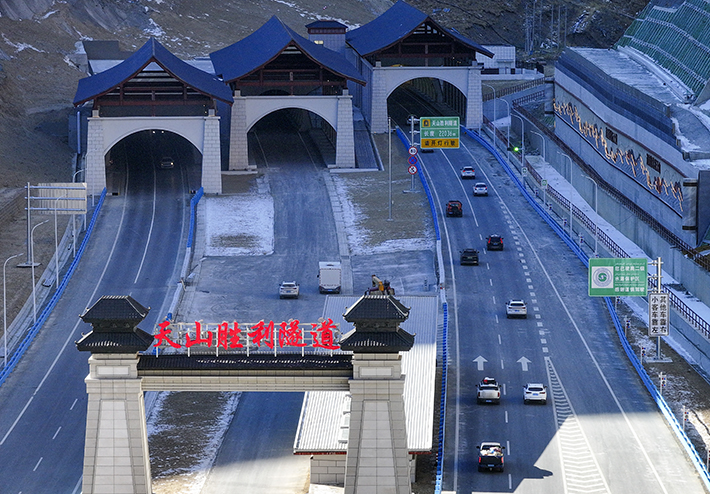
Vehicles enter the Tianshan Shengli Tunnel in Xinjiang Uygur Autonomous Region on 26 December 2025 (XINHUA)
A trade gateway
While physical infrastructure redraws the map, digital trade is redefining market reach. Zhang Cancan, deputy general manager of Xinjiang Silk Road Port Supply Chain Management, told ChinAfrica that companies used to rely on local or regional markets, but digital trade has overcome geographical limits through online platforms, enabling them to reach global customers directly. Primary markets include Russia and European countries, where consumption levels and business sophistication exceed those in Central Asia.
Zhang added, “The logistics infrastructure at Alashankou Port is a critical link in our overall development strategy, not only connecting China with the world, but also providing a foothold and staging ground as the company expands internationally.” Her words capture a broader truth: in Xinjiang today, connectivity is operational, tangible and transformative.
Beyond trade, Tacheng illustrates another aspect of Xinjiang’s transformation: cultural investment. At the New Era Civilisation Practice Centre, musicians rehearse accordion pieces while artists paint pastoral scenes. Economic growth alone is insufficient; communities must feel connected to heritage while adapting to modern life. In rural Emin County, automated feeding systems and data monitoring coexist with traditional herding practices, demonstrating a balance between efficiency and identity preservation.
That balance is also evident at Sayram Lake in Bortala, where controlled access points and waste management systems aim to ensure tourism benefits local economies without harming the environment. Back in Urumqi, the Xinjiang International Grand Bazaar thrives on human interaction, with vendors selling spices and handcrafted textiles to visitors from around the globe. These efforts position Xinjiang as both an economic hub and a destination for cultural tourism.
| About Us | Contact Us | Advertise with Us | Subscribe |
| Copyright Beijing Review All rights reserved 京ICP备08005356号-5 京公网安备110102005860号 |


