| ChinAfrica |
| Kigali Goes Electric |
| How Chinese electric vehicles are quietly revolutionising Rwanda’s future |
| By Alafati Mugabo | VOL. 18 July 2026 ·2026-07-01 |
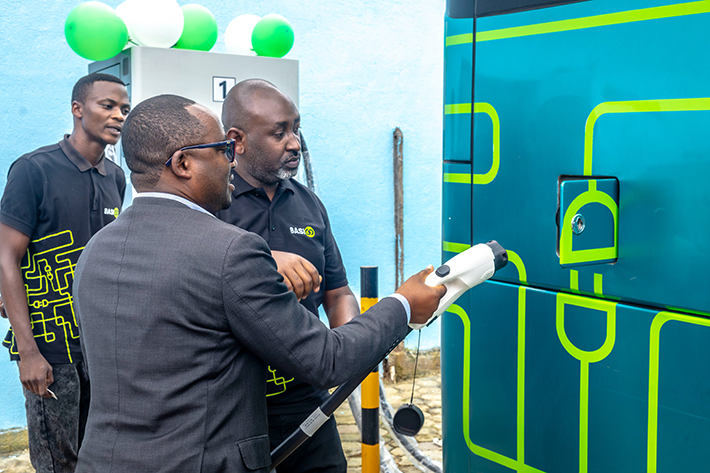
BasiGo staff charge an electric bus at the launch of a charging station in Muhanga, Rwanda, on 27 March (BASIGO RWANDA)
BYD. Geely. Dongfeng. NIO. XPeng. Chery. Names that only a few years ago many Kigali residents would have struggled to pronounce. Today, many aspire to own one of these vehicles.
Parked in glass-fronted showrooms along Kicukiro’s busy roads, stretched across billboards near the Sonatubes roundabout and gliding silently past commuters in Remera, electric vehicles (EVs) have arrived in Rwanda’s capital, and most carry Chinese names. Today, Rwanda is in the middle of a mobility revolution, and China is firmly at the wheel.
The numbers reflect the speed of the transition. Since 2020, when Rwanda accelerated its move towards electric mobility, the country’s EV fleet has grown to more than 7,000 vehicles, including fully electric and hybrid models. In 2020, Rwanda imported just 19 fully electric cars and no hybrids. By 2024, imports had climbed to 218 electric cars and 3,726 hybrids, with the total for the first nine months of the year already exceeding previous annual totals.
The most striking shift, however, is visible in the market itself. A recent survey by ChinAfrica across Kigali found that more than 25 new Chinese car dealerships and vehicle import companies had entered the market in the past year alone. Industry estimates suggest Chinese brands now account for over 70 percent of EVs entering Rwanda, driven largely by lower running costs, as electricity is considerably cheaper and more energy-efficient than petrol or diesel.
The whole conversation
“The dominance we’re seeing is not by accident,” says David Mahoro, a Rwandan businessman who operates 10 electric vans transporting cold-chain goods. “Chinese manufacturers understand markets like ours. They bring vehicles with lower running costs that are available and practical. Western brands are still stuck in pilot phases. Here, where every franc matters, affordability isn’t just one factor. It’s the whole conversation.”
Inside Kigali’s growing network of EV dealerships, the transition in consumer demand is unmistakable. Emmanuel Niyonzima, a sales manager at a bonded yard in Nyabugogo, said the change has been rapid. “Two years ago, customers came asking for Japanese cars, such as Toyota, Nissan and Honda,” he said. “Today, seven out of 10 are asking specifically about Chinese electric models. Many already know the battery range and charging costs. Most of my job now is explaining financing options.”
Affordability remains the key challenge. Entry-level electric cars still range between 30 million Rwandese francs and 60 million Rwandese francs ($20,500 to $41,000), prompting banks to introduce loan schemes and partnerships to make EV ownership more accessible. At the same time, charging infrastructure has expanded rapidly, with Kigali now hosting more than 200 stations.
For dealers, the shift is also economic. Patrick Habimana, who sells cars at DP World in Masaka, has fully pivoted to Chinese EVs and hybrids. “I used to spend heavily storing diesel cars that sat for months,” he said. “Now, a BYD or Geely moves within weeks, sometimes days. The market has spoken.”
For early adopters, the benefits are both financial and symbolic. Claudine Uwera, a 34-year-old accountant in Kacyiru, switched to a Geely Emgrand hybrid after calculating her monthly fuel costs. “I was spending around 250,000 Rwandese francs ($170.8) on fuel. Now I spend about 60,000 ($41.0) in total,” she said. “In one year, I’ve saved nearly 2 million Rwandese francs ($1,366). That’s school fees. And yes, the car is beautiful. People notice it.”
Théogène Nkurunziza, a civil servant who drives a BYD Atto 3, says initial scepticism about Chinese vehicles faded quickly. “People kept asking how long it would take before the car broke down,” he recalls. “Fourteen months later, I have not experienced a single problem. The technology speaks for itself.”
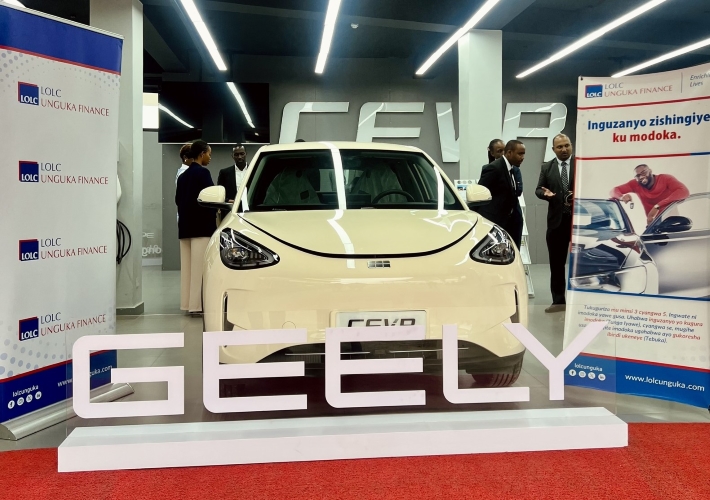
A Geely electric vehicle at a China Electric Vehicle Rwanda showroom in Kigali, Rwanda (CHINA ELECTRIC VEHICLE RWANDA)
Policy push
Rwanda’s shift towards electric mobility began not with private vehicles but with public transport. BasiGo, a Kenya-based company, introduced Chinese-manufactured electric buses into Kigali’s transport network after earlier operations in Nairobi. “We choose China because it leads in battery technology,” Managing Director Doreen Orishaba said during a recent press conference.
The economic advantages quickly became clear. A fully charged electric bus can travel around 300 km, while operating costs are dramatically lower than diesel equivalents. Operators estimate some routes cost roughly $30 using electric buses, compared with more than $100 using diesel. As interest from transport companies has grown, expansion plans have accelerated.
On the passenger side, the arrival of BYD, now recognised as the world’s largest EV manufacturer, marked another important turning point. CFAO Mobility launched East Africa’s first BYD showroom in Kigali, accompanied by charging and maintenance facilities that signalled long-term investment in Rwanda’s market. Other Chinese companies soon followed. China Electric Vehicle Rwanda introduced Geely models through financing partnerships, while Equity Bank Rwanda expanded EV access through dedicated credit schemes. Tailing Electric Vehicle also established an assembly facility in Gahanga focused on electric bikes and tricycles designed for local conditions.
Government policy has played a central role in supporting this expansion. Rwanda eliminated import duties, VAT and excise taxes on EVs and charging equipment while establishing ambitious electrification targets for 2030, including 20 percent of buses, 30 percent of motorcycles and 8 percent of private cars. According to the United Nations Environment Programme, shifting to electric motorcycles alone could save Rwanda approximately $22 million annually in fuel imports.
Rwanda’s EV transition reflects a broader continental trend in which China is emerging as a central partner in Africa’s mobility future. Alongside Kenya and Ethiopia, Rwanda has become one of East Africa’s most attractive markets for electric vehicle investment. More manufacturers are entering the market, competition is intensifying and prices are gradually falling. Together, these changes are creating a self-reinforcing cycle that is steadily reshaping how Rwanda moves.
|
||||||||||||
| About Us | Contact Us | Advertise with Us | Subscribe |
| Copyright Beijing Review All rights reserved 京ICP备08005356号-5 京公网安备110102005860号 |


