| ChinAfrica |
| Paving the Way |
| A China-led arterial road upgrade sparks a new socio-economic era in Malawi |
| By Edwin Nyirongo | VOL. 18 July 2026 ·2026-07-01 |
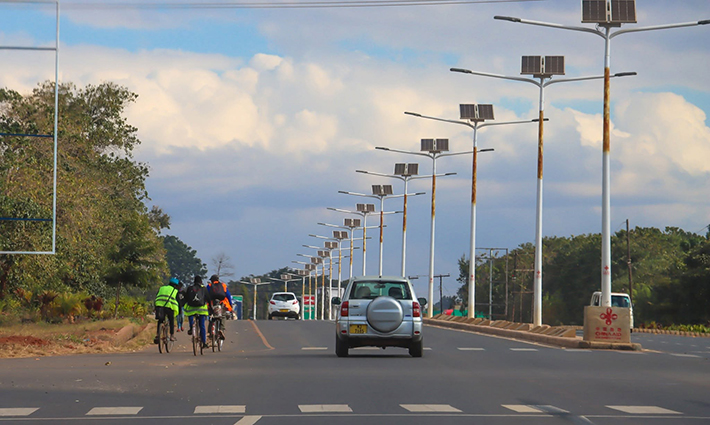
A view of the upgraded Crossroads to Kanengo section of the M1 Road in Lilongwe, Malawi (MALAWIAN GOVERNMENT)
Matias Jere is at a hardware shop in Malawi’s capital city, Lilongwe. He is waiting for it to open so that he can buy ball joints for his vehicle, his third set in as many months.
“Our roads are so bad that ball joints don’t last long, and it’s costing me a small fortune,” he said.
Businessman Rafik Mwamadi is also worried. He needs to travel more than 300 km to the Northern Region city of Mzuzu to deliver merchandise, but the road is riddled with potholes. In the past, the road trip took about five hours, but in its current poor condition, it takes about nine hours.
“To business people like me, time is money. So any delay not only affects my schedule, but also eats into my profits,” he said.
The Lilongwe-Mzuzu Road is part of Malawi’s M1 Road, which extends as far as Karonga in the Northern Region and Nsanje in the Southern Region. The potholes are a national headache caused by a raft of factors, including poor workmanship and heavy rains.
The most damaged stretch ran from Lilongwe to the Northern Region, and the government had long wanted to upgrade it.
China came to the rescue by offering to construct the stretch of road from Crossroads to Kanengo, a 12-km dual carriageway, through a grant of 44 billion Malawi kwacha (about $25 million). The construction, undertaken by Shandong Luqiao Group Ltd., began on 28 December 2021 and was officially handed over on 10 April this year.
The project involved upgrading the road from two lanes to four, with dedicated bicycle lanes and sidewalks on both sides. It also included the reconstruction of two bridges: one measuring 67 metres across the Lingadzi River, one of the capital’s main rivers, and the other spanning a railway near Kanengo, the capital’s industrial area.
According to He Liren, a Chinese representative of the project, more than 600 skilled and unskilled Malawians were employed throughout the project.
Built on friendship
Speaking at the handover ceremony, Chinese Ambassador to Malawi Lu Xu said China funded the road project because of the strong diplomatic relationship between the two countries.
“This project stands as a symbol of the enduring friendship between our two peoples. China continues to work closely with Malawi to deepen our mutually beneficial cooperation and support Malawi’s pursuit of sustainable and inclusive growth,” she said. “The upgraded section of the M1 Road is not only a key route linking Lilongwe to the north, but also a vital piece of infrastructure that reflects Malawi’s national image and supports its socio-economic development,” Lu added.
The expansion from a two-lane road to a four-lane dual carriageway has significantly improved traffic flow in the capital, reduced transportation costs, facilitated trade and mobility, and provided strong support for the realisation of Malawi Vision 2063, according to Lu.
Malawi Vision 2063 is the country’s ambitious blueprint for transforming Malawi into a middle-income nation by 2063. It identifies a modern road network as critical infrastructure for achieving that goal.
Accepting the handover, Minister of Transport and Public Works Jappie Mhango described it as a milestone in the country’s development. He outlined a number of infrastructure projects that China has supported, including the upgrading of the Karonga-Chitipa Road, the construction of the Parliament Building and the Malawi University of Science and Technology, and the ongoing construction of a Judicial Complex to address a shortage of space in the judiciary.
Mhango said it used to be a nightmare to travel from Lilongwe to Kamuzu International Airport, but with the newly constructed road, travel time has decreased.
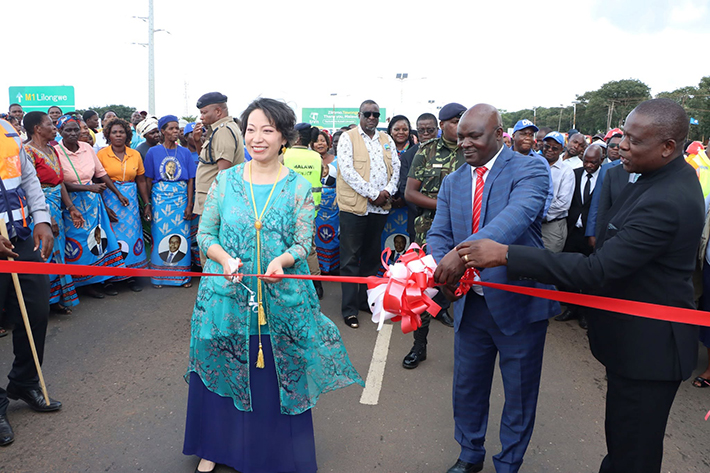
Chinese Ambassador to Malawi Lu Xu and Malawian Minister of Transport and Public Works Jappie Mhango cut the ribbon during a handover ceremony of the upgraded Crossroads to Kanengo section of the M1 Road in Lilongwe on 10 April (MALAWIAN MINISTRY OF TRANSPORT AND PUBLIC WORKS)
Driving growth
Mhango said transport does more than facilitate the movement of people, goods and services.
“It is also a catalyst for the growth and development of other productive sectors of the economy. Transport infrastructure remains a fundamental component of our development agenda,” he said.
Meanwhile, Lu announced that China will also rebuild the road from Kanengo to Kamuzu International Airport, also known as Lilongwe International Airport, which is not only in poor condition but also too narrow.
Mhango welcomed the news, saying the project will change the face of the country and of Lilongwe, as it is the first road visitors to Malawi see.
“We are very grateful for the financial support that the Chinese government is providing to the people of Malawi,” he said.
Since China began supporting Malawi’s infrastructure development, the impact on people’s lives has been substantial.
The Bingu International Conference Centre in Lilongwe, for instance, regularly hosts international conferences, political summits, expositions and music concerts.
It recently hosted the National Open Distance e-Learning Symposium, where academic and policy leaders discussed the importance of e-learning in enhancing access to and success in education, attracting widespread attention from stakeholders.
Another example is the Bingu National Stadium, which has become the country’s premier football venue. After FIFA gave it its stamp of approval, national teams from countries including Kenya and Burundi have also used it to host home matches.
| About Us | Contact Us | Advertise with Us | Subscribe |
| Copyright Beijing Review All rights reserved 京ICP备08005356号-5 京公网安备110102005860号 |


