| ChinAfrica |
| Meaning in Making |
| From childhood craft to adult therapy, a new economy of experience is changing how young Chinese consumers find calm, control and meaning |
| By Li Yin | VOL. 18 July 2026 ·2026-07-01 |
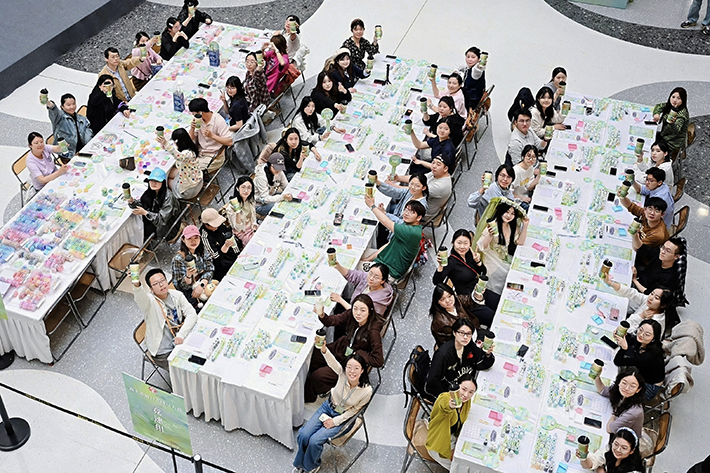
Participants pose for a group photo during a perler bead crafting competition organised by a milk tea shop in Xi’an, Shaanxi Province, on 6 April (XINHUA)
In recent months, a quiet yet striking trend has been unfolding across China’s cities from major metropolises to smaller urban centres. Handmade craft studios have rapidly emerged in shopping districts, cultural blocks and community spaces. Inside these studios, young people gather around shared tables, carefully arranging tiny colourful plastic beads into intricate patterns. After hours of patient design, the creations are fused with heat and transformed into refrigerator magnets, keychains and other personalised crafts.
This activity, known in Chinese as pin dou (perler bead crafting), is deceptively simple. It involves placing small plastic beads onto pegboards to form patterns, which are then ironed to set the design permanently. Once a childhood toy associated with basic creative learning, it has evolved into a full-fledged cultural and commercial phenomenon spreading rapidly across social media platforms and offline retail spaces.
What was once a niche hobby has become a symbol of China’s growing experience economy, where consumers increasingly value emotional fulfilment and personal expression over passive consumption. The rise of perler bead culture reflects not only changing lifestyle preferences among younger generations but also a broader transformation in how leisure consumption and emotional well-being intersect.
Paying for emotional relief
Walk into a perler bead workshop in Shanghai, Beijing, Chengdu or Shenzhen, and a familiar scene unfolds. Young participants sit quietly for hours, fully immersed in their work. Phones are set aside, conversations are minimal, and attention is focused entirely on the slow assembly of colour and form. The process is repetitive, almost meditative, yet deeply absorbing.
In one studio in Shanghai’s Wujiaochang commercial district, a 29.9 yuan per hour perler bead experience has sold more than 11,000 sessions annually. Customers are provided with all necessary tools and materials, and no prior experience is required. The low barrier to entry, combined with short completion time and visible results, makes it especially attractive to young consumers seeking low-pressure leisure activities.
Many participants describe the experience as unexpectedly therapeutic. Sorting beads, selecting colours and gradually watching a pattern emerge provides a sense of control and accomplishment that contrasts sharply with the uncertainty of daily life.
Industry observers note that the rapid rise of perler bead workshops is closely tied to shifting consumer psychology among China’s Gen Z population. What distinguishes this trend is not only its simplicity, but its emotional function.
The popularity of such handmade experiences reflects a broader shift towards “emotional consumption,” where young people are willing to pay for participation, creativity and stress relief rather than finished goods alone. Social media platforms have further amplified the trend, turning small handmade items into shareable visual content and fuelling demand for personalised, aesthetically distinctive creations.
Experts suggest that the appeal lies in accessibility and individuality. Hong Yong, a researcher at the Chinese Academy of International Trade and Economic Cooperation, notes that the activity requires minimal skill and low financial cost, making it widely approachable. Compared with pottery or glassblowing, perler bead crafting requires only basic tool handling, yet still allows significant creative freedom.
Beyond accessibility, psychologists and cultural economists point to deeper emotional drivers. Cao Yixia, a researcher at the Shanghai Academy of Social Sciences, describes perler bead crafting as a form of “immersive healing activity.” The process offers a clear goal and immediate visual feedback, helping to counterbalance modern anxiety and uncertainty.
In psychological terms, it often induces a “flow” state, a condition of deep focus and engagement in which individuals lose track of time.
The repetitive nature of the work is also central to its appeal. In an increasingly fast-paced and fragmented digital environment, young people are drawn to activities that slow time and produce tangible outcomes. Completing a design, no matter how simple, delivers an immediate and visible sense of achievement.
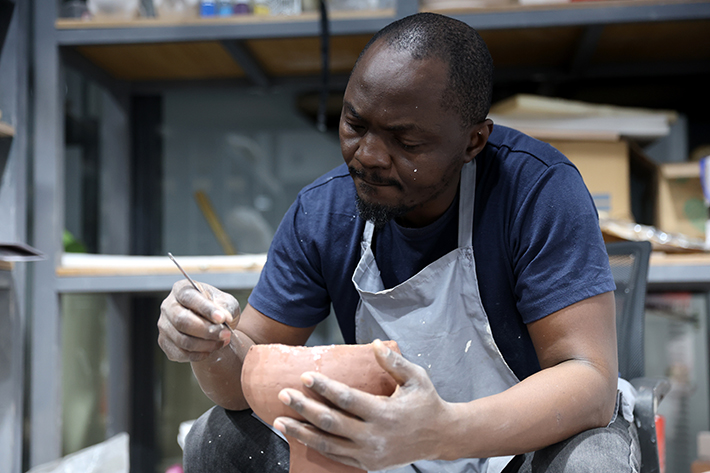
Nigerian ceramic artist Chris Klay works on a pottery piece at Taoxichuan International Studio in Jingdezhen, Jiangxi Province, on 26 March 2025 (CNS)
The value of experience
The popularity of perler bead crafting is part of a broader shift in China’s consumption landscape. As industrial mass production has made standardised goods widely accessible, consumers are increasingly seeking uniqueness, participation and emotional resonance.
In this context, handmade experiences are valuable not because of their material output, but for the process itself. Consumers are not simply buying objects; they are buying time, attention and memory.
This trend extends beyond urban craft studios. Similar patterns have emerged in cultural tourism destinations, where experience-based activities are reshaping travel behaviour.
One of the most notable examples is Jingdezhen, the centuries-old city in Jiangxi Province often called the “capital of porcelain.” Long known for imperial kilns and ceramic craftsmanship, it has become a major hub for experiential tourism. Visitors no longer come solely to observe porcelain production; they come to take part in it.
This shift reflects changing expectations, where immersion and participation matter more than passive observation or purchase.
In Jingdezhen, tourists spend entire days painting ceramic plates, shaping clay and designing personalised porcelain pieces. These works are fired in kilns and mailed home, turning travel into lasting personal artefacts.
In porcelain workshops, professional artists, hobbyists and office workers sit side by side, united by a shared rhythm of concentration. Some spend nine hours or more on a single painting session, fully absorbed in the process.
The emotional appeal is similar to perler bead crafting. Satisfaction comes not from technical perfection, but from personal involvement. Even imperfect brushstrokes or uneven colours carry emotional value because they reflect individual effort and lived experience.
What distinguishes Jingdezhen’s model is its deeper cultural integration. It connects participants to centuries-old craft traditions while embedding them in a contemporary creative economy.
The city has become a magnet for young creatives. With a population under 1 million, Jingdezhen hosts around 60,000 jingpiao migrants, young people working in ceramics and creative industries, more than half born after 1990. Markets such as Taoxichuan and Lotte Art District host over 28,600 artisans, with an average age of just 28.
According to local tourism data, Jingdezhen recorded a 15.43 percent year-on-year increase in domestic tourist arrivals in 2025, with tourism revenue rising by 17.98 percent. This suggests cultural value is increasingly translating into economic growth.
Despite differences in scale and depth, perler bead crafting and Jingdezhen’s ceramic experiences represent two expressions of the same underlying shift.
Perler bead workshops embody a lightweight, fast-paced, highly shareable model of experience consumption. Jingdezhen, by contrast, represents a slower, more culturally embedded form of experiential consumption, offering deeper engagement and longer-lasting impact.
Together, they illustrate a broader transformation, a shift from product-centred consumption to experience-centred value creation. Consumers are increasingly paying not for objects, but for participation, emotion and memory.
From children’s toys to adult stress relief tools, from finished goods to creative participation, China’s experience economy is evolving rapidly. At its core lies a simple but powerful shift: people are seeking meaning in making.
|
||
| About Us | Contact Us | Advertise with Us | Subscribe |
| Copyright Beijing Review All rights reserved 京ICP备08005356号-5 京公网安备110102005860号 |


