| ChinAfrica |
| Building Bridges, Powering Futures |
| How learning Chinese opened a path from student life to national development |
| By Raul de Carvalho | VOL. 18 July 2026 ·2026-07-01 |
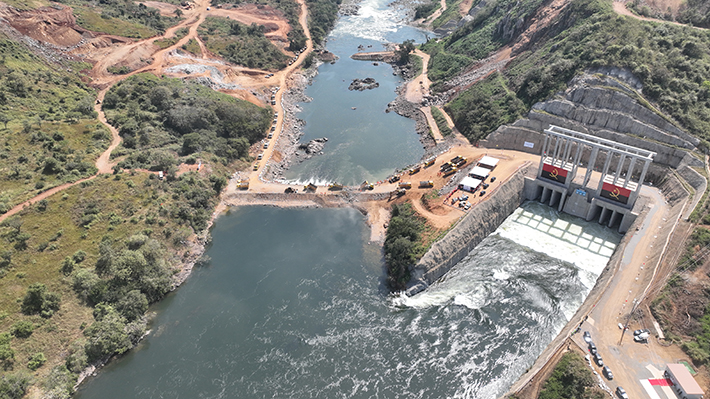
Photo taken on 20 May 2023 shows the river diversion ceremony for the Caculo Cabaça Hydropower Project in Cuanza Norte Province, Angola (XINHUA)
In a world increasingly defined by connectivity, my journey reflects the transformative power of language, opportunity and international cooperation. I am an Angolan civil engineering graduate, a former international student in China, and today a contributor to one of Africa’s most ambitious clean energy projects. My story is not just personal, but a window into the evolving partnership between China and Africa, and the role young people play in shaping that future.
In 2017, I was a civil engineering student in Luanda, navigating an uncertain job market during a period of economic adjustment in Angola. At the same time, cooperation between China and Angola was accelerating, with Chinese-built infrastructure projects expanding across the country.
On campus, a simple idea began to circulate: those who spoke Chinese had more opportunities. Motivated by this reality, I enrolled in Chinese language classes at the Confucius Institute. What began as a practical decision soon became a defining turning point in my life. Learning Chinese was not easy. The tones, characters and structure were entirely different from Portuguese, but persistence revealed something deeper: a new way of thinking, a rich cultural heritage and a bridge to the world.
Opening doors
In 2018, I was awarded a scholarship to study in China. Arriving in Harbin, Heilongjiang Province, I faced freezing temperatures unlike anything I had ever experienced, but I also encountered something equally powerful: a society driven by efficiency, discipline and long-term vision.
China reshaped my perspective, not only academically, but personally. It showed me what was possible.
In 2022, I returned to Angola and joined the Caculo Cabaça Hydropower Project, one of the largest energy infrastructure projects in the country, often referred to as the African Three Gorges. For the first time, I stood inside a project that would directly shape my country’s future.
With an installed capacity of over 2,000 mw, the project is expected to significantly reduce energy shortages, lower greenhouse gas emissions and create thousands of jobs. Beyond the statistics, what truly defines its impact is the transformation it brings to people’s lives, communities gaining access to electricity, young workers acquiring technical skills and families building more stable futures.
At the beginning, my role focused on translation and coordination between Chinese and Angolan teams. However, I quickly realised that language alone was not enough. There was a gap in technical understanding among local workers, and I felt a responsibility to contribute more.
I began supporting training sessions, translating not just words, but also knowledge, engineering concepts, safety standards and operational practices. In doing so, I witnessed firsthand the philosophy often emphasised by Chinese engineers: to teach not just the task, but also the skill. This approach changed everything.
A shared vision
Working at Caculo Cabaça has transformed my life in ways I could not have imagined. Professionally, I evolved from a translator into a coordination and management role in electromechanical systems. Personally, I gained clarity about my purpose: to become a bridge between cultures, technologies and people.
The impact extended beyond my own journey. With a stable income, I was able to support my family, improve our living conditions and help my younger sister to continue her education. Today, she is also learning Chinese, inspired by the possibilities that this path can create.
This is how development becomes real, not through abstract policies, but through tangible change in people’s lives.
China–Africa cooperation is often discussed in terms of investment, trade and infrastructure. But from where I stand, it is something more human. It is the worker who learns to operate new machinery. It is the child who studies under electric light for the first time. It is the community connected by a newly built road. It is opportunity.
Chinese enterprises bring not only capital and technology, but also a culture of planning, execution and long-term commitment. At the same time, local professionals like myself play a crucial role, interpreting, adapting and strengthening this collaboration through cultural understanding. We are not just participants. We are connectors.
Angola stands at a critical moment in its development, with a growing need for sustainable energy and economic diversification. Projects like Caculo Cabaça are not just engineering achievements, but foundations for the future.
As a young professional, I see my generation as central to this transformation. We are the ones who understand both worlds. We are the ones who can translate not only language, but vision. We are the ones who will carry this partnership forward.
My goal is clear: in the next decade, to grow into a key contributor to energy and infrastructure projects that define Angola’s development, while continuing to strengthen China–Africa cooperation.
Looking back, I realise that my greatest achievement was not a degree or a job, but recognising and embracing opportunity. Learning Chinese opened doors. Studying abroad expanded my vision. Working on a national project gave my life purpose. Today, as I stand beside the dam at Caculo Cabaça, watching a massive structure rise from the ground, I see more than concrete and steel. I see a future being built. And I am proud to be part of it.
The author is site assistant engineer of Caculo Cabaça Hydropower Station, Angola
| About Us | Contact Us | Advertise with Us | Subscribe |
| Copyright Beijing Review All rights reserved 京ICP备08005356号-5 京公网安备110102005860号 |


