| ChinAfrica |
| Defying the Virus |
| Chinese medical expert team assists with the Ebola outbreak in the DRC |
| By Godfrey Olukya | VOL. 18 August 2026 ·2026-07-23 |
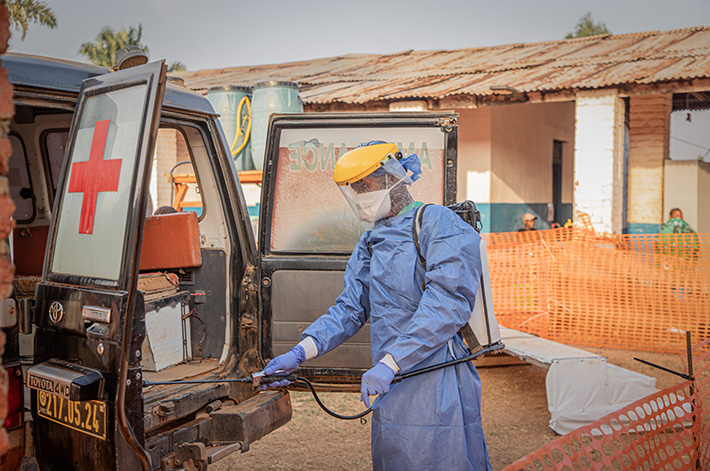
A medical worker disinfects an ambulance at an Ebola treatment centre in Mongbwalu, Ituri Province, the DRC, on 20 June (XINHUA)
The Democratic Republic of the Congo (DRC), along with the World Health Organisation (WHO), announced outbreaks of Ebola in the country on 15 May.
Patrick Muyaya, the country’s minister of communication and media, told the media on 17 May, “Ebola has attacked Congo 16 times since 1976. But this time, according to health experts, it is different. Lab tests confirmed the [current] Bundibugyo strain is rare, aggressive and has no approved vaccine [as] yet.”
By early June, the WHO had declared Ebola in the DRC a public health emergency of international concern. Conflicts, displacement and mass movement around gold mines made contact tracing in the country almost impossible.
China extends a hand
A few days after the initial announcement of Ebola in the DRC, China declared that it would send a team of medical specialists to the country to assist with the outbreak.
On 1 June, Lin Jian, China’s foreign ministry spokesperson, said, “China has decided to provide humanitarian assistance to the DRC and will continue to do so to the best of its ability. We feel for the DRC over the new outbreak of Ebola. China will provide help to the best of its capability in light of Africa’s needs.”
China’s aid wasn’t limited to the DRC. Lin confirmed China would also assist the African Union Commission and Africa Centres for Disease Control and Prevention (Africa CDC) to strengthen outbreak containment across other countries in the region that may report infections.
China’s National Health Commission said in a statement that the medical team sent to the DRC was to work shoulder to shoulder with local authorities to strengthen prevention and treatment capacity. That meant containing the epidemic, training local doctors and nurses and giving epidemic-control guidance to hospitals.
On 2 June, a five-member Chinese anti-epidemic team touched down at the DRC’s N’djili International Airport in Kinshasa. The team included specialists in epidemiology, clinical medicine, outbreak research and traditional Chinese medicine, who will remain for a three-month mission to support the DRC in its battle against Ebola.
Welcoming the Chinese medical team at the airport on behalf of the DRC government, Luku Maleyo Marius from the Ministry of Public Health, Hygiene and Social Welfare said China’s dispatch of the medical experts represents timely and strong support for the Congolese government and people. “Whenever the DRC faces major public health challenges, China has consistently extended timely assistance. We look forward to the mission further strengthening the country’s epidemic prevention, control and treatment capacities, and helping to bring the outbreak under control as soon as possible,” said Marius.
Immediate action
Chinese medical team leader Lu Ming said they would do their best to help the country to overcome Ebola, beginning immediately with epidemic assessment and case management.
“Under the guidance of the Chinese Embassy in the DRC, we will, in addition to attending to patients, also work with Chinese institutions, enterprises and local Congolese communities to promote public awareness of epidemic prevention, and strengthen frontline preparedness,” he said.
When the Ebola outbreak was announced on 15 May, China immediately activated its 24th medical team, which was already stationed in the country. “Since the Ebola outbreak began, they have set up emergency response drills, delivered medical supplies to health centres, and kept frontline clinics running for both Congolese patients and Chinese workers,” said Marius.
Meanwhile, Rose Mundala, director of health care facilities and partnerships at the DRC’s Ministry of Public Health, Hygiene and Social Welfare, said that before the Chinese expert team arrived, China had donated medicines and medical equipment to the Sino-Congolese Friendship Hospital in Kinshasa. She said the supplies had improved the hospital’s treatment conditions and benefitted many local patients. She also noted that in the past, China and the DRC had also cooperated on Ebola and mpox outbreaks.
Mundala added that the Chinese experts have split their work schedule by working at treatment centres in the morning to guide Congolese nurses on how to manage severe cases without a vaccine, training community health workers to spot symptoms early in the afternoon, and coordinating with Chinese companies to protect their staff and surrounding villages in the evening.
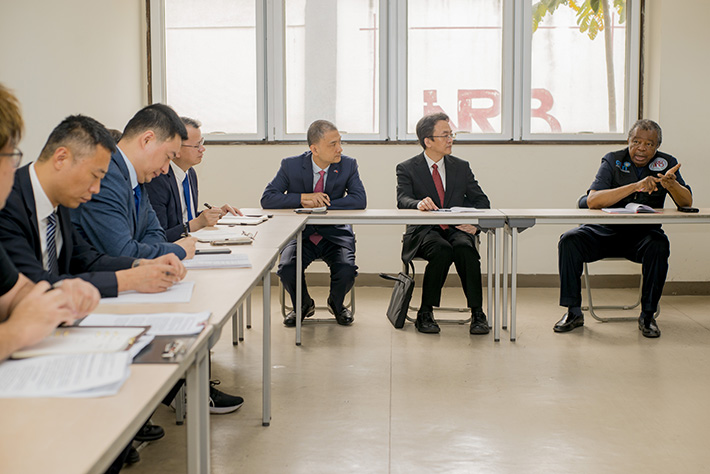
Chinese medical experts discuss the Ebola response with Jean-Jacques Muyembe (right), head of the National Institute of Biomedical Research of the DRC, in Kinshasa on 10 June (XINHUA)
Decades of medical assistance
The DRC has suffered more Ebola outbreaks than any other nation. The 2018-2020 outbreaks in North Kivu Province killed over 2,200 people. The current outbreak is concentrated in three eastern provinces, all affected by armed conflict, which makes it difficult for health services to move about freely and trace contacts.
China’s June 2026 Ebola response is part of a bigger story. Over the past six decades, China has regularly sent medical teams to Africa during health crises. During the 2014-2016 West Africa Ebola crisis, China sent 1,000 health workers and pledged over $120 million in aid.
In addition, more than 45 Chinese medical teams have worked across 44 African countries in recent years.
The Forum on China-Africa Cooperation, last held in September 2024 in Beijing, made public health a core pillar, and emphasised training African medical personnel, building hospitals and deploying medical teams.
In a report on 6 June, the DRC National Institute of Public Health reported 515 confirmed cases and 91 deaths. Health authorities also indicated that 283 patients are currently hospitalised or in isolation, while 12 people have recovered since the start of the outbreak.
According to the WHO, the latest Ebola figures from the DRC appear to offer some hope as the number of cases is not increasing at a high rate as had been feared.
Jean Kaseya, director general of the Africa CDC, has welcomed China’s “firm commitment” to help Africa meet its public health objectives, in the wake of the Ebola virus outbreak.
“The Africa CDC welcomes China’s continued engagement and its firm commitment to supporting Africa’s public health priorities,” Kaseya told Xinhua News Agency recently, highlighting the long-standing partnership between China and Africa in the public health sector.
| About Us | Contact Us | Advertise with Us | Subscribe |
| Copyright Beijing Review All rights reserved 京ICP备08005356号-5 京公网安备110102005860号 |


