| ChinAfrica |
| Engineering a Lifeline |
| Chinese-built canals are turning Iringa’s dry, rain-dependent fields into a thriving commercial rice belt |
| By Derrick Silimina | VOL. 18 August 2026 ·2026-07-23 |
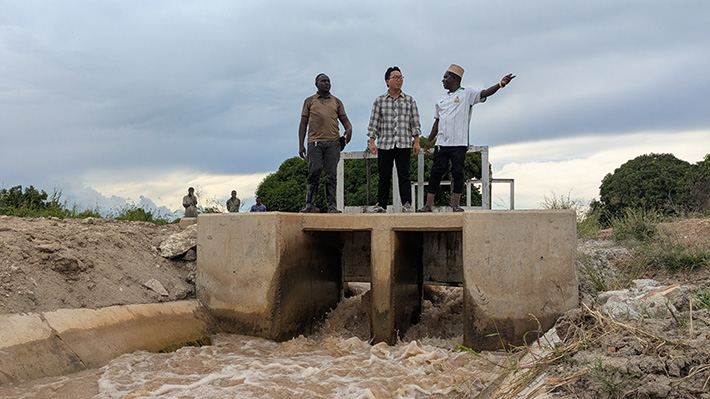
Local offcials chat with a Chinese representative at an irrigation facility in Iringa Region, Tanzania, on 20 March (XINHUA)
As the first rays of light illuminate the lush rice fields in Tanzania’s Iringa region, Josef Muhesi stands among the rice plants, feeling a gentle breeze move through the young stalks in soft, rippling waves.
“Our rice fields barely produced enough to feed us due to poor rainy seasons,” he told ChinAfrica. “Today, not only do we eat from our harvest, but we also sell the surplus to sustain our livelihoods.”
His field sits on the fringes of the ecologically restored plains, where the low-altitude and semi-arid flatland environment results in hot and dry conditions. Compared to the cooler, mountainous parts of Iringa, this area requires structured irrigation to sustain rice farming effectively. For years, the farming calendar here was shaped by an unspoken anxiety: farmers scanning the sky, waiting for rain that came late, if it came at all, with a whole family’s fortunes riding on a single fragile harvest.
“I am farming not only for the next meal, but also cultivating a surplus,” Muhesi said. He expects the 2025–2026 season, and those that follow, to cover his children’s school fees, a future he now trusts as much as he trusts the water at his feet.
That water sits cool and clear around the roots of his crop, no longer left to the whims of the clouds. It arrives instead with engineered precision through a new irrigation scheme built by China Railway Jianchang Engineering Co. Ltd. (CRJE).
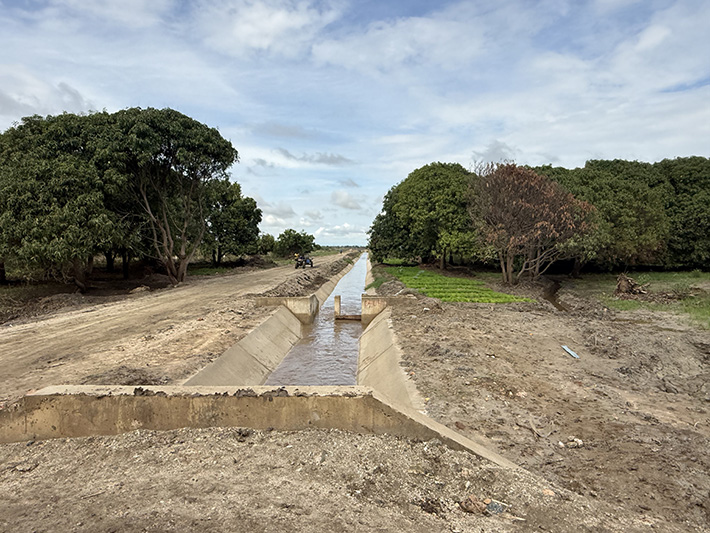
Water flows through an irrigation canal in Iringa Region, Tanzania, on 5 January (XINHUA)
From canals to commerce
The project, built in Tanzania’s southern highlands, comprises roughly 78 km of irrigation canals and 85 km of rural roads. The scheme is designed to serve more than 6,000 hectares of farmland, with tens of thousands of farmers across several villages expected to benefit.
Backed by government funding of about 34 billion Tanzanian shillings (about $14 million), the project spans multiple villages and supports rice production for major cities such as Dar es Salaam and Dodoma.
A dense network of primary and secondary canals distributes water evenly across Iringa’s uneven terrain. By overhauling the water management system, CRJE has helped farmers to move beyond subsistence farming to commercial-scale production.
Neema Mdogo, a rice supplier who has benefitted directly from the project, believes the Chinese-built infrastructure is changing lives across Iringa. In the distance, the fields bustle with activity, accompanied by the joyful laughter of local farmers wading through the shallow waters.
For years, prolonged dry spells disrupted Mdogo’s supply chain and strained her family’s finances. Today, however, she values the irrigation project less for its engineering than for what it has restored to the community: a sense of hope and resilience that runs beneath the everyday work of farming.
“The arrival of the CRJE-built infrastructure feels like a lifeline to me. Thanks to a partnership built on solid ground, I can now measure my business success by the abundance of each rice harvest,” she said.
Economists note that the project’s benefits extend well beyond agriculture, feeding into the wider local economy. Investment has flowed into rice processing and related industries, while upgraded roads have made trade and transport easier across the region.
Youth employment has also risen, with hundreds of young people now working in construction and agriculture, contributing to community development and economic growth.
Iringa’s canals stand as evidence that reliable access to water, made possible through international partnership, can do more than irrigate fields. It can turn uncertainty into a foundation for growth. The project is a clear example of how cooperative infrastructure development can strengthen both agricultural output and community resilience over time.
“Every grain of rice leaving Iringa now carries a story, carved in stone and grown with joy,” said Kizito Msafiri, who owns a rice milling plant in the area.
CRJE project manager Zhang Hong said the facility, which includes farm roads and water conservancy systems, extends across 6,000 hectares. It supports more than 30,000 residents and produces around 25,000 tonnes of grain each year, underpinning local food security.
“We prioritised local employment by creating more than 800 jobs and providing skills training to nurture local talent while balancing ecological protection and people’s livelihoods,” Zhang said.
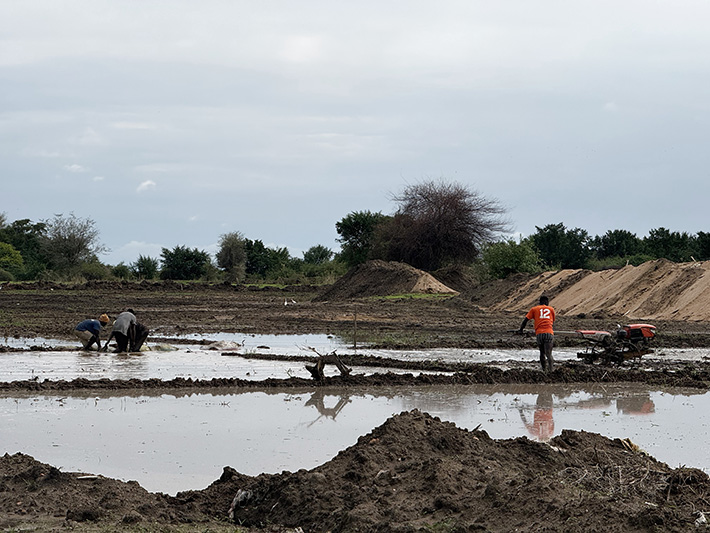
Local farmers work in irrigated fields in Iringa Region, Tanzania, on 5 January (XINHUA)
Ripples across the region
Pawaga, roughly 80 km northwest of Iringa, has long been one of the region’s key rice-growing areas.
Pawaga Division Officer Emmanuel Ngabuji sees strong potential ahead, noting that because agriculture underpins local livelihoods, the gains from recent development work are already becoming evident.
“Production is increasing, and opportunities are expanding. In the past, we relied on simple traditional canals that could not meet demand. Now, areas that never received water are being cultivated,” he said.
Raheem Ndagala once turned to fishing after repeated poor rice harvests. Now, watching water flow steadily across his land, he sees possibilities he once thought were out of reach.
Although the project is not yet fully complete, more than 70 percent of the irrigation system is already operational, giving farmers like Ndagala a glimpse of stronger yields and steadier livelihoods ahead.
“Before the irrigation scheme was introduced, harvesting eight to 10 bags of paddy per acre was considered a good yield. Now I am able to harvest 25 bags, and I expect even more,” he said.
Tanzania is Africa’s fourth-largest rice producer and ranks second in Eastern and Southern Africa. The country produces roughly 2.43 million tonnes of milled rice each year and has the capacity to reach nearly 3 million tonnes, according to Tanzania’s Ministry of Agriculture.
Chinese Ambassador to Tanzania Chen Mingjian recently highlighted China’s contributions to hybrid rice technology, agricultural demonstration centres, drone applications, mechanised farming and modern agricultural systems.
Chen encouraged young people to embrace modern technology in agriculture, noting its potential to transform the sector.
“Tools like advanced irrigation, agricultural drones, precision farming, smart logistics, satellite surveillance and digital marketplaces can turn farming into a more lucrative and modern industry,” the Chinese envoy said at the opening of the recent “Experience China” High-Tech Fair in Dar es Salaam.
|
||||||||||||
| About Us | Contact Us | Advertise with Us | Subscribe |
| Copyright Beijing Review All rights reserved 京ICP备08005356号-5 京公网安备110102005860号 |


