| ChinAfrica |
| Beyond the Lens |
| A Chinese photographer’s journey across Kenya and into himself |
| By Li Xiaoyu | VOL. 18 August 2026 ·2026-07-23 |
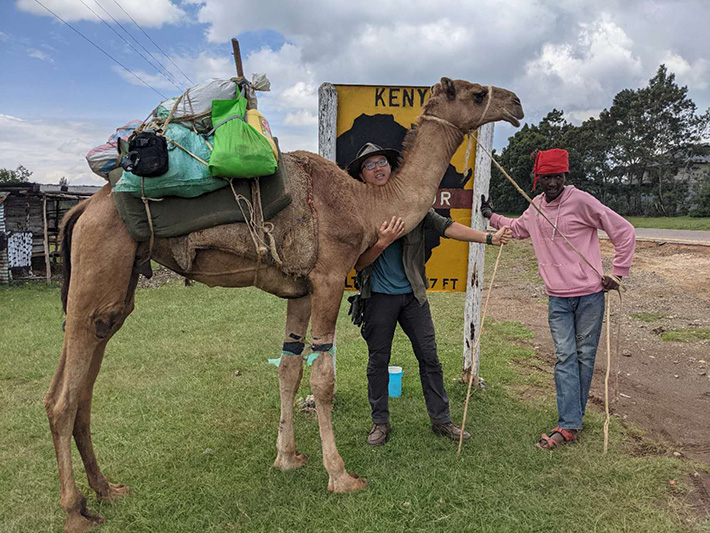
Qi Lin poses with his guide Martin and his camel Kipesh beside the equator marker in Nyahururu, Kenya, on 9 September 2021 (COURTESY)
Of all the meals photographer Qi Lin, 42, ate during his 701-km trek across northern Kenya, one stands out for reasons few people would envy. After a long day’s walk in September 2021, Qi and his Samburu guide Martin unpacked a piece of mutton bought only hours before. White maggots already covered its surface. They knocked the meat against a rock, cooked it with cabbage and ate it anyway.
“Protein is protein,” he said matter-of-factly. Out in the wilderness, where food is scarce and survival outweighs convention, gratitude replaces disgust. That moment, recorded in The Camel Diaries, has become one of the book’s most talked-about passages. For Qi, though, it isn’t a story about endurance. It’s about perspective.
Published in April this year, The Camel Diaries traces Qi’s two-month journey on foot through Kenya’s northern frontier, alongside a guide and a single camel named Kipesh. What began as daily WeChat updates meant to reassure family and friends eventually grew into a travel memoir that pairs unedited diary entries with photographs.
“I never imagined they would become a book,” Qi told ChinAfrica. “At first they were simply conversations with myself.”
His decision to keep the diaries almost exactly as written has become central to the book’s appeal. Rather than reconstruct memories from the comfort of home, Qi preserved the words he had typed on a cracked phone beneath acacia trees or beside dry riverbeds, after walking up to 40 km each day. “Those sentences only existed in that specific place, at that specific moment,” he explains. “I could never write them again.”
That authenticity is precisely what distinguishes the book, said Cao Yin, associate professor of history at Peking University. “At a time when travel is increasingly reduced to carefully curated social media moments, Qi’s account moves in the opposite direction,” he said. “It is built on blistered feet, sunburnt skin, stomach illness and months of sharing meals and daily life with local communities.” Cao believes the book offers not just compelling travel writing, but grassroots material for understanding African societies from lived experience.
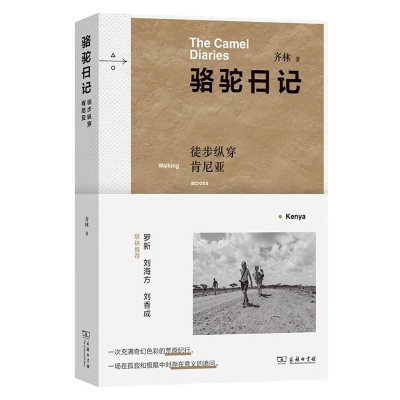
Published in April this year, The Camel Diaries chronicles photographer Qi Lin’s journey across northern Kenya with a young Samburu guide and a camel (COURTESY)
More than an adventure
The journey itself was daunting.
Setting out in September 2021, Qi, Martin and three-year-old Kipesh crossed Kenya’s equator, highlands, savannas and elephant forests before reaching Lake Turkana, often called the “cradle of humankind,” and finally entering the unforgiving Chalbi Desert. With only one camel, rather than the several such an expedition would normally require, they carried water, food and camping equipment across some of East Africa’s harshest terrain.
The most dangerous moment came not from armed tribesmen, nor later when robbers took their camel, but during the desert crossing itself. Qi recalled repeatedly approaching heatstroke. A metallic taste filled his mouth. Hallucinations set in. Worse than the physical collapse was the psychological weight of an endless horizon with no shade and no hope in sight.
“It was the only time I truly wondered whether I could continue,” he said.
Yet hardship, he insisted, was never the point. For more than a decade, Qi has taken on one or two months of what he calls “ascetic journeys” each year, not to conquer nature, but to better understand himself.
“In the wilderness, you can’t pretend,” he said. “You can’t perform. You have to respond to the world exactly as you are.”
The expedition also marked a turning point after years of personal turmoil. Having witnessed extreme violence in Haiti, mourned the death of a close friend and struggled with depression and deteriorating eyesight, Qi found himself emotionally disconnected from the world.
Photography, once his way of engaging with the world, no longer felt enough. “The camera used to stand between me and reality,” he said. “Now I experience the world first, through my body and senses. Only then do I reach for the camera.”
At several points during the trek, Qi felt what he described as complete immersion in nature. “The colours became brighter. I could feel the weight of the wind and the warmth of sunlight. The whole world suddenly came alive.” In an era increasingly shaped by AI, Qi believes this kind of embodied perception may prove to be humanity’s most valuable capability.
“AI is good at thinking,” he said. “But sensing the world, that still belongs to us.”
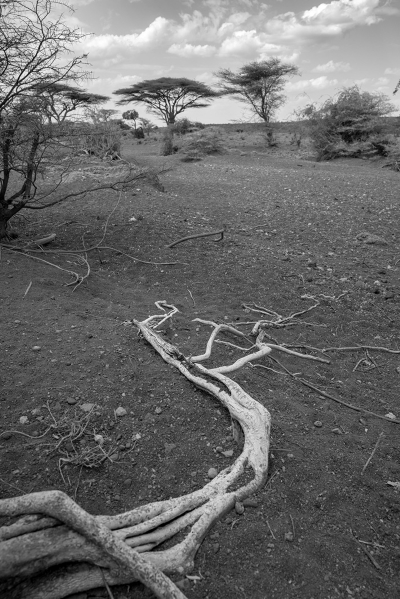
A dry riverbed on the western edge of the Chalbi Desert in Kenya, where Qi Lin’s team camped on 23 October 2021 (COURTESY)
A journey of equals
Although The Camel Diaries unfolds across northern Kenya, Qi resists calling it a book about Africa. “I don’t think I’m qualified to explain Africa,” he said. “It’s simply a story about myself, who happened to be in Kenya.”
Having lived and worked in Africa since first arriving in 2011, Qi has watched Kenya modernise rapidly. But the remote north remains economically isolated, even as climate change and globalisation reshape daily life elsewhere. One image continues to haunt him: a three- or four-year-old girl in Maikona, Marsabit County, who had never seen rainfall because of prolonged drought.
“Her future is tied to the choices all of us make,” he said. “Climate change, energy consumption, AI: those aren’t abstract issues. They will eventually reach her.”
The journey also challenged assumptions about cultural distance. One afternoon, Qi met Samburu herders leading a cow to market, planning to sell it to buy wedding rings. “Our wedding customs are completely different,” he said. “But the excitement of preparing for one of life’s biggest moments, that feeling is exactly the same.”
Encounters like this gradually replaced stereotypes with familiarity. Sharing meals, sleeping in villages and walking alongside local communities let trust build naturally. “The material conditions were difficult,” he said. “But happiness and sadness are universal.” That, perhaps, is the deeper message behind the book.
Rather than asking readers to adopt a new narrative about Africa, Qi hopes simply to spark curiosity. “If people become curious enough to visit Africa themselves, that’s the best outcome,” he said. “Even my book can’t represent Africa. The continent is simply too large.”
For Liu Haifang, director of the Centre for African Studies at Peking University, that spirit sets The Camel Diaries apart from conventional exploration literature. “This is a great African dream undertaken alongside a camel, but it is also an Eastern journey unlike the narratives of Western exploration. With only one camel, this contemporary Chinese traveller entered local communities, breathing the same air as the people he met. His path is filled with dust, and in that dust lies the scent of freedom.”
The comparison feels fitting. Unlike travel narratives built around conquering landscapes or decoding civilisations, Qi’s journey is defined by uncertainty, vulnerability and humility. His diaries are neither comprehensive portraits of Kenya nor authoritative interpretations of Africa. They are fragments of a life lived one step at a time.
And the journey, he insisted, is far from over. Northern Kenya has already changed dramatically since 2021. If he returns, and he believes he will, it won’t be to repeat the same expedition. Instead, he imagines arriving with an unlikely new companion.
“I’d like to bring a robot,” he said with a grin. “I’d like AI to see the cradle of humankind.”
For a traveller who once crossed deserts with a single camel, the idea seems entirely in character. The journey was never about adventure for its own sake. It has always been the search for a more honest way of seeing the world and, ultimately, himself.
| About Us | Contact Us | Advertise with Us | Subscribe |
| Copyright Beijing Review All rights reserved 京ICP备08005356号-5 京公网安备110102005860号 |


