| ChinAfrica |
| The Hidden Value of Crayfish Shells |
| Chinese researchers are transforming discarded food waste into reusable microplastic traps |
| By GE LIJUN | VOL. 18 August 2026 ·2026-07-23 |
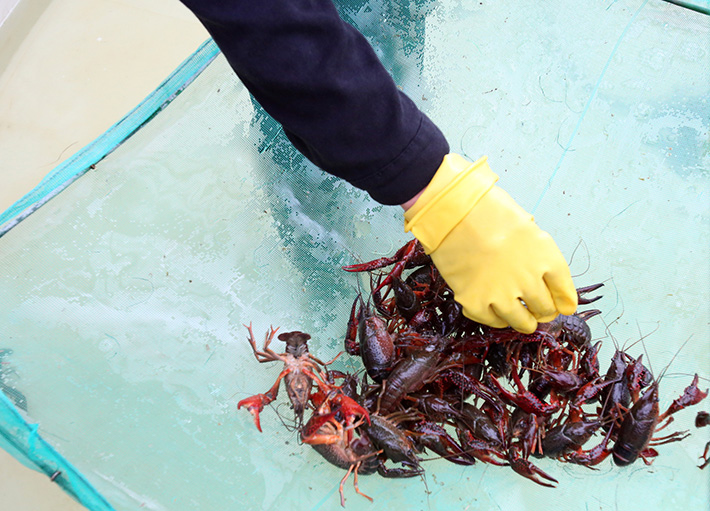
Crayfish reared at a demonstration centre for standardising the modern agricultural supply chain in Xuyi County, Jiangsu Province, on 27 March (XINHUA)
In many parts of China, crayfish are the stars of evening meals. But behind this beloved delicacy lies a mountain of discarded shells, long regarded as little more than waste. Chinese researchers now see them as a valuable resource in the fight against microplastic pollution.
Microplastics, plastic particles smaller than five millimetres in size, have polluted oceans, rivers, soil and even the air. They can also enter the food chain and eventually accumulate in the human body. Conventional methods of removing them are often costly or ineffective.
A team led by Professor Deng Hongbing of Wuhan University has discovered that the fibrous structure of crayfish shells makes them an excellent natural material for capturing microplastics. After several years of research, the scientists have developed a technology that is already being applied commercially. The team has secured more than 30 patents, generating economic value of more than 800 million yuan ($118 million).
Why crayfish shells? Their internal structure resembles a highly ordered network of natural fibres. Chitin forms the framework, while proteins and calcium carbonate provide strength and rigidity. Once much of these components has been removed, a fibrous skeleton remains that can effectively trap microplastic particles.
The innovation also stands out for its sustainability. The shells can be reused multiple times through a process that removes the trapped particles. It is a practical example of the principle of “using one type of waste to treat another.”
The researchers have also developed a new material extracted from squid pens and pollen grains. Free of chemical additives, this biodegradable sponge can adsorb nanoplastics. Just one gram is enough to remove nanoplastics from a tonne of naturally contaminated water while retaining its effectiveness through repeated cycles of use.
Tested in a wide range of water bodies, from the lakes on Wuhan University’s campus to the Yangtze River and the Bohai Sea, the technology has already attracted interest from companies developing filter cartridges for water purifiers.
Researchers at Shanghai Ocean University have also shown that, after a specialised treatment, crayfish shells acquire a positive charge that naturally attracts microplastics, which generally carry a negative charge.
The research demonstrates that biological waste such as crustacean shells could become a powerful new tool for water purification while advancing the circular economy.
| About Us | Contact Us | Advertise with Us | Subscribe |
| Copyright Beijing Review All rights reserved 京ICP备08005356号-5 京公网安备110102005860号 |


