| ChinAfrica |
| Lessons from Lingyunce |
| Field observations from Hebei Province reveal how institutions, governance and renewable energy can drive rural transformation |
| By Raphael Adibase | VOL. 18 August 2026 ·2026-07-23 |
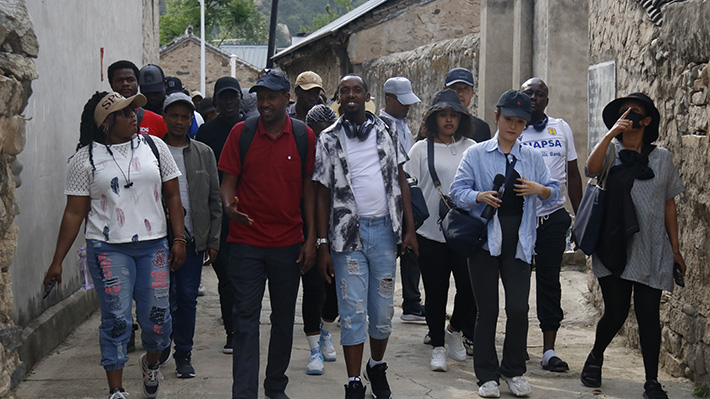
Students from China Agricultural University visit Yixian County, Hebei Province, in 2023 (COURTESY)
During my fieldwork in Lingyunce Township, Yixian County, Hebei Province, I saw firsthand how renewable energy had become an integral part of rural life rather than merely a government policy. As I walked through the village, I saw biogas pipes fixed securely along village walls, connecting kitchens to a centralised system that transforms livestock manure and crop residues into clean cooking fuel. These pipes represented more than energy infrastructure; they embodied years of coordinated planning and a long-term commitment to sustainable rural development.
The integration of renewable energy extended well beyond household cooking. On nearby farms, drones sprayed crops while mechanised irrigation systems improved agricultural efficiency. Small rural enterprises, including a handbag factory employing local residents, operated with a stable electricity supply, while well-maintained roads ensured smooth access to surrounding markets. Digital technology also played a role in village life, with WeChat enabling residents to share information and coordinate community affairs.
Integrated approach
The renewable energy system in Yixian is built around large-scale biogas facilities developed under the Hebei Rural Renewable Energy Development Project. Agricultural waste, particularly crop residues and livestock manure, is processed in anaerobic digesters to produce biogas for cooking, heating and, in some cases, electricity generation. By turning agricultural by-products into a reliable source of clean energy, the system reduces waste while meeting the daily energy needs of rural households.
Its success has been supported by strong institutional backing. Government subsidies, complemented by structured financing from the World Bank, helped to fund the construction of the facilities while also supporting ongoing technical assistance. Provincial and county project management offices coordinated implementation, established monitoring mechanisms, and enforced environmental and safety standards to minimise risks such as gas leakage and slurry overflow.
What stood out most during my field visits was the close integration of renewable energy with agricultural production. The digestate produced by the biogas system is returned to the fields as organic fertiliser, creating a circular system that recycles nutrients while reducing dependence on chemical fertilisers. Renewable energy in Yixian is therefore not simply a means of providing cleaner energy; it forms part of a broader model of integrated rural development that links environmental sustainability with agricultural productivity.
By comparison, Ghana’s renewable energy landscape has evolved along a different path. The country relies primarily on large-scale hydropower from the Akosombo and Bui dams, complemented by thermal power generation. Although solar energy has expanded through initiatives such as the Bui Solar Hybrid Project and mini-grid systems in northern Ghana, many rural households continue to depend on biomass and charcoal for cooking. The Renewable Energy Act, introduced in 2011 and amended in 2020, established mechanisms to promote feed-in tariffs, net metering and investment in renewable energy. However, implementation has been uneven, with financing constraints, grid instability and weak maintenance systems limiting long-term sustainability.
Unlike Lingyunce, Ghana has yet to systematically integrate agricultural waste, particularly from its cocoa-growing and livestock-producing regions, into large-scale biogas production. Similar challenges can be seen elsewhere in Africa. Tanzania and Kenya have piloted household biodigester programmes, but many have struggled to sustain technical support, routine maintenance and long-term monitoring.
The key difference lies in policy consistency and institutional capacity. In Yixian, renewable energy deployment is backed by sustained government support, closely monitored and fully integrated into county-level development planning. By contrast, many renewable energy initiatives in Ghana rely on donor funding or private-sector pilot programmes, often without strong district-level institutions to oversee implementation and long-term management. As a result, the integration of renewable energy with agricultural modernisation remains far less developed than Hebei’s circular model.
Knowledge exchange
There are significant opportunities for practical cooperation and knowledge exchange. Ghana could introduce clustered biogas digesters in livestock-intensive areas, such as the Upper East and Northern Regions, transforming animal waste into clean cooking fuel while producing organic fertiliser for local agriculture. Establishing district-level renewable energy management units, modelled on Hebei’s project management offices, could strengthen project oversight and accountability. Performance-based subsidies linked to maintenance compliance could also help to improve system reliability and reduce the risk of infrastructure failure.
Conversely, Lingyunce and similar Chinese townships could draw lessons from Ghana’s decentralised solar entrepreneurship. Ghana’s off-grid solar companies have demonstrated flexible and cost-effective approaches to delivering electricity to dispersed rural communities, offering useful insights for mountainous or sparsely populated areas. Likewise, community-managed mini-grids piloted in parts of Africa highlight the value of participatory governance and local ownership, which can complement China’s more centralised approach to renewable energy management.
My experience in Lingyunce reinforced the view that renewable energy infrastructure alone is not enough to ensure long-term success. Effective governance, sustainable financing, robust monitoring and close integration with agricultural development are equally important in determining whether renewable energy systems endure. Ghana’s renewable energy transition could therefore benefit from adapting, rather than replicating, Hebei’s institutional model, while Hebei could further strengthen its approach by incorporating elements of decentralised innovation and community participation demonstrated in parts of Africa.
The author is a Ghanaian student from China Agricultural University
| About Us | Contact Us | Advertise with Us | Subscribe |
| Copyright Beijing Review All rights reserved 京ICP备08005356号-5 京公网安备110102005860号 |


