| ChinAfrica |
| Science for Shared Development |
| Science popularisation is opening new channels for China-Africa cooperation, from health and agriculture to space technology and digital exchange |
| By Wang Heng, Shi Min and Zhu Bin’er | VOL. 18 September 2026 ·2026-08-26 |

Visitors experience VR devices at the L.I.S.T.E.N. Science Space in Gauteng, South Africa, on 21 November 2025 (GAUTENG DEPARTMENT OF EDUCATION)
In recent years, cooperation in science popularisation has expanded from basic science education to agriculture and food security, public health, ecological and climate protection, green energy and people-to-people exchanges. It has become an important means of advancing modernisation, promoting mutual learning between civilisations, strengthening friendship and enhancing scientific literacy.
The opening to the public last year of the L.I.S.T.E.N. Science Space, jointly established by the China Science and Technology Museum and Sci-Bono Discovery Centre in South Africa, represented a significant new step in this field.
The year 2026 marks the 70th anniversary of the establishment of diplomatic relations between China and African countries and the China-Africa Year of People-to-People Exchanges. As scientific and technological cooperation is an important part of these exchanges, science popularisation provides a particularly effective channel for bringing such cooperation closer to ordinary people.
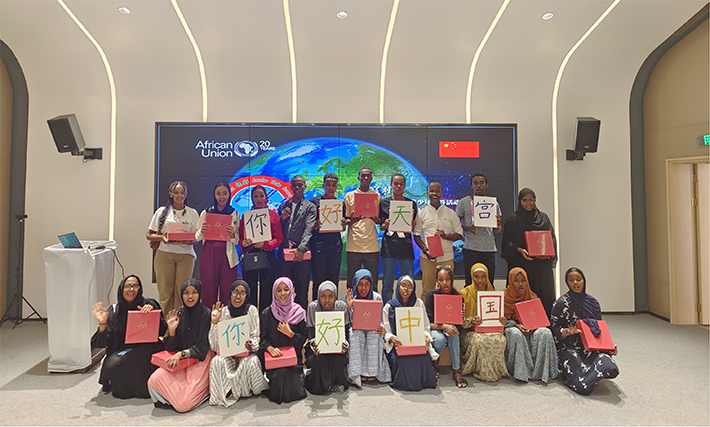
Participants of the “Talk with Taikonauts” event pose for a group photo in Djibouti on 6 September 2022 (CHINESE EMBASSY IN DJIBOUTI)
Improving lives
Public health has been one of the longest-standing and most people-centred areas of this cooperation. In 1963, China sent its first medical team to Algeria, beginning decades of medical assistance and health education across Africa. Beyond frontline services, China has established paired cooperation between 45 hospitals in 40 African countries, providing medical expertise and supporting the strengthening of local health care systems.
Today, a range of initiatives help communities acquire essential health knowledge and improve their well-being while enhancing the professional skills and service capacity of health care workers across the continent.
Agriculture has likewise been a cornerstone of China-Africa cooperation. In 1961, Chinese agricultural experts travelled to Mali, where they successfully introduced and cultivated tea and sugarcane, laying the foundations for decades of agricultural cooperation. Since then, such collaboration has become an important pillar of Africa’s food security and sustainable development. Hybrid rice developed by the team of Chinese agronomist Yuan Longping was later introduced in countries including Madagascar, significantly increasing yields while promoting knowledge of modern breeding techniques and efficient field management.
Cooperation has since expanded through institutional mechanisms, with China establishing partnerships with 23 African countries and regional organisations and signing 72 cooperation agreements. In 2026, activities including exchanges on practical technologies for tropical agriculture are bringing technical knowledge to grassroots communities through classroom instruction and hands-on training, further strengthening local capacity for sustainable agricultural development.
Space technology is another emerging area of China-Africa cooperation and science popularisation. China has launched communications and remote-sensing satellites for countries including Nigeria, Algeria and Ethiopia and signed memorandums of understanding on satellite-data applications with 13 African countries and regional organisations.
Building on these efforts, China has trained African engineers in satellite tracking, control and data analysis. Ethiopian aerospace engineers, for instance, received training in China and participated in the design and development of Ethiopia’s first microsatellite, ETRSS-1. The project marked a breakthrough “from zero to one” in China-Africa space cooperation while helping to inspire greater interest in space science and technology among young Africans.
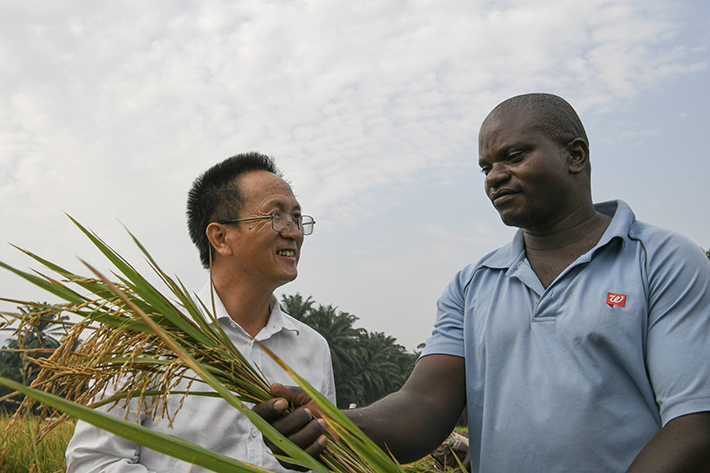
Yang Huade, head of a Chinese agricultural expert team, talks with a farmer in a rice field in Gihanga, Burundi, on 20 June 2023 (XINHUA)
New frontiers
As cooperation needs have diversified, China-Africa science popularisation has evolved beyond conventional knowledge sharing and technical assistance into a more multidimensional model. This includes bringing African professionals to China for in-depth training, taking technologies and expertise to Africa for practical demonstrations and using digital platforms to “meet in the cloud” and share knowledge and experience. These approaches have helped overcome traditional constraints of time and distance, turning science popularisation from one-way dissemination into a process of mutual learning and exchange.
“Bringing in” reflects a shift from technical training towards deeper participation in joint research. At a roundtable on science, technology, innovation and science popularisation education for developing countries held at Zhejiang Normal University, representatives from Kenya, Mauritius and other countries discussed national needs in science popularisation and think tank development with their Chinese counterparts, exploring new directions for international cooperation. The Chinese government also provides scholarships for African students to pursue master’s and doctoral degrees in science and engineering in China, enabling them to engage in advanced research and evolve from recipients of knowledge into contributors to scientific exploration.
“Going out” represents a further shift from one-way knowledge transfer towards mutual learning. Early cooperation focused largely on cultural displays and science education, including the translation of the Chinese science book One Hundred Thousand Whys into Swahili and touring exhibitions on ancient Chinese science and technology. Today, such exchanges increasingly emphasise dialogue between civilisations. Major people-to-people activities have become important platforms for cooperation, creating sustained channels for China-Africa friendship to grow through cultural and scientific exchange.
“Meeting in the cloud” has emerged as a new mode of cooperation in the digital era. The rapid development of digital technologies has created more efficient ways to connect China and Africa and share scientific knowledge. Particularly since the COVID-19 pandemic, online exchanges have provided a convenient bridge between scientific and medical communities. Digital platforms, with their high level of interactivity, are enabling China-Africa science popularisation to become more frequent and in-depth.
Ultimately, China-Africa science popularisation is about more than sharing knowledge and technology. It is a dialogue between civilisations and a bridge between peoples, putting the vision of a community with a shared future for mankind into practice.
As 2026 provides a new opportunity to deepen people-to-people exchanges, stronger cooperation in science popularisation can help translate the spirit of the China-Africa Year of People-to-People Exchanges into concrete action. A more equal, inclusive and sustainable model of cooperation will strengthen the people-to-people foundation of a high-level China-Africa community with a shared future and contribute to the steady, development of the China-Africa partnership.
Wang Heng, deputy Dean and PhD Supervisor;
Shi Min, PhD Candidate;
Zhu Bin’er, Master’s Student, Institute of African Studies, Zhejiang Normal University
|
||
| About Us | Contact Us | Advertise with Us | Subscribe |
| Copyright Beijing Review All rights reserved 京ICP备08005356号-5 京公网安备110102005860号 |


