| ChinAfrica |
| Opening the AI Gateway |
| China and Africa are forging new pathways for artificial intelligence, connecting technology with local needs, development and global cooperation |
| By Etienne Bankuwiha | VOL. 18 September 2026 ·2026-08-31 |
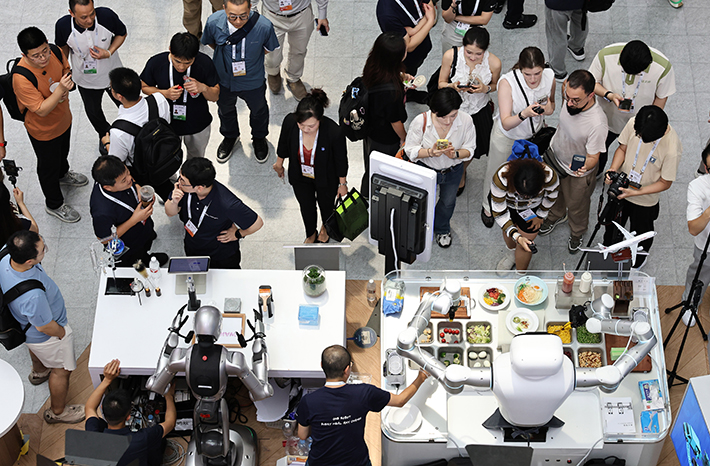
People watch robot skill demonstrations during the 2026 World AI Conference in Shanghai on 17 July (XINHUA)
At the 2026 World AI Conference (WAIC), China unveiled the latest version of its intelligent weather warning system, Mazu, named after the Chinese goddess of the sea. Mazu Djibouti 2.0 improves forecast resolution from 9 km to 3 km, giving local authorities a more precise picture of approaching weather risks. China also signed agreements with Côte d’Ivoire, Guinea and Cameroon to expand the system’s use across Africa.
For Gaspard Banyankimbona, commissioner for education, science, technology and innovation at the African Union (AU), the significance extends beyond weather forecasting. Speaking in Shanghai, he said China’s human-centred approach to AI resonates with the AU’s own vision of using technology to drive development while ensuring that its benefits reach people across the continent.
As African countries accelerate their digital transformation, cooperation with China is opening new possibilities, from weather forecasting and agriculture to language technologies and digital public services. The emerging partnership is also raising a bigger question: can AI become a tool for narrowing the development gap rather than widening it?
Rooted in local needs
Unlike high-cost, closed-source commercial models, whose subscription fees can be beyond the reach of many households in Sub-Saharan Africa, China is championing a more open and inclusive approach. President Xi Jinping emphasised at WAIC the importance of encouraging open-source collaboration and helping Global South countries bridge the digital divide.
Leading Chinese open-source models such as DeepSeek and Qwen are reaching African users through Chinese smartphones tailored to local markets, including Transsion brands such as Tecno, Infinix and Itel. Infrastructure providers such as Huawei Cloud offer bundled model-and-cloud services, helping to reduce deployment costs. Projects such as AI4D, led by the AU Development Agency, complement these accessible technologies, enabling local developers to turn open-source models into practical applications and productivity gains.
For AI to take root in Africa, technological cooperation must go hand in hand with respect for national sovereignty and local priorities. The AU Peace and Security Council has stressed the need to protect Africa’s digital and data sovereignty from “digital exploitation,” while highlighting the importance of developing technologies that reflect the continent’s linguistic diversity.
The AU’s Continental AI Strategy, adopted at its 45th Executive Council meeting in Accra, reflects this approach. Aligned with AU Agenda 2063 and the UN Sustainable Development Goals, the strategy places people and local needs at the centre of AI development. Countries including Mauritius, Egypt, Rwanda and Tunisia have already developed national AI strategies, while more than 10 others, including Ethiopia, Ghana, Kenya and Nigeria, have introduced AI guidelines.
Language is one area where the need for locally rooted technology is particularly clear. Initiatives supported by organisations like the Masakhane community and the University of Pretoria are developing local AI models, including Egypt’s Karnak and Nigeria’s Atlas, helping address the shortage of training data for more than 50 African languages. At the same time, AI is moving beyond the digital sphere to address everyday challenges. In agriculture, which employs 45-60 percent of Africa’s workforce, AI-powered tools are being used for applications such as crop and weather forecasting.
China’s cooperation with Africa is contributing to this practical approach. Its plan to deploy Mazu in 30 countries, together with cooperation with institutions such as the Ethiopian AI Institute, is helping translate AI capabilities into tools tailored to development needs on the ground.
A bigger say in AI
If AI is reshaping the world, the countries of the Global South need a voice in deciding how that future is governed. At WAIC 2026, China and its partners took a step in that direction by signing an agreement to establish the World Artificial Intelligence Cooperation Organisation, described as the world’s first independent intergovernmental organisation dedicated to AI, with its permanent headquarters in Shanghai. Ten of its 29 founding members are African countries, including Algeria, Cameroon, Ethiopia, Kenya and South Africa.
The move comes as African leaders push for a stronger role in shaping the continent’s AI future. Ethiopian Prime Minister Abiy Ahmed has advocated the use of AI in areas such as digital health, while calls for an “African AI Fund” reflect the need for greater investment in the continent’s technological capabilities.
China has also pledged practical support. President Xi Jinping announced that China would provide 5,000 AI-themed training opportunities for developing countries over the next five years and establish international AI application cooperation centres with partners including the AU.
For Banyankimbona, the next stage of China-Africa cooperation lies as much in developing people and knowledge as in advancing technology. Talent training, joint research and the use of AI to advance sustainable socio-economic development are expected to be central to the partnership. As China and Africa deepen their engagement, they are seeking not simply to participate in the AI revolution, but to have a greater say in shaping the rules by which it unfolds.
Associate Professor, School of Global and Area Studies, Guangdong University of Foreign Studies
|
||||||||||||
| About Us | Contact Us | Advertise with Us | Subscribe |
| Copyright Beijing Review All rights reserved 京ICP备08005356号-5 京公网安备110102005860号 |


