| ChinAfrica |
| A Partner for a Greener Future |
| From restoring deserts to expanding renewable energy, China’s ecological journey offers insights for countries seeking a more sustainable future |
| By Erik Solheim | VOL. 18 September 2026 ·2026-09-02 |
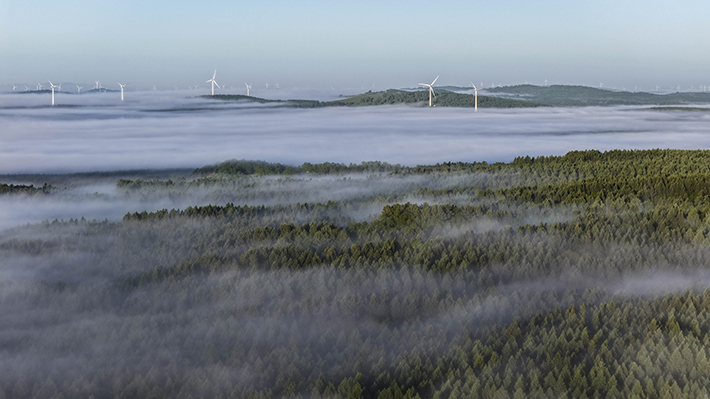
A view of Saihanba Forest Farm in Hebei Province on 23 May (XINHUA)
People often ask why I feel such a close connection to China. My answer is always the same: to engage with China is also to engage with the countries of the Global South, and therefore with the future of green development. When a nation devotes such sustained effort to the global ecological cause and achieves such remarkable results, anyone working in this field cannot and should not overlook such a powerful force for good.
When I arrived at the UN Environment Programme (UNEP), one thing immediately stood out: very few Chinese projects had received the Champions of the Earth Award, the organisation’s highest environmental honour. This was not because China lacked outstanding green achievements, but rather because of geographical and cultural biases in the international evaluation system at the time. Many jurors, sitting thousands of miles away, struggled to appreciate the profound ecological transformation taking place in China. I was nevertheless convinced that, had they visited in person, they would have found no shortage of outstanding models of sustainable development.
My own experience demonstrates this clearly. Since I first set foot on Chinese soil in 1984, I have travelled across more than half the country and made it a habit in every new city to go for a run so that I could experience the local environment firsthand. Over the past 15 years, I have witnessed continuous improvements in air quality, remarkable advances in water management and the steady expansion of urban green spaces. Today, the results of this ecological transformation are visible everywhere.
This momentum eventually received the international recognition it deserved. In 2017, UNEP awarded the Champions of the Earth Award to the builders of the Saihanba Forest Farm in Hebei Province. Their story continues to move me deeply. On land that had been on the verge of becoming desert, three generations of Chinese people, driven by unwavering determination over more than half a century, created one of the world’s largest man-made forests, covering more than 1 million mu (about 67,000 hectares).
It is not only a marvel of ecological engineering but also a remarkable testament to human determination working in harmony with nature’s regenerative power. Another compelling example is Zhejiang Province’s rural revitalisation programme. Having travelled through the province many times, I have witnessed how this ambitious effort has transformed countless villages.
In a relatively short period, China has achieved environmental governance goals that took many Western countries decades to reach, while significantly improving people’s quality of life. The speed and scale of this transformation are truly impressive, and the experience it offers provides valuable lessons for developing countries around the world.

People wait to board a BYD electric bus in Cape Town, South Africa, on 28 February 2024 (XINHUA)
From concept to reality
What, then, is the philosophy behind this transformation? I believe the answer lies in a comprehensive understanding and practical application of the principle that “lucid waters and lush mountains are invaluable assets.” Championed by Chinese President Xi Jinping, this vision rejects the notion that countries must choose between economic growth and ecological protection. Instead, it argues that these two goals can coexist and even reinforce one another until they become inseparable.
My repeated visits to the Kubuqi Desert in the Inner Mongolia Autonomous Region have allowed me to witness a fundamental shift. Local residents no longer see the desert as a fate to be endured but as a resource to be harnessed. Through the development of the photovoltaic industry, ecotourism and the cultivation of medicinal plants, the region has restored its ecosystem while creating jobs and raising local incomes.
More importantly, this approach to ecological development demonstrates a sophisticated understanding of public engagement. Technical and obscure language often fails to inspire enthusiasm for environmental protection. By contrast, expressions such as “lucid waters and lush mountains” and “a Beautiful China” are simple, memorable and compelling. They translate complex environmental concepts into language that ordinary people can relate to and are encouraged to embrace.
The success of China’s ecological transition has been driven by a distinctive combination of strong central planning and dynamic market mechanisms. Whether through its long-term goals for 2035 or its centenary goals for 2049, China has shown a remarkable ability to set long-term objectives and steadily advance them through successive five-year plans. This strategic consistency is one of the country’s distinctive institutional strengths.
China’s green development is now having an impact far beyond its borders. The close integration of new quality productive forces with sustainable development offers fresh hope for the world. On the one hand, emerging technologies such as AI are accelerating the green transition at an unprecedented pace. On the other, without an abundant and affordable supply of clean energy, it would be impossible to meet the enormous energy demands of the industries of the future. The two are fundamentally interconnected.

A zebra is seen next to a fence as a freight train runs on the Mombasa-Nairobi Railway track in Kenya on 28 July 2022 (XINHUA)
A shared future
What is particularly notable is China’s willingness to share the benefits of technological progress. By making its green technologies more widely available, it is helping other countries accelerate their energy transition at lower cost. This is reflected in the global availability of large AI models such as DeepSeek, BYD’s manufacturing presence in Brazil and CATL’s investments in Hungary. The more global public goods China provides, the greater the international confidence in a greener and more sustainable future.
It is no exaggeration to say that, without China, the global green transition would not stop, but it would almost certainly become far slower and more expensive. This is why I have consistently advocated “green trade,” an approach that goes beyond the exchange of goods to promote environmentally sustainable cooperation. This philosophy of win-win cooperation is also reflected in the Belt and Road Initiative. Travelling across the Kenyan savannah on the Mombasa-Nairobi Railway, it is not unusual to see elephants crossing safely through wildlife corridors built by Chinese engineers. Such practical measures have helped establish China as an important driver of global green governance.
Some people worry that relying on Chinese green technologies could reduce other countries’ autonomy. I take the opposite view. Using high-quality, affordable Chinese technologies and equipment to develop renewable energy systems can strengthen energy independence while supporting the growth of local industries and creating jobs.
We must recognise that addressing climate change, tackling the ecological crisis and eradicating poverty are shared global responsibilities. Achieving consensus requires more than technology and capital. It also calls for drawing on the wisdom of the world’s great civilisations. Living in harmony with nature has long been a core principle shared by many of them. In my view, China is not seeking only its own green transition. Rather, it aspires to work with the rest of the world to build a modern “green civilisation” founded on harmony between humanity and nature. I am convinced that the countries of the Global South can play a decisive role in this effort, bridging differences through dialogue among civilisations and strengthening cooperation on green development to build a greener and fairer future together.
*This article was first published in People’s Daily.
The author is Former Executive Director, UN Environment Programme
|
||||||||||||
| About Us | Contact Us | Advertise with Us | Subscribe |
| Copyright Beijing Review All rights reserved 京ICP备08005356号-5 京公网安备110102005860号 |


