| ChinAfrica |
| Taming Deserts Together |
| China and Africa can share experience and solutions in the fight against desertification |
| By Hu Fan | VOL. 18 September 2026 ·2026-09-02 |
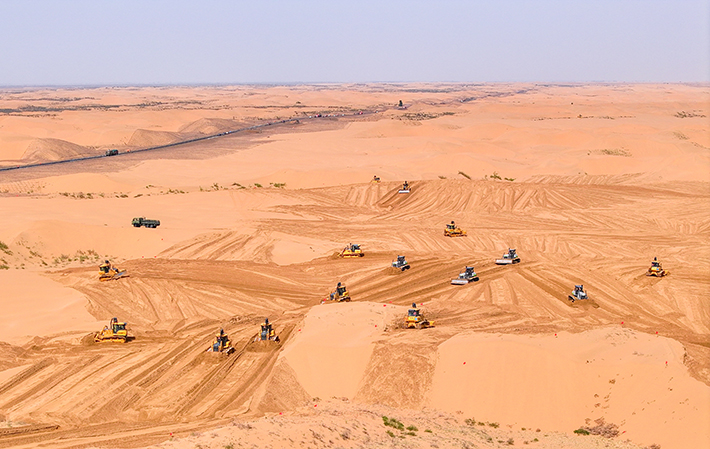
Construction machinery operates at a desertification control site in Ordos, Inner Mongolia Autonomous Region, on 20 May 2025 (XINHUA)
The opening of the 17th session of the Conference of the Parties (COP17) to the UN Convention to Combat Desertification (UNCCD) in Ulaanbaatar, Mongolia, on 17 August once again drew global attention to the daunting challenge of land degradation. Despite decades of international efforts, the problem remains severe, with vast areas of productive land continuing to deteriorate and millions of people facing growing threats to their livelihoods.
The host country itself is on the front line. According to the UNCCD, nearly 77 percent of Mongolia’s land is degraded. Mongolia has therefore placed land restoration, rangelands and pastoral livelihoods at the centre of its COP17 presidency. It has also launched a national “Billion Trees” campaign, with the goal of planting one billion trees by 2030.
The challenge extends far beyond Mongolia. Globally, about 1 million square km of healthy and productive land is degraded each year, while around 1.3 billion people are directly affected by land degradation. In Africa, the flagship Great Green Wall initiative has made progress, but its achievements still fall considerably short of its ambitious targets.
Against this backdrop, China has emerged as a country that has made significant progress in combating desertification and restoring degraded land. During the 14th Five-Year Plan period (2021–2025), China treated 10.1 million hectares of desertified land, while its annual net reduction in desertified land has exceeded 600,000 hectares, according to the National Forestry and Grassland Administration.
China has also played an active role in sharing its experience and supporting global efforts to combat desertification. This has become an important area of China-Africa cooperation. The FOCAC Beijing Action Plan (2025–2027), for example, explicitly calls for sharing China’s experience in integrated desertification prevention and control and providing continued technical support for the Great Green Wall.
What China has to share with Africa, however, goes far beyond techniques for planting trees. First and foremost is a long-term commitment to the issue. China’s experience shows that combating desertification is not a short-term campaign, but a sustained undertaking requiring consistent policies, scientific research, investment and local participation.
The Three-North Shelterbelt Forest Programme is perhaps the clearest example. Launched in 1978, the programme has continued through successive decades and is scheduled to run until around 2050. Its longevity demonstrates the importance of maintaining policy continuity and pursuing ecological restoration over generations, rather than judging results within the lifespan of individual projects.
China’s commitment to ecological protection has also continued to deepen at the institutional level. On 15 August, the landmark Ecological and Environmental Code came into force, becoming China’s second formal statutory code after the Civil Code and strengthening the legal foundation for ecological protection. Desertification prevention and control is among the areas addressed by the code.
China and Africa share a strong interest in combating land degradation. Both face the environmental and socio-economic consequences of desertification and recognise that restoring degraded land is not only about protecting ecosystems, but also about safeguarding food security, water resources and livelihoods.
This shared challenge creates considerable space for cooperation. China’s experience can offer useful lessons, technologies and approaches, while African countries bring their own ecological knowledge, local experience and innovative solutions. The objective should not be to replicate a single model, but to develop approaches suited to local conditions.
With COP17 bringing land restoration and drought resilience to the centre of the global agenda, it is time to revisit what China and Africa can learn from each other. From the Sahel to northern China, the fight against desertification is ultimately a shared endeavour: restoring the land, strengthening livelihoods and building a more resilient future together.
| About Us | Contact Us | Advertise with Us | Subscribe |
| Copyright Beijing Review All rights reserved 京ICP备08005356号-5 京公网安备110102005860号 |


