| ChinAfrica |
| Growing the Gobi |
| Advanced greenhouse technology and soilless cultivation are turning the desert into a fertile land for fruit and vegetable production |
| By GE LIJUN | VOL. 18 September 2026 ·2026-09-02 |
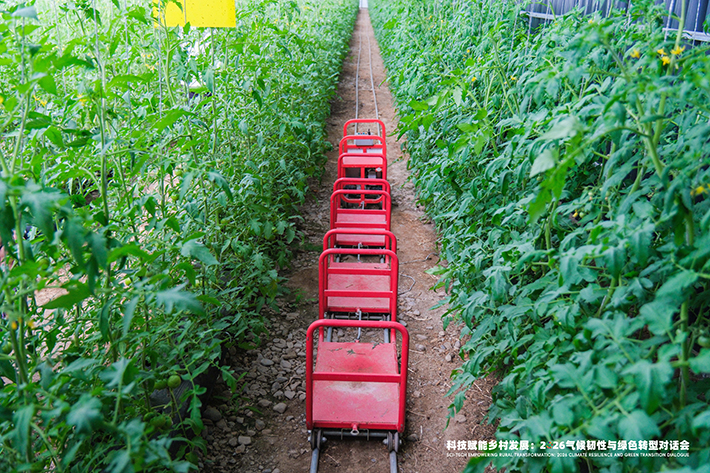
The small service trains installed in the greenhouses significantly improve production efficiency (CICG)
In summer, the horizon in Suzhou District, Jiuquan, Gansu Province seems almost surreal. As far as the eye can see, thousands of greenhouses sparkle beneath the blazing sun, standing in stark contrast to the barren Gobi terrain that was once defined by little more than rocks and relentless winds. Here, agriculture has not conquered the desert; it has found a way to coexist with it.
Li Junguo, a farmer from Dongdong Town, operates 24 solar greenhouses, each covering approximately 1.4 mu (0.09 hectares). At the height of the growing season, just four to five people are enough to run the operation. The rest of the work is handled by mechanised equipment and automated systems. Human labour is limited to precision work, including pruning, thinning and harvesting.
His greenhouses form part of the Suzhou Gobi Desert Agricultural Demonstration Base. Planned in 2017 and built from 2018, the site now comprises nearly 3,000 modern greenhouses covering a total built-up area of 17,300 mu (1,153 hectares). The base also serves as the core of the Jiuquan Sino-Israeli Eco-Industrial Park, established by Gansu Province to develop an integrated agricultural industry encompassing intensive horticulture, irrigation technology and agri-food processing.
Together, the demonstration base and industrial park have transformed local agriculture. Once regarded as an inhospitable frontier, the Gobi is steadily being turned into productive farmland through technological innovation, demonstrating how advances in agricultural science can overcome some of the harshest natural conditions.
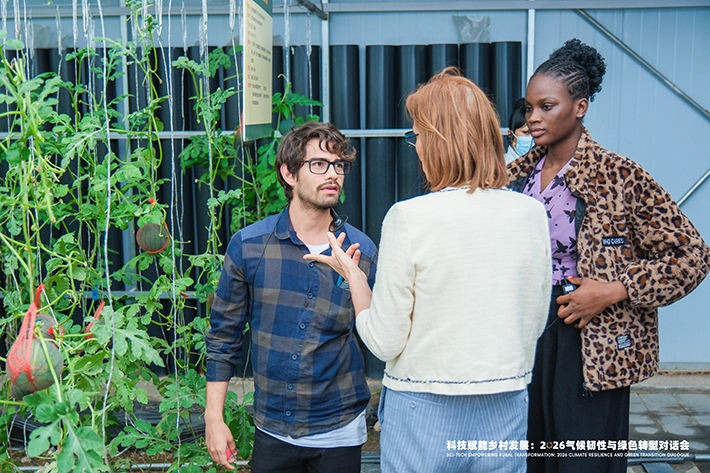
Foreign experts tour the Suzhou Gobi Desert Agricultural Demonstration Base in Jiuquan, Gansu Province, on 6 June (CICG)
Smart greenhouses
At first glance, nothing suggests that this vast expanse of the Gobi Desert could become farmland. There is virtually no arable soil here. The goal, therefore, is to use this non-arable land to grow fruit and vegetables while preserving fertile farmland for grain production, helping safeguard the country’s food security.
Inside one of Li’s greenhouses, rows of green tomatoes thrive in a fully controlled environment. Water, a scarce resource in this arid region, is used with remarkable efficiency. The greenhouses combine drip irrigation beneath plastic mulch, micro-sprinklers and fertigation, reducing water consumption by more than 35 percent compared with traditional open-field cultivation while producing higher-value crops.
Reducing water consumption is only one aspect of the technological innovation underpinning Gobi agriculture. According to Zhang Guosen, a researcher at the Institute of Bioengineering at Jiuquan Vocational Technical University, the transformation has been driven in large part by a research centre dedicated to Gobi agriculture, bringing together researchers from national and provincial institutions and Israeli experts. Together, they have developed several greenhouse designs, standardised organic growing substrates and established technical protocols covering fertilisation, pollination, pest and disease management, and precise irrigation.
Soilless cultivation is among the most significant innovations. In the absence of arable land, fruits and vegetables are grown on specially formulated substrates made from agricultural waste, including straw, mushroom residues and cattle manure, all processed in local factories. “This allows us to make use of agricultural waste while providing crops with a perfectly suited growing medium,” Jia Qi, deputy director of the Vegetable Research Institute at the Jiuquan Academy of Agricultural Sciences, told ChinAfrica.
Jia demonstrated the digital greenhouse management platform. Using a computer or smartphone, farmers can remotely monitor and control every aspect of greenhouse operations, from opening and closing insulating covers to adjusting temperature, humidity and light levels.
The impact on farmers’ incomes has been striking. Previously, most local residents grew seed maize, earning just over 3,000 yuan ($442) per mu (0.067 hectares) each year. Today, the greenhouses produce fruits and vegetables, typically with two harvests annually. Each greenhouse generates a gross income of between 60,000 and 80,000 yuan ($8,848-11,798), a dramatic increase in returns.
Li has since joined a cooperative. “Everyone contributes what they’re good at, whether farming skills or labour. Major retailers now require green-certified produce, and marketing collectively is more credible and more stable. After costs are deducted, members receive tens of thousands of yuan in dividends every year,” he told ChinAfrica.
Keen to push innovation further, the base inaugurated three pilot greenhouses last year, equipped with its most advanced technologies. Designed to withstand Gansu’s strong winds and harsh winters, they feature an innovative structure that keeps interior temperatures at 5-8 degrees Celsius, higher in winter without requiring heating. The greenhouses are also testing multi-layer cultivation techniques that improve water and nutrient retention.
Each of the three pilot greenhouses received a public grant of around 60,000 yuan ($8,848) to encourage the adoption of these new technologies. “Our teams provide free technical support to all operators, including agricultural enterprises, cooperatives and individual farmers, so that everyone can benefit from the latest innovations,” Zhang told ChinAfrica. Today, around 16,500 people work in this agricultural sector, with its economic benefits now reaching villages across the region.
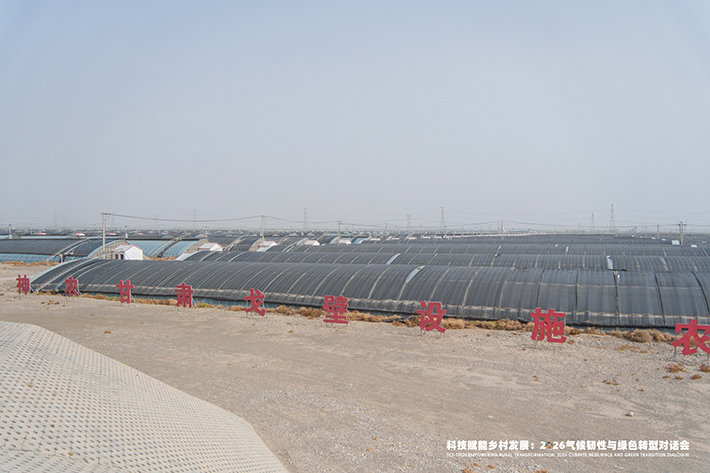
The Suzhou Gobi Desert Agricultural Demonstration Base in Jiuquan, Gansu Province, on 6 June (CICG)
From the Gobi to national markets
Jiuquan is widely regarded as the birthplace of Gobi agriculture in China. In Suzhou District, the focus has gone beyond experimentation to building a complete agricultural industry. Annual production now reaches around 35,000 tonnes of fruits and vegetables, which are distributed across the country.
Launched in 2018, the Sino-Israeli Eco-Industrial Park in Jiuquan is central to this development. It brings together 46 companies and cooperatives, encompasses 4,140 standardised greenhouses, and integrates the entire value chain - from seedling production to sorting, processing, storage and cold-chain logistics.
The main crops include cucumbers, courgettes, peppers, runner beans and watermelons. Premium varieties are supplied to major retail chains in China’s largest cities. Production is highly standardised to ensure consistent quality, stable volumes and coordinated harvest schedules.
The complex also strengthens market access through 23 corporate brands under the Ganwei (Flavours of Gansu) label, alongside 21 certified product brands. End-to-end traceability is ensured through the digitalisation of production and distribution, while refrigerated logistics enable fresh fruits and vegetables to reach major Chinese cities in less than 48 hours.
Reflecting on the project’s early days, Zhang recalled how far it has come. “At the beginning, we built the first greenhouses by hand, using stones collected on site. Today, we have a modern agricultural park covering several thousand hectares. The journey from rudimentary greenhouses to standardised facilities perfectly illustrates the development of Gobi agriculture in Suzhou,” he told ChinAfrica.
The project continues to expand. Local authorities aim to establish Suzhou as a leading national hub for fruit and vegetable production in arid environments and a gateway for exports to Central Asia and beyond. Once synonymous with barrenness, the Gobi is steadily being reshaped into a strategic agricultural region, demonstrating how innovation is reshaping agriculture in some of China’s most challenging landscapes.
| About Us | Contact Us | Advertise with Us | Subscribe |
| Copyright Beijing Review All rights reserved 京ICP备08005356号-5 京公网安备110102005860号 |


