| ChinAfrica |
| Healing Without Borders |
| Chinese surgeons and TCM specialists are helping Rwandan hospitals build lasting expertise |
| By Jean d’Amour Mbonyinshuti | VOL. 18 September 2026 ·2026-09-07 |
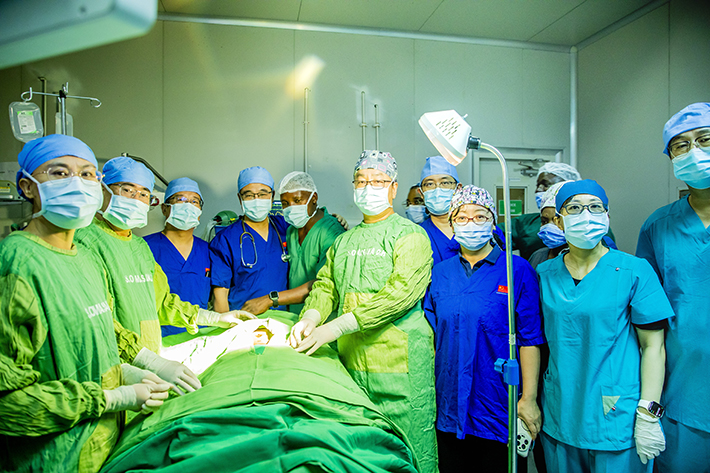
Chinese and Rwandan medical workers perform a laparoscopic minimally invasive surgery at Masaka District Hospital in July (KELLYA RAISSA KEZA)
When Jean-Damascene Hitimana first noticed his eyelid beginning to droop, he worried that he might eventually lose his sight. Doctors diagnosed him with a neuromuscular disorder and prescribed medication, but despite months of treatment, little changed.
“I noticed something was wrong with my eyelid. I tried conventional treatment, but there was little improvement,” the 43-year-old recalled.
Hitimana continued working at a Chinese construction site while living with the condition. It was there that an unexpected opportunity emerged. “When my boss saw that I was not getting better, he brought me here,” he said, referring to the Traditional Chinese Medicine (TCM) clinic at Masaka District Hospital.
Chinese doctors recommended 10 acupuncture sessions, twice a week. Unfamiliar with the treatment, he decided to trust the specialists. “At first, I wasn’t sure it would work, but I decided to try,” he said. The results surprised him. “After five sessions, the eyelid began to improve, and it eventually recovered.”
For Hitimana, the treatment restored more than normal movement in his eyelid. It renewed his confidence after conventional treatment had failed to provide relief. His story is one of thousands unfolding at Masaka District Hospital and Kibungo Hospital, where Chinese doctors are introducing new techniques, sharing knowledge with Rwandan professionals and strengthening a China-Rwanda partnership that spans more than four decades.
Traditional medicine, modern hospitals
Each morning, patients start arriving at the TCM clinics inside Masaka and Kibungo hospitals. Some limp in with chronic back pain, while others struggle with facial paralysis, stroke complications or joint disorders. Many have already tried conventional treatment without success. Inside the consultation rooms, acupuncture needles, cupping therapy equipment and rehabilitation tools sit alongside conventional medical equipment, a reflection of two medical traditions working together.
Rather than relying primarily on pharmaceuticals, Chinese specialists combine acupuncture, cupping therapy, gua sha, tuina (Chinese therapeutic massage) and rehabilitation exercises to promote the body’s natural healing. Nirite, leader of the TCM team in Rwanda, said the clinics have grown busier as more patients learn about the services. “In Masaka District Hospital, the clinic receives about 116 patients per day,” he said, noting that stroke complications and musculoskeletal disorders are among the most common conditions treated.
TCM, he explained, is designed to complement rather than replace conventional health care. “We can reduce drug use. Many patients normally use painkillers, but acupuncture and massage can help manage symptoms,” Nirite said. “We also prescribe exercises that help patients recover. Some symptoms do not respond well to medicine, but acupuncture can help relieve them.”
TCM is only one part of the Chinese medical team’s contribution. The 19-member team works across eight specialties, including general surgery, orthopaedics, internal medicine, obstetrics and gynaecology, dentistry, anaesthesiology and nursing. Earlier this year, Chinese obstetricians collaborated with Rwandan midwives to help women deliver safely using acupuncture alongside modern obstetric care, reducing labour pain without relying solely on medication.
According to Han Hongyang, head of the Chinese medical team, patient recovery remains the team’s greatest source of motivation. “Many patients arrive using a walking stick, but after treatment they can walk on their own,” he said.
Building local capacity
Beyond treating patients, the Chinese medical team is helping Rwanda strengthen its own health care system. In July, Chinese surgeons performed the first laparoscopic hernia repair at Masaka District Hospital, introducing a minimally invasive procedure that uses small incisions instead of conventional open surgery. The operation, led by Fan Guidong and Yin Tao alongside Rwandan colleagues, marked an important milestone for the district hospital.
Jean-Aristide Ufitinema, clinical director at Masaka District Hospital, said laparoscopic surgery has traditionally been concentrated at referral hospitals because many district hospitals lack specialised equipment and expertise. “Before, when we had many surgical cases, one option was to transfer patients to hospitals like the University Teaching Hospital of Kigali. But now that the Chinese medical team is here, many of those cases can be handled at Masaka,” he said, adding that keeping patients closer to home reduces waiting times and improves outcomes. “The difference between performing surgery with the equipment and without it is significant. Laparoscopic surgery takes less time, requires smaller incisions and reduces the risks associated with the operation.”
The collaboration extends beyond the operating theatre. Chinese specialists are training Rwandan surgeons to perform laparoscopic procedures independently, while TCM experts are teaching local health care workers acupuncture and rehabilitation techniques. For hospital leaders, this transfer of knowledge may prove the partnership’s most enduring legacy.
Medical cooperation has long been a pillar of Rwanda-China relations. According to Gao Wenqi, Chinese ambassador to Rwanda, the partnership began in 1982 and has continued uninterrupted since. “For more than four decades, China and Rwanda have maintained a close partnership in health care,” Gao said. Over that period, China has dispatched 26 medical teams comprising 343 health care professionals to Rwanda, treating more than 720,000 patients, performing over 40,000 surgeries and helping save more than 16,400 critically ill patients. “Our cooperation, however, is measured not only in years but also in lives touched,” the ambassador said.
As Han put it, “There are borders between countries, but there is no border for medicine. Our dream is to improve the health of ordinary Rwandan people. Health means happiness, and it is the foundation of a strong country.”
Every acupuncture session that relieves pain, every surgery performed closer to home and every Rwandan doctor trained by Chinese specialists strengthens not only the health care system but also the friendship between the countries.
For patients like Hitimana, it is a partnership measured not by official statistics, but by restored health, renewed hope and transformed lives.
| About Us | Contact Us | Advertise with Us | Subscribe |
| Copyright Beijing Review All rights reserved 京ICP备08005356号-5 京公网安备110102005860号 |


