| ChinAfrica |
| Furnace, Factory, Future |
| New assembly lines are becoming China’s unlikeliest tourist draws |
| By Lu Yan | VOL. 18 September 2026 ·2026-09-07 |
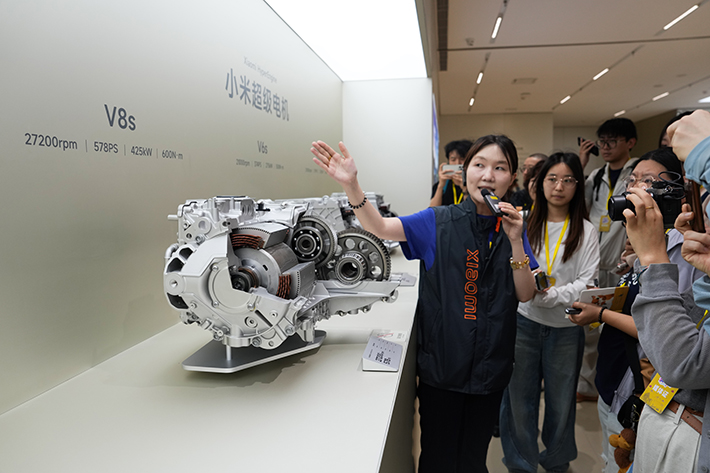
Visitors learn about the HyperEngine produced by Chinese tech giant Xiaomi at the company’s automobile factory in Beijing on 16 June 2025 (XINHUA)
Inside the workshop, giant robotic arms swing back and forth, the 9,100-tonne casting press rumbles like thunder and automated trolleys weave through the aisles. This is not the film set of a sci-fi blockbuster; it’s a typical weekend scene at a car factory of Chinese tech giant Xiaomi in Beijing. The once forbidding industrial site, ringed by high walls and emblazoned with “No Admittance” warnings, has emerged as a cultural landmark where tickets might be harder to come by than concert passes.
Covering 718,000 square metres, the mega-factory has seen its popularity soar since opening to visitors in November 2024. As of early July, it had received 250,000 visitors in total. In addition to production line tours, attractions such as go-kart tracks and science lectures have also proven highly popular as factory tours become a new choice for family outings.
“Through industrial tourism, science education programmes and other initiatives, we hope to bring more people into our factory, give them a closer look at manufacturing and let them experience firsthand the vitality of China’s auto industry as it innovates and grows,” Ma Lan, who is in charge of public tours and visitor engagement at Xiaomi’s auto plant, told People’s Daily.
Xiaomi is just one example of a broader boom: Industrial tourism is taking off across China. From appliance factories to breweries and heavy machinery workshops, manufacturers are opening their doors to the public. Once off-limits industrial zones are being reborn as theme parks, science museums and family destinations. Behind the shift are three forces: rising consumer curiosity, corporate branding strategies and a state-level push to recast the “Made in China” label as a source of innovation, quality and national pride.
Policy incentives
The rise of factory tours is the result of a convergence of policy incentives, shifting consumer behaviour and corporate transformation.
On the policy front, Beijing has been steadily pushing for the deeper integration of industrial culture and heritage with tourism and cultural development. In May, the Ministry of Culture and Tourism, together with six other government departments, issued a notice encouraging enterprises in the aerospace, shipbuilding, automotive and robotics sectors to develop themed visitor factories.
The notice encourages enterprises in equipment manufacturing, consumer goods and e-commerce logistics to innovate with projects such as production process observation, simulated operations, hands-on experiences and product customisation, building themed visitor factories.
It supports the use of digital technologies and devices, including the BeiDou Navigation Satellite System, AI, ultra-high-definition video, virtual reality and autonomous driving, to create immersive and intelligent industrial tourism experiences.
The release of this notice aligns with the Outline of the 15th Five-Year Plan (2026-2030) for National Economic and Social Development of China, which states that “we will develop red tourism, rural tourism, health tourism and industrial tourism according to local conditions.”
Industrial tourism is not merely about observing production processes. Its core value lies in linking the public with brands and technology, allowing visitors to gain a more direct understanding of the development level and technological progress of China’s manufacturing sector, Jiang Yiyi, dean of the School of Leisure Sports and Tourism at Beijing Sport University, told Global Times.
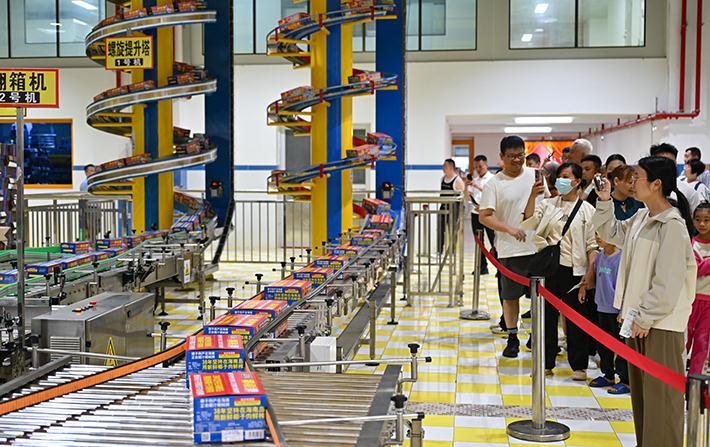
Visitors tour the Coconut Palm Group factory in Haikou, Hainan Province, on 27 February (XINHUA)
Diverse experience
Arctic Ocean and Yili are two brands familiar to generations of Beijingers. One is a beloved soda brand founded in 1936; the other a bakery and confectionery brand dating back to 1906. Today, the two time-honoured brands operate under one roof at the Arctic Ocean-Yili industrial park in Beijing, which has become one of the city’s most popular industrial tourism destinations.
Along its elevated glass-walled walkways, visitors can watch the entire bread-baking and soda-bottling process unfold in real time. Within the 2,000-square-metre DIY zone, parents and children knead dough and bottle soda together, laughing as they get their hands messy.
The park also recreates nostalgic scenes from the 1980s, including a Yili retail store, a warehouse, a brewery and a retro arcade. Sculptures of a giant polar bear, Arctic Ocean’s mascot and a soda-can-shaped slide have become social-media magnets, drawing endless lines of visitors snapping photos.
In the southern city of Liuzhou, Guangxi Zhuang Autonomous Region, another food factory is drawing crowds for a very different reason. The Luobawang industrial park, home to the city’s iconic luosifen, a pungent, savoury rice noodle soup that has become a nationwide sensation, runs fully automated production lines. Ingredients are measured, pretreated, sterilised and packaged in a seamless, high-speed process, with bags of instant luosifen rolling off the line non-stop.
After the tour, visitors head to a self-service cooking area, where they pick their own ingredients, mix their own seasonings and boil their own noodles. When a steaming bowl of luosifen is finally placed on the table, many diners dig in with gusto, slurping loudly and giving it a thumbs-up: “Tastes amazing!”
“We decided to open our factory to the public in 2021,” recalled Yao Hanlin, chairman of Guangxi Luobawang Brand Management Co. Ltd. At the time, the luosifen industry was plagued by widespread public concern over hygiene and food safety, posing a major hurdle to growth. “Against that backdrop, we thought: Why not let consumers see for themselves? We wanted them to walk through our lab and watch the capsaicin testing, the X-ray foreign object inspection and the full-scale disinfection processes in our workshops. We believed that transparency was the best way to put concerns to rest.”
Song Shuang, deputy director of the Consumer Economy Research Centre at CCID, a research institution under the Ministry of Industry and Information Technology, said that advanced technologies have turned factories into visually compelling spaces, adding that this new “visual appeal” and “openness” driven by industrial upgrading have laid the essential groundwork for the rise of industrial tourism.
|
||||||||||||
| About Us | Contact Us | Advertise with Us | Subscribe |
| Copyright Beijing Review All rights reserved 京ICP备08005356号-5 京公网安备110102005860号 |


