| ChinAfrica |
| Technology Takes on Typhoons |
| Drones, AI and digital platforms are transforming disaster monitoring, early warning and emergency response |
| By GE LIJUN | VOL. 18 September 2026 ·2026-09-07 |
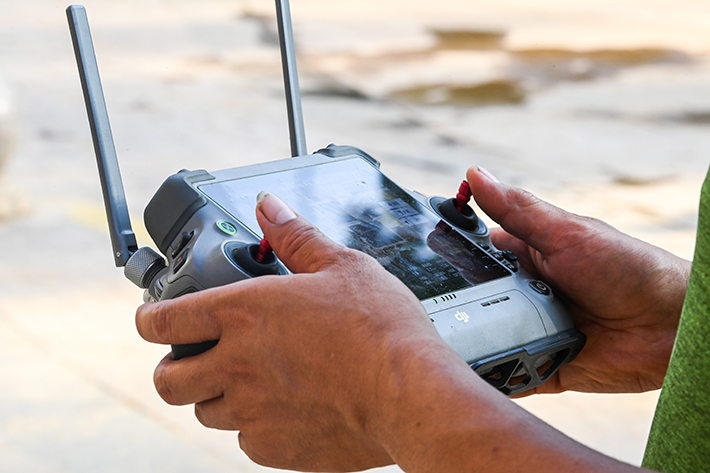
A rescue worker operates a drone to deliver supplies in Guigang, Guangxi Zhuang Autonomous Region, on 10 July, after Typhoon Maysak caused significant damage across the region (XINHUA)
Typhoons are among the major natural disasters threatening China. In recent years, regions vulnerable to these extreme weather events have increasingly turned to drones, AI and digital platforms to modernise their prevention and response systems. The traditional model, relying on human intervention, direct observation and telephone calls, is gradually giving way to an intelligent system that combines real-time monitoring, data analysis and coordinated response.
Drones now play a vital role in typhoon preparedness and response. At the fishing port in Daishan District, Zhoushan, Zhejiang Province, drones equipped with high-definition cameras and loudspeakers patrol the skies, monitoring people who remain at the port and checking whether vessels are securely moored. More than 400 boats are now monitored through a combination of aerial surveillance and ground inspections.
At the Xixian Dam in Hangzhou, Zhejiang Province, which protects the Hangjiahu Plain, an intelligent air-ground surveillance system has also been deployed. Drones equipped with infrared thermal cameras use AI to automatically detect potential hazards such as water seepage and landslides. The information is relayed in real time to ground teams, enabling a rapid response.
When disasters disrupt power and communication networks, hybrid-wing drones can quickly establish temporary airborne communication stations and relay real-time images from affected areas, allowing emergency operations to continue without interruption.
Beyond field equipment, integrated digital platforms serve as the “brains” of modern operations. In Zibo, Shandong Province, a monitoring network that combines meteorological and hydrological data with ground imagery allows authorities to track risk developments.
The integration of human expertise and smart technologies is enhancing disaster prevention and mitigation capabilities. At the meteorology conference held in Shanghai as part of the 2026 World Artificial Intelligence Conference, China’s Mazu weather warning programme was officially launched, bringing several key technologies into operation. It represents the world’s first national initiative developed in response to the UN’s call for early warning systems that are accessible to all.
When technological innovation is closely aligned with real-world needs, it becomes a powerful tool for safeguarding communities and enhancing urban resilience against natural disasters.
| About Us | Contact Us | Advertise with Us | Subscribe |
| Copyright Beijing Review All rights reserved 京ICP备08005356号-5 京公网安备110102005860号 |


