| ChinAfrica |
| Reading One Another |
| Publishing can become a powerful new bridge between China and Africa, connecting readers, writers and ideas while deepening people-to-people understanding |
| By Elias Wondimu | VOL. 18 September 2026 ·2026-09-07 |
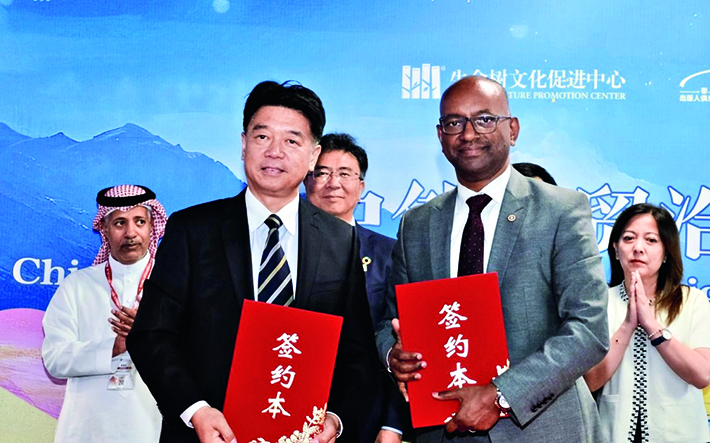
Elias Wondimu (right) and Li Shuangwu, president of Contemporary World Press, at a rights-signing ceremony during the 2025 Beijing International Book Fair (COURTESY)
For decades, the story of China-Africa cooperation has largely been told through infrastructure - roads, railways, ports, industrial parks, trade and investment. These connections have transformed economies and brought millions of people and businesses closer together.
But I believe the next frontier will be different. It will be knowledge.
In August 2026, publishers and cultural institutions from China and Africa will gather in Jinan, Shandong Province, for the launch of the China-Africa Publishing Association. Its founding, as part of the China-Africa Year of People-to-People Exchanges, marks an important effort to give our two publishing industries a more permanent framework for cooperation.
As one of its co-founders, I see its potential extending far beyond the exchange of books. Publishing can become one of the most powerful ways for China and Africa to understand one another - and to allow each to see the other beyond headlines and stereotypes.
I have spent almost three decades in publishing, much of that time away from my native Ethiopia. For many years, I lived in exile while building TSEHAI Publishers, working to keep African knowledge connected to its source. Books became a bridge between distance and home.
When I eventually returned to Ethiopia, I came back with a deeper conviction: knowledge must circulate. It must travel outward, and it must also find its way home.
That experience taught me that publishing is not simply an industry that produces books. It is knowledge infrastructure. A healthy knowledge society needs authors, translators, editors, designers, printers, literary agents, booksellers, libraries, universities and, above all, readers. If any link in that chain is missing, ideas struggle to travel.
For Africa, this is particularly important. The continent is home to more than 1.5 billion people and the world’s youngest population, while its economy is approaching $3 trillion. Yet Africa’s greatest resource may be one that is difficult to measure: the knowledge contained in its civilisations, languages, oral traditions, literature and lived experience.
The challenge is to ensure that this knowledge does not remain confined by national or linguistic borders, but becomes part of the world’s wider intellectual conversation.
China’s vast readership
On my visits to China, I have been struck by the breadth of literature and scholarship from Europe and elsewhere that is available in Chinese. Walk into a major Chinese bookshop and you can find generations of world literature, philosophy, history and science presented to Chinese readers in their own language.
This did not happen by accident. China invested in translation because access to the intellectual production of other societies was regarded as an important part of national development. There is a lesson here for Africa.
There is also another side to this story. Despite the growing China-Africa relationship, African literature, scholarship and contemporary thought remain relatively underrepresented in Chinese translation.
I see it as an enormous opportunity.
China has a vast potential readership. Africa has thousands of writers, scholars and thinkers whose work could deepen Chinese understanding of the continent. The task now is to build the mechanisms that allow those books and ideas to travel.
For TSEHAI, that journey has already begun.
Through our newly established literary agency, the first Ethiopian title that we presented has been acquired for publication in China and is expected to appear in the coming months.
In the vast world of international publishing, one book can seem insignificant. But every bridge begins with a single crossing.
Imagine that one Ethiopian title becoming 10, then 100 - Nigerian novels, Kenyan children’s books, Senegalese history, South African scholarship, Ghanaian philosophy, Ethiopian literature, Egyptian thought and Tanzanian memoirs, all finding Chinese readers.
Then imagine the traffic moving in the other direction, with African readers gaining much greater access to Chinese literature, science, philosophy and contemporary intellectual life.
That is what genuine cultural exchange should look like: not one culture exporting itself to another, but a reciprocal exchange in which both sides have something to give and something to discover.
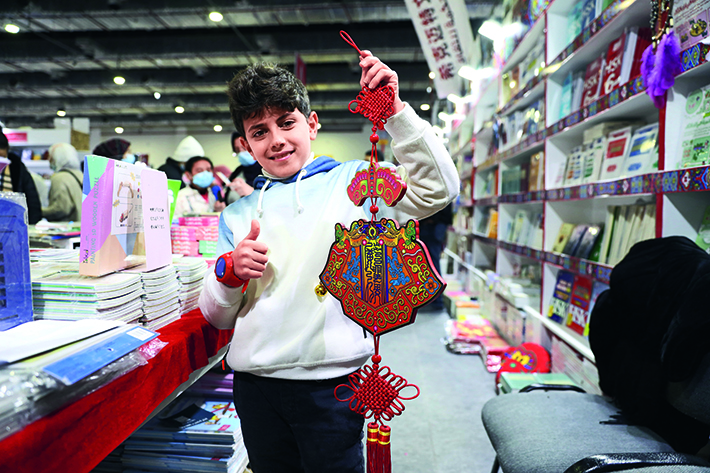
A boy shows a Chinese New Year decoration at the pavilion for translated Chinese books at the 53rd Cairo International Book Fair in Cairo, Egypt, on 4 February 2022 (XINHUA)
Let Africans introduce Africa
Perhaps publishing’s most important contribution to China-Africa relations is its ability to help people encounter one another beyond the headlines.
China’s understanding of Africa should not rest primarily on news reports or books about Africa written elsewhere. Chinese readers should hear directly from African writers: African historians, African novelists and African scholars writing on different aspects of African societies.
Africa is not a single story. It is 54 countries, thousands of languages and communities, ancient civilisations and modern cities. It is a continent of extraordinary creativity, alongside very real challenges.
We Africans, too, want to understand China - its ancient civilisation, literature and philosophy, as well as the extraordinary transformation it has undergone in recent decades.
But mutual learning must travel in both directions. We want Chinese readers to know our struggles, our achievements, our humour and our hopes. Publishing creates the space for that encounter to take place with greater depth and nuance.
A book can take a reader somewhere a news report rarely can. It can place them inside another person’s memory, imagination and experience. That is the kind of understanding that people-to-people exchange should seek.
From book deals to an ecosystem
For the China-Africa Publishing Association to fulfil its potential, it must do more than facilitate individual copyright deals. It needs to help build an ecosystem.
That means systematic translation programmes between Chinese and African languages; stronger rights marketplaces that connect publishers directly; fellowships allowing editors, translators and literary agents to work within one another’s institutions; co-publishing arrangements that keep books affordable in African markets; and distribution systems that ensure translated books actually reach readers.
Relationships between civilisations are ultimately built by people. An agreement can begin cooperation, but trust develops when editors know editors, translators know translators, and authors begin to imagine readers beyond their own borders.
The association can provide a platform for those relationships to grow.
Technology, particularly artificial intelligence, offers another opening.
AI can help overcome some of the traditional barriers to multilingual publishing by assisting with translation, metadata, digitisation and discoverability. This could be especially significant for African languages that have long been underserved by digital technologies.
But technology should strengthen human creativity, not replace it.
Authors, translators, editors and publishers must remain central to the process. Copyright, attribution and fair compensation must not become afterthoughts simply because reproduction has become easier.
Bringing Africa’s books to the world
For much of the modern publishing era, Africa’s challenge has been gaining access to books produced elsewhere. That challenge remains.
But another equally important challenge is emerging: Africa must not only bring the world’s books home; it must also bring Africa’s books to the world.
China can become one of the most important partners in making this happen. In turn, China can encounter Africa not simply as a market, an investment destination or a geopolitical region, but as a vast intellectual and cultural world.
That is why the China-Africa Publishing Association matters.
Its success should not be measured only by the number of agreements signed or publishing rights exchanged. We should ask different questions.
How many new African authors reached Chinese readers? How many Chinese authors reached African readers? How many translators were trained? How many African languages entered new digital environments? How many partnerships survived beyond a single project?
And, most importantly, how much better did our people come to understand one another?
If, 10 or 20 years from now, we can answer those questions positively, the association will have accomplished something far greater than moving books across borders. It will have helped build an intellectual bridge between two enormous parts of humanity.
We are not simply creating a mechanism to move books between two markets. We are creating an opportunity for two great civilisations to read one another - to discover each other’s histories, ideas, creativity and aspirations.
That may prove to be one of the most enduring forms of China-Africa cooperation yet.
The author is founder of TSEHAI Publishers
|
||||||
| About Us | Contact Us | Advertise with Us | Subscribe |
| Copyright Beijing Review All rights reserved 京ICP备08005356号-5 京公网安备110102005860号 |


