| ChinAfrica |
| Technology Powers Trade |
| Exploring Tianjin’s smart port, technological innovation and rich cultural heritage on a four-day journey |
| By Getahun Assefa | VOL. 18 September 2026 ·2026-09-07 |
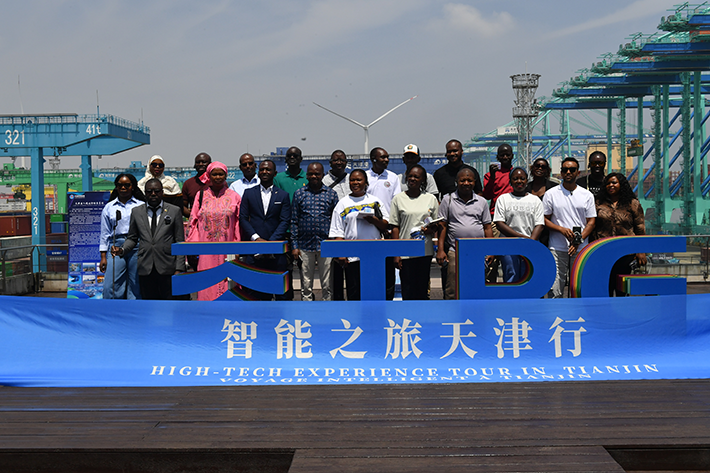
African journalists pose for a group photo at Tianjin Port in May (COURTESY)
During a recent visit to Tianjin, I experienced the city for the first time. Over four days, I explored its historic streets and cultural landmarks, visited technology and innovation centres, and saw how the city is combining its industrial heritage with new technologies.
Every stop offered a memorable experience. Yet my visit to Tianjin Port left the strongest impression, offering a fascinating glimpse into the future of modern logistics.
A gateway for global trade
The first thing that struck me at Tianjin Port was not the size of the ships or the mountains of containers. It was the movement.
Standing at the Smart Zero-Carbon Terminal, I watched containers being transported across the vast expanse of the port by autonomous vehicles. Cranes lifted and moved cargo with remarkable precision. There was no visible bustle, no crowds of workers rushing between containers, and remarkably little of the noise and commotion I had expected from one of the world’s busiest ports.
Instead, everything seemed to move according to an invisible choreography.
Behind this seemingly effortless operation is a sophisticated digital system. AI helps coordinate activities across the terminal, while advanced communication and positioning technologies enable machines to work together with extraordinary precision. Human operators and engineers remain an essential part of the process, supervising operations remotely and intervening when human judgement is required.
Watching this unfold, I was struck by how different the port looked from the traditional image of a busy waterfront. Technology here is not simply an added layer of modernisation; it has become part of the way the port functions.
Automation has practical benefits. It allows ships, containers, vehicles and cranes to be moved safely and efficiently. It also means fewer people need to work directly in physically demanding or potentially hazardous environments.
Automation, however, is only part of the story. Tianjin’s Smart Zero-Carbon Terminal is also an experiment in making a major industrial operation more environmentally sustainable. Renewable energy, including wind and solar power, is integrated into the terminal’s operations, while extensive electrification is changing the way vehicles and equipment are powered.
This is particularly significant in a port. Global trade depends heavily on maritime transport, but the infrastructure that makes that trade possible consumes enormous amounts of energy. Cranes, vehicles, storage facilities and other equipment all have to operate continuously, often on a massive scale.
At Tianjin, I could see how these different challenges were being addressed as part of a single system. The same technologies that make the terminal more automated can also make it more efficient. The same transition that changes how machines are powered can also reduce the environmental cost of moving goods.
What impressed me most was that the port does not exist as an isolated technological showcase. It is part of a vast network linking ships with railways and roads, logistics companies with industrial centres, and Chinese manufacturers with markets around the world.
Standing among the containers, I began to see the port not simply as a gateway through which goods pass, but as a glimpse of how global trade itself may be organised in the years ahead.
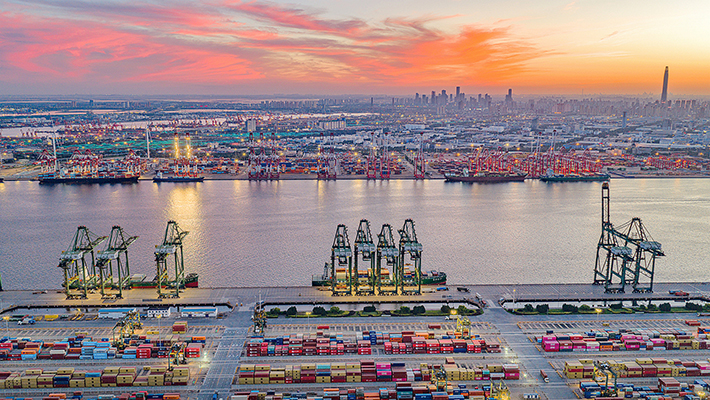
A view of Tianjin Port on 20 June (XINHUA)
More than just a port city
The visit also made clear that Tianjin’s technological development extends far beyond its waterfront.
At Deepinfar Ocean Technology Company, I explored underwater intelligent robots, underwater operational equipment and other marine technologies.
At AtomRobot, I learned about parallel robots and embodied intelligent robotics. At the Tianjin Electric Power UAV Patrol Operation Centre, I saw how unmanned aerial vehicles are being used to support the safe operation of critical power infrastructure.
Although these technologies serve very different purposes, they reflect a common direction: intelligence is increasingly moving from digital environments into the physical world. Robots are operating in industrial settings. Drones are supporting infrastructure inspection. Intelligent systems are coordinating complex operations.
Tianjin provides a particularly interesting environment to observe this transition because its industrial, technological and maritime sectors are closely connected.
This became even clearer during the 2026 World Intelligence Expo, which Tianjin hosted from 28 to 31 May at the National Convention and Exhibition Centre. Centred on the theme “AI+,” the expo showcased developments in artificial intelligence, embodied intelligence, intelligent connected vehicles, smart manufacturing, the low-altitude economy, commercial space and smart living.
Inside the exhibition halls, I witnessed emerging technologies shaping the next generation of intelligent industries. At the port, I could see how some of these ideas are already being applied to real-world economic activity.
That connection between innovation and practical application is important. Technology becomes most significant when it moves beyond demonstrations and begins addressing the everyday challenges faced by industries and communities.
Technology, however, is only one part of Tianjin’s development story. During the four-day visit, I also experienced the city’s historical and cultural character.
At Ancient Culture Street, I saw traditional crafts and performances, while at Yangliuqing Ancient Town, I explored traditional New Year paintings, paper cutting and other forms of cultural heritage. I also visited the Haihe River, an important part of Tianjin’s historical development and contemporary urban landscape.
These experiences offered a different perspective on the city.
Tianjin has long been a gateway to China. Today, at its waterfront, it is becoming something more: a gateway to the future of global logistics.
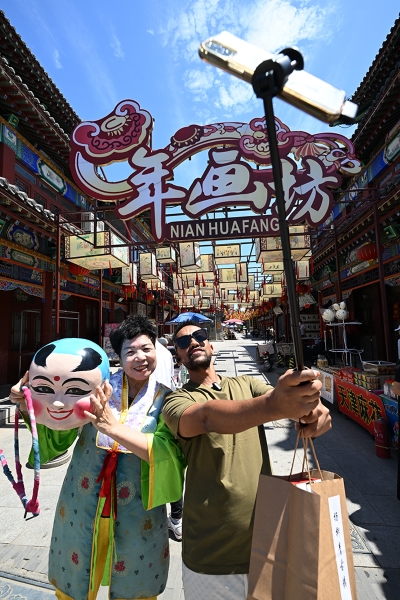
Getahun Assefa takes selfies with a local artist in Tianjin in May (COURTESY)
Lessons for Africa
The visit offered more than a showcase of advanced technology. It also provided an opportunity to reflect on how similar innovations could shape the future of infrastructure and connectivity in Africa.
African countries are investing in ports, railways, logistics networks, industrial zones and other infrastructure as they seek to expand domestic and international trade.
The challenge is increasingly about more than building infrastructure. It is about developing systems that can remain efficient, sustainable and adaptable as technology continues to evolve.
Tianjin offers an experience worth studying.
Its port demonstrates how maritime infrastructure can be connected with digital technologies, renewable energy, advanced manufacturing and wider transportation networks.
For Africa, where improving connectivity and logistics remains essential to expanding trade, experiences such as Tianjin’s can provide useful reference points for discussion and exploration.
|
||
| About Us | Contact Us | Advertise with Us | Subscribe |
| Copyright Beijing Review All rights reserved 京ICP备08005356号-5 京公网安备110102005860号 |


