| ChinAfrica |
| A Timeless Spirit |
| To understand the journey of a giant, one must go back to the roots of the unwavering confidence forged through suffering |
| By DAVID GOSSET | VOL. 18 October 2026 ·2026-10-08 |
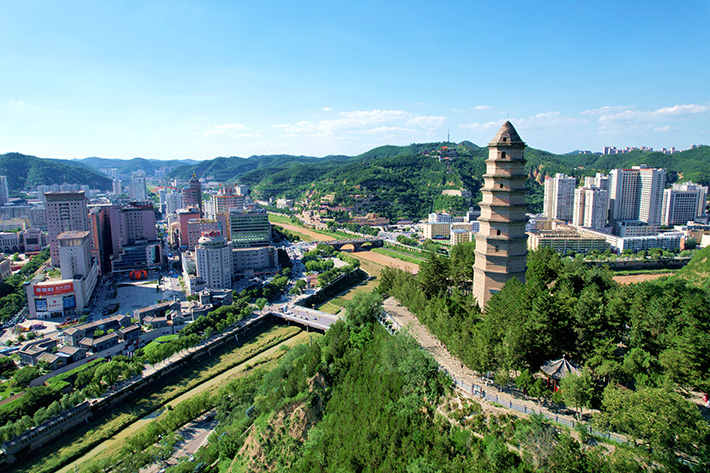
An aerial view of the downtown area of Yan’an in Shaanxi Province (CNS)
Some historical events transcend the pages of history and enter a more mysterious realm, where peoples draw the images through which they understand themselves. The Long March is one such event. Ninety years after the completion of this epic journey, it is no longer simply a matter of recounting the movement of thousands of men across mountains, marshes and rivers, but of examining an adventure which, like all great political foundations, is as much a matter of historical fact as it is of its transformation into collective memory.
I often think of that encounter recounted by André Malraux in Les Antimémoires. Facing Mao Zedong, he sought neither biographical detail nor personal revelations. What interested him was of a different nature: how does a man become the custodian of a collective endeavour? How does a single life come to embody the destiny of a civilisation?
France has its founding narratives, such as the French Revolution or the Resistance. China, too, has its own, but few of them occupy such a unique place as the Long March. It is not merely a military retreat that became a moral victory. It is an answer to a question that all civilisations face one day: how to survive when all seems lost?
The turning point
Amid the turmoil of the first half of the 20th century, China appeared to Western observers as a fragmented country, torn apart by civil wars, foreign interventions and the humiliations accumulated since the Opium Wars in mid-1900s. Many predicted its demise. Few imagined that this seemingly doomed land was already preparing its comeback. The Long March represents precisely that paradoxical moment when defeat ceases to be the end and becomes the beginning of a new phase.
The figures have often been cited: thousands of kilometres covered, mountains crossed at extreme altitudes, rivers forded, immense losses. But no statistic can convey what transforms a retreat into a legend.
The Greeks already knew that a civilisation lives as much through its stories as through its laws. Modern China is no exception to this universal truth. Mao emerges from this journey much like Napoleon after the Italian campaign or de Gaulle from London: less because he commanded than because he embodied. Historical circumstances sometimes produce leaders; more rarely, symbols. The Long March made Mao one of those symbols whose significance transcends the individual.
Malraux, who had met so many heads of state, had realised that Mao never presented himself as a mere political actor. He spoke with an awareness of history that stretched across centuries, making him seem like a voice through which generations of Chinese history were speaking. This dimension undoubtedly explains why the Long March continues to fascinate far beyond China’s borders.
The contemporary West often struggles to understand this legacy. It looks for programmes, institutions and doctrines, forgetting that nations also thrive on images and narratives. The Long March is, first and foremost, a vast national narrative. It teaches that endurance can become a strategy. It affirms that willpower is sometimes more effective than material resources. Finally, it reminds us that a nation can transform its wounds into historical energy.
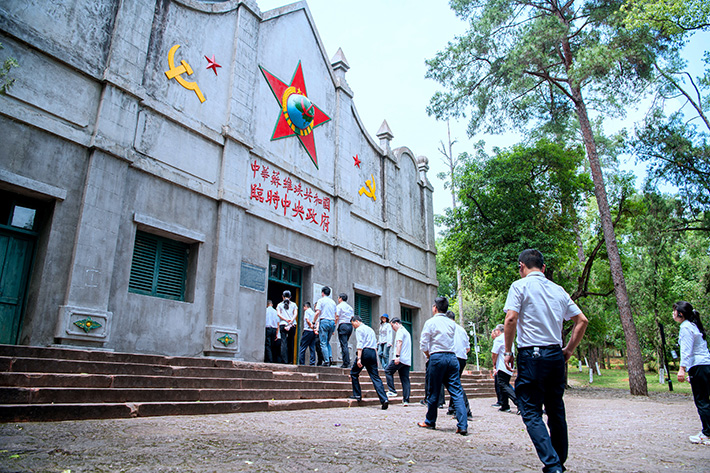
Visitors enter the site of the Provisional Central Government of Chinese Soviet Republic in Ruijin, Jiangxi Province, to retrace the history of Chinese red revolution and honour revolutionary predecessors on 19 May 2024 (VCG)
Beyond the past
It would, however, be reductive to confine this episode to a static celebration of the past. Commemorations have meaning only when they engage with the present. Yet, today’s China is no longer the China of the 1930s.
The country that was painstakingly building a few roads has become one of the world’s leading infrastructure builders. The nation that sought to preserve its unity is now developing rail networks linking thousands of cities. The nation that fought for its survival ranks among the world’s leading scientific, industrial and technological powers.
History never repeats itself, but it retains profound similarities. What links the Long March to contemporary China is not a similarity of circumstances, but a certain conception of the long term. Major Chinese policies are rarely driven by urgency. They stem more from the strategic patience that characterises ancient civilisations.
In a world dominated by immediacy, where social media dictates the pace of the moment and where financial markets operate on a millisecond timescale, this ability to frame collective action over several decades, or even within a secular timeframe, remains one of China’s most distinctive traits. The Long March thus emerges as an enduring metaphor: accepting the length of the journey rather than seeking the ease of a shortcut. This lesson extends far beyond China’s borders.
Our era is experiencing a crisis of the long term. Western countries often struggle to frame their actions within a long-term perspective; societies are growing impatient; technology is accelerating decision-making and conflicts are fragmenting our horizons. In this world of constant acceleration, the memory of the Long March paradoxically invites us to take a longer view of history. It reminds us that no civilisation is built in a few years, that no national renaissance is instantaneous and that no collective ambition can avoid trials and tribulations.
A lasting legacy
Malraux wrote that civilisations only truly die when they cease to believe in their own destiny. Contemporary China, whatever debates its political or economic choices may provoke, undeniably displays a renewed confidence in its historical continuity. This confidence is rooted not only in several millennia of civilisation, but also in the formative trials of the 20th century, of which the Long March remains one of the most significant.
Every national history has its dark chapters, its tragedies and its contradictions. Historical insight consists precisely in accepting this complexity while recognising what gives coherence to a collective journey.
The Long March has become part of the shared human history of great collective experiences, while remaining deeply rooted in Chinese national memory. It carries within it a question that transcends time and space: what becomes of a people when they refuse to give up? Perhaps this is where the true relevance of this anniversary lies.
At a time when international balances are being redrawn and Asia is regaining a central place in world affairs, understanding China requires an appreciation of the narratives that continue to shape its national consciousness. One cannot understand France without Valmy. One cannot understand India without the Salt March. One cannot understand China without the Long March.
It is not merely a military episode: it is an expression of perseverance. And when one rereads the passages in which Malraux discusses Mao, one impression lingers. Beyond ideological differences and historical debates, he perceived something deeper: certain human endeavours transcend the ordinary categories of politics and enter a realm where history becomes destiny.
The Long March continues to speak to us not because it belongs to the past, but because it reminds every generation that peoples are defined not only by what they possess, but also by the paths they choose to tread together. Perhaps this, ultimately, is the true victory of the Long March: a road transformed into memory, an ordeal into hope and a journey into a horizon.
The author is founder of China-Europe-America Global Initiative
|
||||
| About Us | Contact Us | Advertise with Us | Subscribe |
| Copyright Beijing Review All rights reserved 京ICP备08005356号-5 京公网安备110102005860号 |


