| ChinAfrica |
| Skills That Empower |
| African youth find new opportunities through vocational training in China |
| By Li Yin | VOL. 18 October 2026 ·2026-10-09 |
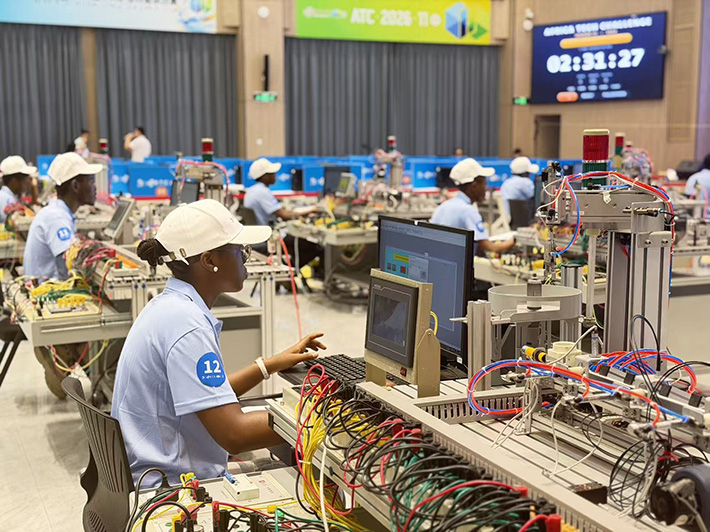
Contestants at the 2026 ATC competition in Weifang, Shandong Province, on 29 August (COURTESY)
In Weifang, east China’s Shandong Province, a group of young people from Africa gathered at a competition venue, surrounded by computer screens and machinery. With their eyes fixed on their tasks, the contestants worked with intense concentration, debugging code on their screens, adjusting movements on workstations and checking each operation with care.
The 11th Africa Tech Challenge (ATC) began on 28 August in Weifang, bringing together 68 students from Cameroon, Ghana, Rwanda, Senegal, South Africa and Zimbabwe. All the contestants were African international students in China participating in the “Future of Africa” China-Africa Vocational Education Cooperation Plan.
This year’s event featured two competition categories – industrial robotics technology application and programmable logic controller (PLC) application technology. The choice of competition categories reflects the changing demand for technical skills as African economies pursue industrialisation and manufacturing development. PLC technology is widely used in industrial production lines, while industrial robotics represents a more advanced area of intelligent manufacturing.
More than a competition, the ATC has developed into a platform linking vocational education, industrial skills training and China-Africa youth exchanges.
From classroom learning to hands-on competition
The ATC was launched in 2014 against the backdrop of AVIC Innovation Holding Limited’s vocational education programmes in Africa. Over more than a decade, the competition has expanded from areas closely associated with traditional machining to a wider range of technical fields, including CNC machining, information technology and construction engineering drawing. It has now served participants from 14 African countries, with the number of teachers and students benefitting from the programme reaching 2,000.
According to Shi Yue, director of the ATC, the event was designed from the beginning to combine training with competition rather than simply bring students together for a short contest.
The reason was straightforward: many contestants initially had limited opportunities for intensive practical training. A competition without sufficient preparation, Shi explained, would not fully serve the educational purpose of the programme.
In previous editions held in Africa, Chinese experts and teachers provided intensive training before the competition, sometimes spending about five weeks with students. The training was designed not only to improve their performance in the competition but also to provide practical skills that could be useful when they entered the job market. For every participant, a training certificate documenting the skills acquired through the contest is a valuable asset.
Rather than focusing solely on a single technical operation, the programme increasingly combines vocational training with practical industrial applications. For Ghanaian contestant Piiru Sampson, the value of this practical approach was particularly clear.
Studying mechanical engineering at Weifang Vocational College, Sampson had learned about programmable logic controllers as part of his academic programme, but much of his previous knowledge had been theoretical. “Before the training, I had some knowledge about programmable control, but that was just book knowledge. I could not apply it,” he told ChinAfrica.
The training taught him how to operate machines and, importantly, how to approach problems systematically. When a programme failed to run as expected, he learned to identify the problem, debug it and solve it step by step.
For him, the experience also went beyond technical skills. Working with Chinese teachers required him to communicate across a language barrier, while the intensive training schedule taught him to be more conscious of time and more disciplined in organising his work. Competing alongside students from other countries gave him confidence in his own abilities.
A competition that opens doors
For some participants, the ATC has become a gateway to opportunities that extend well beyond the competition itself.
Kenyan student Victor Ngumbau Mue first encountered the ATC while studying at the Technical University of Kenya. He participated in the ATC in 2023 and won first place in the CNC machining category. His prize opened a new chapter: a scholarship to study at Beihang University in China.
Now, after two years at Beihang, Mue said the experience had broadened his exposure beyond his technical studies, and he was grateful for the high-quality education he had received. “The opportunity to study at Beihang has been one great opportunity that the ATC gave me,” Mue told ChinAfrica.
“Even if not everyone gets the opportunity to come and study in China, the skills they learned during the process are very important. They allow people in Africa to not just see the machine but also see what more they can do with the machine and programming.”
He hopes in the future that this event can become more popular in Africa and allow more people to develop their professions and improve their career outlook. He plans to apply the results of his research to civil engineering projects in Kenya, using unmanned aerial vehicles to monitor infrastructure.
Shi has also observed changes among African contestants themselves over the years. Today’s young African contestants are increasingly confident, curious about new technologies and eager to explore how technologies encountered in China could eventually be used in Africa.
That trajectory gives vocational education a significance beyond individual employment.
A technically trained young person may become an engineer, technician, teacher or entrepreneur. Some former participants have gone on to work with Chinese companies operating in Africa, while others have returned home to teach or pursue their own ventures, according to Shi.

Contestants prepare to fly their handmade kites in Weifang, Shandong Province, on 30 August (COURTESY)
Beyond the workshop
The ATC has gradually incorporated cultural activities alongside technical training. In cooperation with local Confucius Institutes, previous editions have included experiences such as movable-type printing, Peking Opera mask painting and calligraphy, while this year’s participants in Weifang were also introduced to the city’s kite culture after the competition. The organisers regard such activities as a way to give students space to relax while creating opportunities for cultural exchange. The purpose is to allow young people to gain an understanding of China beyond the classroom and workshop.
These experiences add another dimension to a competition centred on machines, programming and technical standards. In this sense, a vocational skills competition becomes more than a contest.
For Shi, vocational skills exchange and people-to-people exchange are closely connected. Students who come to China for training can experience Chinese education, technology and culture at the same time, while those who return to Africa may carry their experiences into their future careers and communities.
As China and African countries deepen cooperation in education and skills development, such exchanges can help young Africans acquire technical capabilities relevant to their own development while giving them direct experience of China’s vocational education system.
In 2026, as China and Africa mark the 70th anniversary of the establishment of diplomatic relations and observe the China-Africa Year of People-to-People Exchanges, the experience of the youth offers a concrete example of how human-centred cooperation can take shape: one classroom, one workshop and one shared challenge at a time.
|
||||
| About Us | Contact Us | Advertise with Us | Subscribe |
| Copyright Beijing Review All rights reserved 京ICP备08005356号-5 京公网安备110102005860号 |


