| ChinAfrica |
| A Shared Bond, A Shared Future |
| Malian Orchid Awards jury member talks about China-Africa friendship and cooperation |
| By Wang Wenye | VOL. 18 October 2026 ·2026-10-09 |
For Yoro Diallo, winner of the 2024 Chinese Government Friendship Award, a Malian scholar and executive director of the Centre for Francophone Studies at the Institute of African Studies of Zhejiang Normal University, this relationship is more than a record of diplomatic milestones. It is a bond shaped by decades of contact, cooperation and mutual learning, and one that continues to evolve as new areas of partnership emerge.
Diallo has experienced this evolution from several perspectives. He first travelled to China in 2001 and returned in 2011. In 2013, he was appointed First Counsellor at the Embassy of Mali in Beijing. Since 2017, he has worked in China as a researcher, while also taking part in activities organised by institutions including the African Museum and the China-Africa Exchanges Museum. His experience has given him a perspective that spans diplomacy, academic research and cultural exchange.
For Diallo, the history of China-Africa relations provides an important foundation for understanding their present development. From the Bandung Conference in 1955 and the first visits by Chinese leaders to Africa in the 1960s to the establishment of the Forum on China-Africa Cooperation in 2000, he sees the relationship as one that has continued to develop through successive stages of engagement.
An increasingly diverse partnership
Over the decades, China-Africa cooperation has become considerably more diverse. Infrastructure remains an important area, but trade, agriculture, education, telecommunications, the digital economy, green technologies, health care and cultural exchanges are playing an increasingly prominent role. In 2025, China-Africa trade reached $348.05 billion, up 17.7 percent year on year and setting a new historical record.
For Yoro Diallo, this diversification reflects a profound evolution in China-Africa relations, which are no longer limited to material needs but have expanded to include the sharing of experience and the search for common solutions. The people-to-people dimension, in particular, is playing an increasingly important role.
In 2026, this friendship entered a new phase with the China-Africa Year of People-to-People Exchanges. Officially launched on 8 January at the headquarters of the African Union in Addis Ababa, Ethiopia, the initiative has already given rise to numerous activities.
On 3 April in Beijing, the 2026 Crabapple Gala and Poetry Party, themed “Crabapple Blossoms, Cultures Bloom,” brought together more than 200 Chinese and foreign guests, including diplomats and representatives from more than 30 African countries.
He noted that the China-Africa Year of People-to-People Exchanges includes activities for young people, academic exchanges, Chinese-language learning programmes and initiatives in artificial intelligence and emerging technologies. “Young people are the future. Young Africans studying in China should gain a better understanding of Chinese society, its language and culture before sharing their experiences in their home countries,” Diallo said.
Cultural exchanges also hold a special place in the relationship. Established in 2022 by the China International Communications Group (CICG), the Orchid Awards honour foreign individuals and institutions that have contributed to cultural exchanges, mutual understanding and dialogue among civilisations.
Making China-Africa voices heard
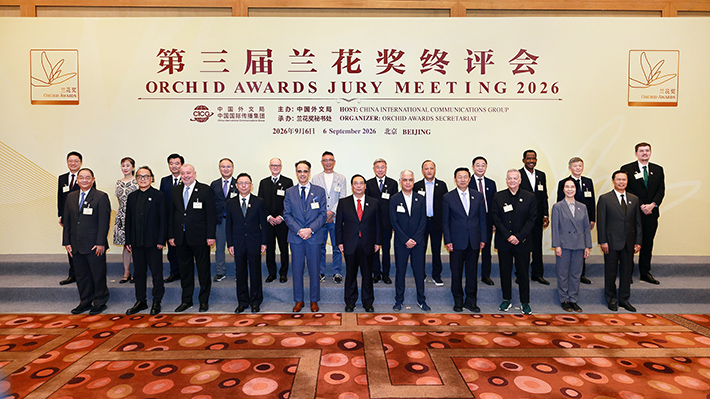
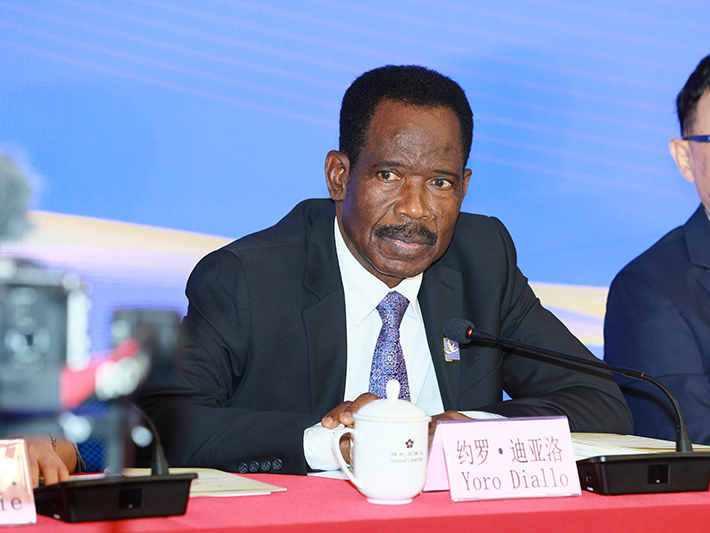
On 6 September, the final jury meeting for the third edition of the Orchid Awards was held in Beijing. Comprising 23 members from China and nine other countries - the UK, the US, Australia, India, Italy, Kazakhstan, Lebanon, Mali and Thailand - the jury selected 10 candidates to be honoured in three categories. The names of the 10 winners will be officially announced at the awards ceremony scheduled for later this year.
For Diallo, the awards are above all “a bridge between peoples.” Against a backdrop of international tensions and misunderstandings, he said dialogue among civilisations can help people gain a better understanding of one another’s realities and move beyond reductive perceptions. “The Orchid Awards play a role in communication and encouragement, inspiring young Africans to strive for excellence, better understand China-Africa cooperation and engage in this cooperation for the well-being of the Chinese and African peoples,” he added.
According to Diallo, strengthening China-Africa relations also requires greater participation by African researchers and media organisations in the production and dissemination of knowledge.
“We must participate ourselves in disseminating our history and telling our own story,” Diallo said when asked how the visibility of China-Africa voices could be strengthened amid the still considerable international influence of Western media and academia.
He stressed that young Africans should be encouraged to consult different sources of information, develop critical thinking skills and themselves participate in producing knowledge about their continent and Africa’s relations with the rest of the world.
Exchanges among academics, media organisations, think tanks and institutions can thus contribute to greater mutual understanding and the joint production of knowledge. For Diallo, young Africans who study or work in China should become active participants in this process of mutual understanding by sharing their experiences in their home countries.
| About Us | Contact Us | Advertise with Us | Subscribe |
| Copyright Beijing Review All rights reserved 京ICP备08005356号-5 京公网安备110102005860号 |


