| ChinAfrica |
| Zimbabwe’s Industrial Shift |
| China’s $10 billion investment supports an industrial local processing shift in Zimbabwe |
| By Problem Masau | VOL. 18 October 2026 ·2026-10-10 |
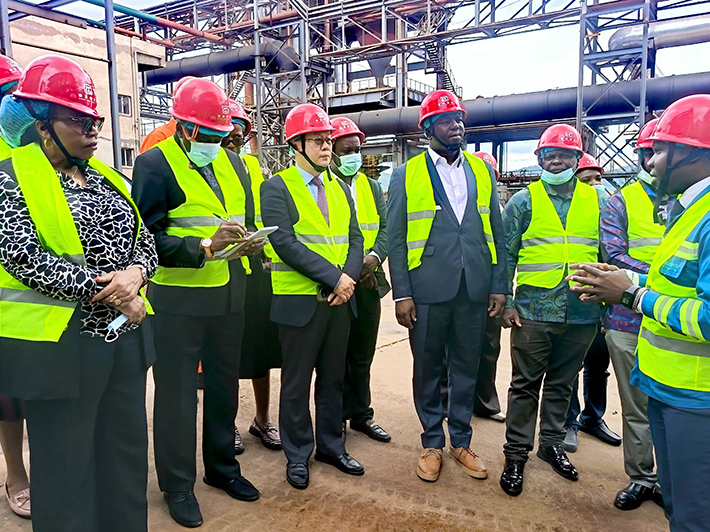
Chinese envoys and Zimbabwean government officials visit Dinson Iron and Steel Plant in Manhize, Midlands Province, Zimbabwe, on 22 January (CHINESE EMBASSY IN ZIMBABWE)
Chinese investments in Zimbabwe have topped $10 billion, cementing China’s position as the Southern African country’s largest source of foreign direct investment and supporting a strategic shift from resource extraction towards local industrial processing.
Chinese Ambassador to Zimbabwe Zhou Ding confirmed the milestone during the Zimbabwe-China Investment Symposium in Harare in early July, saying the investments span mining, manufacturing, energy, agriculture and digital infrastructure.
The influx of capital has created nearly 1 million local jobs and generated hundreds of millions of dollars in annual tax revenue, according to Zhou.
“The future of Zimbabwe lies not only in extracting its natural resources, but in processing them locally, creating industries, developing skills and generating sustainable employment,” Zhou told delegates, outlining a roadmap for industrial transformation aligned with Zimbabwe’s National Development Strategy 2.
The announcement comes as bilateral trade reached a record $4.4 billion in 2025, a 15.2 percent year-on-year increase. Zimbabwe recorded a trade surplus of $740 million, according to Chinese customs statistics and data released by the Chinese embassy in Zimbabwe.
The growing partnership reflects China’s broader engagement with African countries through infrastructure development and industrial cooperation.
From steel to energy
At the heart of Zimbabwe’s industrial drive is Dinson Iron and Steel Plant in Manhize, Chirumhanzu District, Midlands Province. The $1.5-billion integrated steelworks, developed by China’s Tsingshan Holding Group, is Africa’s largest such facility.
Already producing more than 500,000 tonnes of steel annually, the plant is expected to increase output to 1.2 million tonnes, helping transform Zimbabwe from a net steel importer into a regional exporter.
“A total of 60 percent of this production is exported, directly generating the foreign currency that is the lifeblood of Zimbabwe’s economy,” Zhou said during a recent visit to the facility.
The project has created thousands of jobs, with 95 percent of its workforce being Zimbabweans, predominantly from surrounding communities, according to Dinson CEO Benson Xu. More production is also expected to create opportunities for upstream and downstream industries.
The steel plant has reduced Zimbabwe’s reliance on imported steel, which previously cost the country up to $1 billion annually. More than 140,000 tonnes were exported in the first half of 2025 alone.
Chinese investment has also helped address Zimbabwe’s chronic power shortages. The $1.5-billion expansion of Hwange Thermal Power Station Units 7 and 8, financed through Chinese concessional loans and executed by Sinohydro Corp., added 600 mw to the national grid. Completed in 2023, the project has strengthened electricity supply for industries and households.
Another major Chinese-backed project, the expansion of Kariba South Hydro Power Station, added 300 mw when completed in 2018. Together, the projects have reduced Zimbabwe’s power import bill and improved energy security.
Zhou said Chinese investors are also developing captive power plants with a combined capacity exceeding 1,000 mw, particularly supporting energy-intensive mining and processing operations.
Zimbabwean economist Brains Muchemwa stressed the importance of such investment. “When you look at the key enablers, in particular infrastructure and energy, that is where we definitely need more investment,” he said.
Processing more, exporting more
Zimbabwe’s lithium industry illustrates the country’s push to retain more value from its mineral resources. Chinese companies have invested more than $2 billion in the sector since the government banned raw lithium exports in 2021, encouraging local processing.
Prospect Lithium Zimbabwe, in partnership with China’s Huayou Cobalt, has invested about $400 million in the Arcadia lithium sulphate plant, which began production in early 2026 and became Africa’s first lithium salt producer. The plant has an annual capacity of 50,000 tonnes and has created 2,000 direct and 2,000 indirect jobs.
At Sinomine Resource Group’s Bikita Minerals, a lithium sulphate processing plant valued at about $500 million has been built, with further investment planned. A third major facility is under construction at the Kamativi mine by Sichuan Yahua Industrial Group.
According to a Ministry of Mines and Mining Development position document, these commitments represent close to $1 billion in domestic lithium processing infrastructure, supporting the government’s local beneficiation policy.
Chinese investment is also expanding manufacturing. Shuntai Investments is set to commence operations at its $200-million cement facility in Chegutu, western Zimbabwe, in September. The plant is designed to produce up to 6,000 tonnes of cement daily and employ 1,500 to 2,000 workers as operations expand.
The integrated project includes a 50-mw solar power plant, a packaging facility and an electric vehicle fleet, with plans to feed excess electricity into the national grid.
“We want to be self-sufficient in our operations,” said Shuntai administrator Jack Zhang.
Despite the investment surge, infrastructure gaps remain. Zhou identified electricity, transport, water and digital connectivity as key constraints and called for sustained investment.
“Looking ahead, there are significant business opportunities in transport corridors, railway rehabilitation, renewable energy, industrial parks, logistics hubs and digital infrastructure to support Zimbabwe’s industrialisation,” he said.
| About Us | Contact Us | Advertise with Us | Subscribe |
| Copyright Beijing Review All rights reserved 京ICP备08005356号-5 京公网安备110102005860号 |


