| ChinAfrica |
| Wells of Well-being |
| China-aided water project is bringing clean water closer to rural communities in southern Chad, improving health, livelihoods and daily life |
| By Derrick Silimina | VOL. 18 October 2026 ·2026-10-10 |
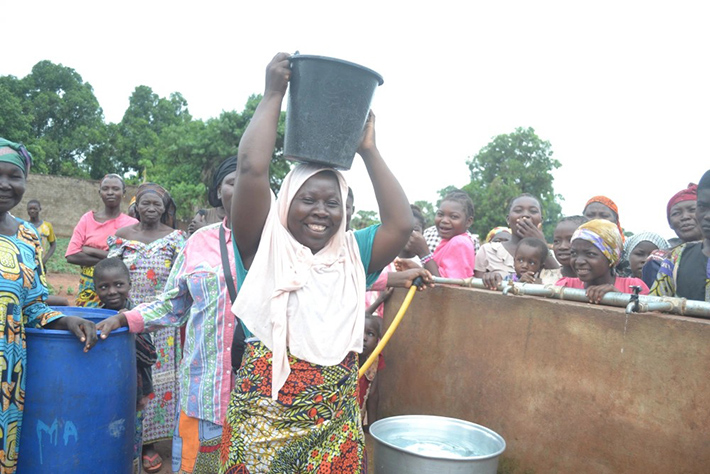
Residents fetch water at a water station under a China-aided water supply project in Koumra, Mandoul Province, Chad, on 5 June (XINHUA)
Before first light reaches Chad’s dusty Sahel, Madeleine Ndjeria is already awake. She lifts a yellow 20-litre jerrycan onto her shoulder and begins the familiar journey to fetch water, her footsteps disappearing into the cool darkness before the day’s heat takes hold.
By midmorning, temperatures can climb towards 40 degrees Celsius, turning the dusty paths of Mandoul into shimmering corridors of heat. For Ndjeria and countless other women and girls, the journey is not a chore that can be postponed. It is a daily calculation of distance, strength and survival. Every trip home means another heavy container carried on tired shoulders; every drink from an unreliable source carries the possibility of illness.
“In my hometown of Mandoul, a day without walking was a day when your children went thirsty. For years, every sip was a gamble, and life has long been measured in kilometres travelled and litres carried,” Ndjeria told ChinAfrica.
Across Mandoul and neighbouring Salamat Province, water scarcity has long shaped the rhythm of rural life. Families have relied on shallow wells, often shared with livestock, while inadequate sanitation has left communities vulnerable to disease. For farmers and pastoralists, the lack of reliable water has also limited livelihoods.
But beneath this parched landscape lies another possibility. In late 2024, Chinese engineers began drilling deep into the rocky ground, searching for groundwater that had remained beyond reach for generations. Their work has since brought hundreds of wells, water stations and public latrines to rural communities, offering a new measure of hope: water closer to home, cleaner water to drink, and the possibility of a life no longer defined by the long walk to find it.
A search for water
Data from the UNHCR reveal severe gaps in Chad’s water, sanitation and hygiene infrastructure. Just 52 percent of Chadians have access to basic drinking water, a figure that drops to 44 percent in rural communities. Sanitation coverage is even more dire: only 13 percent of the national population has access to basic sanitation facilities, plummeting to a critical 5 percent in rural areas.
Echoing Ndjeria’s struggle to access safe drinking water in Chad’s remote southern and south-eastern provinces, another local farmer François Mbaïlao recalled surviving a bout of diarrhoeal disease, remembering it not merely for the searing pain, but for the terrifying sensation of being close to death.
“I struggled with severe dehydration and later an abdominal infection after drinking contaminated water, which posed a threat to my life,” Mbaïlao told ChinAfrica.
For years, rural communities have endured long, gruelling journeys to fetch water from shallow wells shared with livestock, exposing entire villages to potentially deadly waterborne diseases.
The African Development Bank Group has warned that Chad faces a severe sanitation crisis: more than 82 percent of the population lacks adequate sanitation, 63 percent practise open defecation and just 11 percent have access to safely managed sanitation services. The deficit carries a heavy economic toll, costing an estimated $129.5 million annually while undermining public health, environmental safety and socioeconomic development.
The situation began to improve in late October 2024, when engineering teams from China Jiangxi International Economic and Technical Cooperation Co., Ltd. (CJIC) deployed advanced drilling technology across Mandoul and Salamat. They began drilling deep beneath the region’s arid terrain to unlock clean groundwater.
“Our previous drilling attempts had failed for two decades because the rocky terrain yielded almost no groundwater. But after eight months of work, our team finally hit a flow rate that works for the Chadian community,” CJIC Project Manager Fu Renyin said.
Fu said the project has so far delivered more than 500 hand-pump wells, 57 centralised water supply stations and more than 100 public latrines.
He explained that the hand-pump wells are drilled to an average depth of more than 45 metres, while the centralised water stations reach depths exceeding 90 metres. In some locations, the deepest wells extend beyond 150 metres to access clean aquifers.
According to CJIC Project Site Manager Huo Wenlong, drilling teams conduct extensive geological surveys and water-resource assessments before beginning work.
“We always conduct thorough preliminary exploration and analysis. The wells we drill must strictly meet water quality and quantity standards,” Huo said.
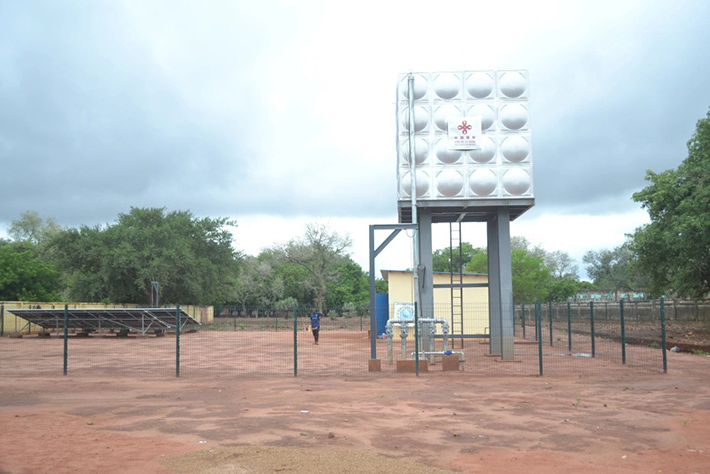
A water tower under a China aided water supply project in Koumra, Mandoul Province, Chad, on 5 June (XINHUA)
A new source of hope
Local leaders have since affirmed that the China-aided water initiative has delivered crucial relief to more than 6,000 residents. Beyond providing water for domestic use, the project is also supporting local pastoralists by eliminating the long, arduous treks once required to fetch water for their livestock.
In the villages of Salamat Province, the benefits have also reached smallholder farmers. In Abou-Deïa, Aboubacar Oumarou has secured year-round irrigation for his vegetable production.
“I no longer search for water to irrigate my garden. This China-aided water project is a huge relief for us, our crops and our animals,” Oumarou said.
To ensure a continuous water supply, Huo said engineers installed a dual-power system at the water stations.
“When the sun is shining, the station runs on solar energy. In the evening or during overcast weather, it automatically switches to the generator to ensure an uninterrupted water supply,” he said.
Chadian Minister of Water and Energy Passalet Marcelin, who has visited the construction sites several times, said the project is expected to benefit more than 600,000 people.
“This project is shining proof of the fruitful cooperation between Chad and China. It will help us accelerate the implementation of our National Drinking Water Supply and Sanitation Programme, particularly in the most vulnerable rural areas,” he said.
Chinese Ambassador to Chad Wang Xining has also commended the Chadian government’s strong partnership in public infrastructure, highlighting the China-aided water project.
“The project aims to alleviate the drinking water difficulties for the local population and improve their livelihood and well-being,” Wang said during a material donation ceremony for the project.
Part of the Belt and Road Initiative, the effort is designed to tap into the region’s rich but underutilised groundwater resources. It represents “a concrete measure in implementing the principle of sincerity, real results, affinity and good faith,” Wang said.
|
||||||||||||
| About Us | Contact Us | Advertise with Us | Subscribe |
| Copyright Beijing Review All rights reserved 京ICP备08005356号-5 京公网安备110102005860号 |


