| ChinAfrica |
| From Racing to Real Life |
| Two competitions illustrate the progress humanoid robots are making towards practical applications |
| By GE LIJUN | VOL. 18 October 2026 ·2026-10-19 |
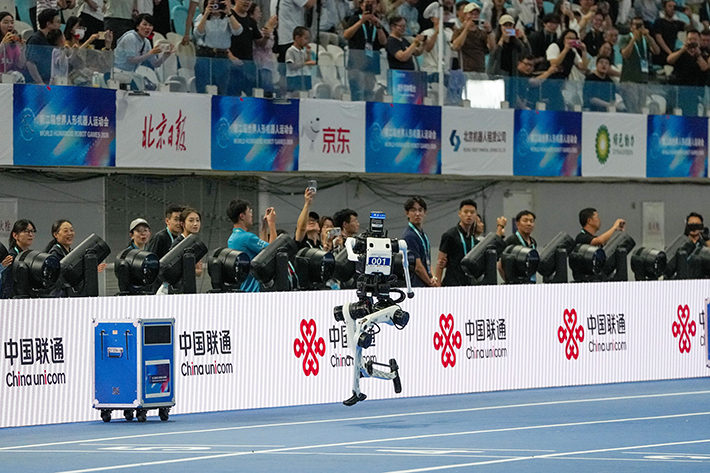
A robot from the Tiangong team competes in the 400-metre final (large robot category) at the second World Humanoid Robot Games in Beijing on 23 August. It finished in 38.15 seconds (XINHUA)
Robots are no longer limited to running and jumping. They can now sort parcels and prepare noodles, as well as compete in sporting events. This was evident at two major technology events, the 2026 World Robot Conference and the second World Humanoid Robot Games, recently concluded in Beijing.
In the 400-metre race for large robots, Tiangong Ultra crossed the finish line in 38.15 seconds. A year earlier, the winner had taken 1 minute and 28 seconds. This improvement reflects advances in motion control and perception.
Sports events test the physical capabilities of robots; real-world competitions assess their ability to perform tasks. Of the 51 events at the Games, 21 focused on practical applications in homes, hotels, factories, the catering sector and emergency response.
At the World Robot Conference, experts emphasised that embodied intelligence products were moving from small-scale trials to industrial deployment. Nearly 10 car manufacturers, including Xiaomi and BYD, are already testing these technologies on their production lines, particularly for handling and loading parts.
The collection of real-world data helps to improve models and algorithms. At the Shijingshan training centre in Beijing, trainers remotely control robots to teach them, for example, how to tidy clothes away. The system records the movements and angles of the joints, data that will be useful for their future deployment in the workplace.
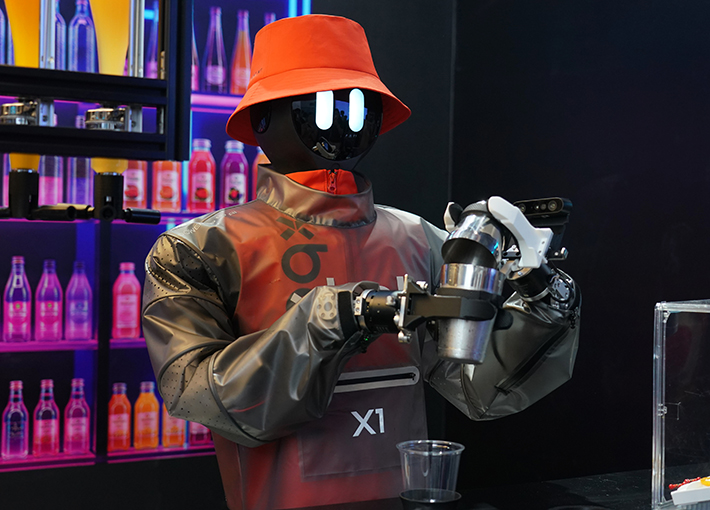
A “bartender” robot prepares a cocktail at the 2026 World Robot Conference on 19 August (XINHUA)
According to the 2026 Report on the Development of the Humanoid Robot Industry, technological innovation is entering a new phase of “cluster emergence,” while the industrial supply chain is achieving breakthroughs in both quality and efficiency. The report states that China delivered more than 40,000 humanoid robots in the first half of 2026, accounting for 97 percent of the global total.
The path to everyday use, however, remains challenging. Wang Xingxing, founder of Unitree Robotics, said robots still have limitations in efficiency and adaptability. Adapting them to complex environments such as hospitals will take time, while “butler” and “caregiver” robots remain at the trial stage.
|
||||||||||||
| About Us | Contact Us | Advertise with Us | Subscribe |
| Copyright Beijing Review All rights reserved 京ICP备08005356号-5 京公网安备110102005860号 |


