| ChinAfrica |
| Yangtze’s Second Wind |
| A decade of work has meant cleaner waters and more advanced industries along the river’s banks |
| By YUAN YUJUN | VOL. 18 November 2026 ·2026-11-03 |
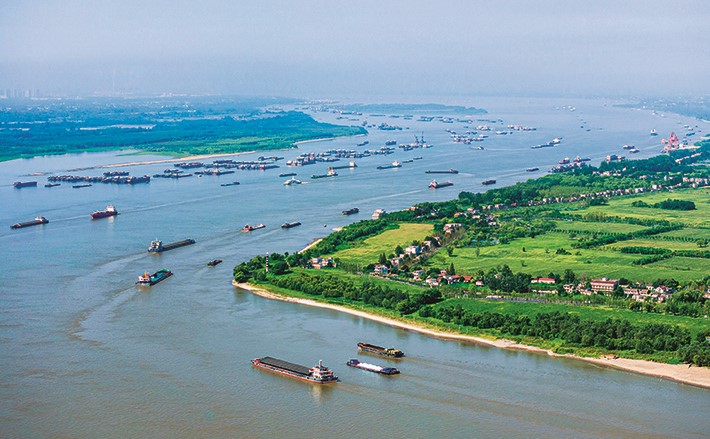
Cargo ships travel through the Wuhu section of the Yangtze River in Anhui Province on 16 September 2025 (VCG)
The Yangtze River, the world’s third-longest river, has changed a great deal in the past 10 years. According to figures released by the State Council Information Office on 5 January, the proportion of the river sections with fairly good or better water quality (Grade III or better) in the Yangtze River Economic Belt rose from 67 percent in 2015 to 96.5 percent. Regional GDP has more than doubled, and the belt now accounts for 47.3 percent of the national total, up from 42.2 percent. Per-capita disposable income for residents along the river rose by 91 percent, from 23,000 yuan ($3,445) to 44,000 yuan ($6,591).
China uses a five-tier surface water quality system, with Grade I the best. Water quality is considered fairly good if it reaches Grade III, which is sufficient for most aquatic organisms to survive.
Those gains did not come easily, and they were not inevitable. For much of the late 20th century, the Yangtze’s economic boom came at a heavy environmental cost. Factories discharged untreated waste into the river, and riverbanks were crowded with docks, chemical works and illegal wharves. Fish stocks dwindled, and the species that depended on the water struggled to survive.
These numbers describe a shift from an era when chemical plants lined the banks to one driven by scientific development. They also reflect a change in how China thinks about development itself. The question was no longer how quickly the river could be made to pay, but how it could sustain both people and the ecosystem that supports them.
Setting the course
The transformation began in January 2016, when President Xi Jinping chaired a symposium in Chongqing and declared that ecological restoration must take priority, with coordinated conservation and no large-scale exploitation. The Outline Plan for the Development of the Yangtze River Economic Belt followed in September.
Xi chaired follow-up meetings in Wuhan in 2018, Nanjing in 2020 and Nanchang in 2023. The focus shifted to high-quality development. The National Development and Reform Commission and local governments have implemented the plan through five-year implementation plans and three-year action plans.
The starting point was grim. In 2018, chemical plants crowded the river, illegal docks were widespread and water quality in some stretches had fallen to Class V, the lowest grade in the national system. Xi described the Yangtze as seriously ill, shaping the response that followed.
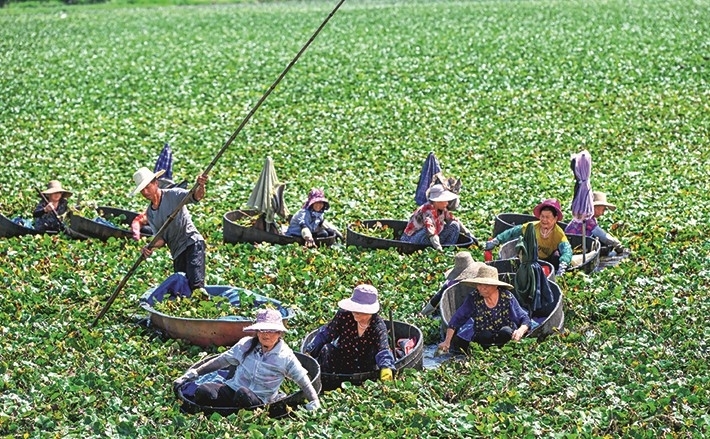
Farmers harvest water caltrops at a planting base in Tianjinghu Village, Huanggang, Hubei Province, on 3 August (VCG)
Cleaner water, richer banks
Over the past decade, provinces and municipalities have tackled pollution through closures, upgrades, relocations and industrial transformation. Nearly 10,000 chemical enterprises were closed, upgraded, relocated or transformed. More than 1,360 illegal wharves were cleared, and black and malodorous water bodies in prefecture-level and higher cities have been eliminated.
Water quality along the main stream has remained at Class II since 2020. Total phosphorus concentrations in the basin have fallen by more than 40 percent compared with 2015. The Yangtze River Protection Law, which came into force in March 2021, was China’s first law designed specifically for a river basin, integrating pollution control, ecological restoration and industrial transformation.
The 10-year fishing ban, fully launched in 2021, has helped restore aquatic life. Between 2021 and 2025, a total of 351 native fish species were recorded in the basin, 43 more than before the ban. In 2025, aquatic resource density in the main stream reached twice its pre-ban level. Around 142,000 former fishing households had found new employment by the end of the third quarter of 2025.
Industry has changed alongside the water. The belt has 24 national carbon peaking pilot cities and industrial parks and 14 zero-carbon industrial parks. Energy consumption per unit of GDP has fallen by about 24 percent, while carbon emission intensity has dropped by more than 30 percent. It generates close to half of national output and has developed 41 advanced manufacturing clusters. In 2025, Shanghai, Jiangsu, Zhejiang, Anhui and Chongqing each produced more than 1 million new energy vehicles.
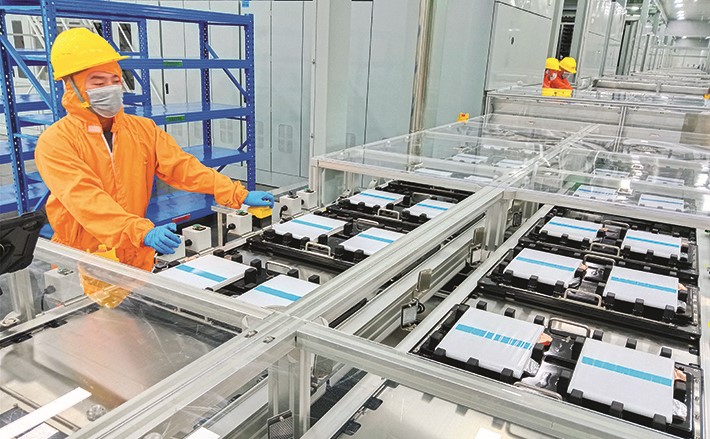
Employees work in an intelligent dust-free factory in Yichang, Hubei Province, on 9 August (VCG)
Two provinces, two paths
Hubei and Jiangxi show how the national effort has taken shape locally. Hubei, with the longest Yangtze shoreline of any provincial-level region, was heavily affected by riverbank chemical industries. In 2018, it became the first province to begin relocating, renovating, closing or transforming chemical enterprises along the river. During the 14th Five-Year Plan period (2021-2025), it overhauled 478 enterprises and remediated 12,480 river discharge outlets. More than 180 km of riverfront were reclaimed, and 8.56 million square metres of greenery restored.
Hubei has promoted electric, gas-powered and hydrogen-powered shipping. Core power systems for electric vessels built in the province hold a 62-percent market share. In the first half of 2026, value added by high-technology manufacturing rose by 36.8 percent. The shift from chemical plants towards electric ships and smart factories shows how ecological protection can drive industrial upgrading.
Jiangxi has combined conservation with development. In the first five years of the campaign, it reclaimed 7 km of Yangtze shoreline, dismantled 87 illegal docks and closed 34 chemical plants within 1 km of the river. Former industrial corridors have become reed wetlands, green trails and public riverside spaces.
The province has introduced a five-tier river and lake chief system, with 42,000 officials overseeing waterways from provincial to village level. Jiangxi has also enacted provincial regulations on mine ecological restoration and phosphorus control in lakes.
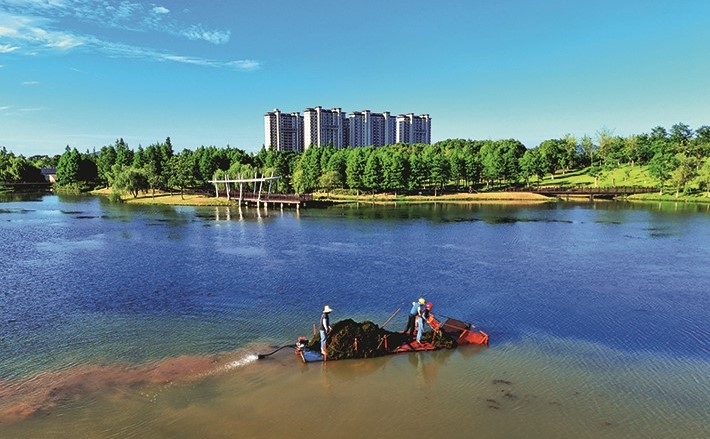
Sanitation workers remove aquatic plants at Xinghai Lake Park in Ganjiang, Jiangxi Province, on 2 August (VCG)
A model for other rivers
Germany worked with riparian countries to establish a coordination mechanism for the Rhine in the 1980s, while the US developed a collaborative approach to the Mississippi involving federal coordination, state implementation and public participation.
China’s approach puts comprehensive conservation first while the economy continues to grow. Supporters say its ability to mobilise resources and systematic governance helped reduce total phosphorus and ammonia nitrogen concentrations in a decade by amounts comparable to improvements the Rhine took nearly 30 years to achieve.
The Yangtze offers three broader lessons: avoid polluting first and treating later; coordinate national strategy, local regulation and interprovincial compensation; and recognise that conservation and growth can coexist. Regional GDP has more than doubled as the share of good-quality water has risen by nearly 30 percentage points.
Challenges remain. Industries along the river must move further up the value chain, and ecological compensation schemes need to become fairer and more effective. Researchers and officials are also considering how the experience could be adapted to other river basins.
A decade is a fleeting moment in the life of a great river. Yet in that time the Yangtze has been transformed. From riverbanks crowded with chemical plants to a region driven by innovation, the river has become both a practical example of modernisation and, in the view of its champions, a model for the world. Whether that model can be replicated elsewhere will depend on what happens along other rivers in the years to come.
The author is President of China Yangtze River Economic Zone Development Institute
|
||||||||
| About Us | Contact Us | Advertise with Us | Subscribe |
| Copyright Beijing Review All rights reserved 京ICP备08005356号-5 京公网安备110102005860号 |


