| ChinAfrica |
| An Ecosystem for Global Ambitions |
| Hubei is connecting businesses with global markets through trade services, institutional innovation and integrated transport |
| Zhao Yang | VOL. 18 November 2026 ·2026-11-04 |
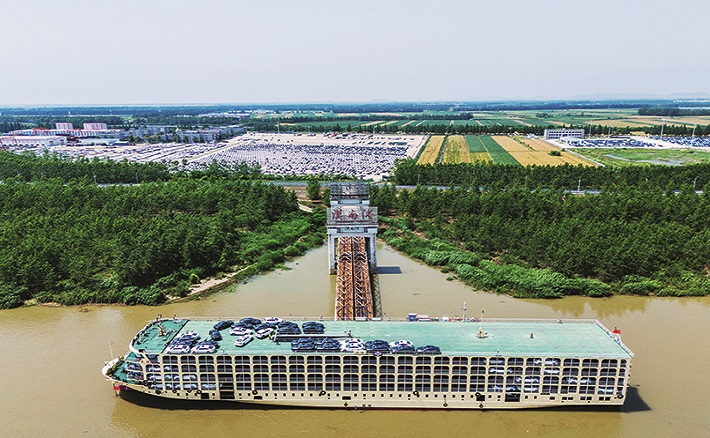
The vehicle carrier Chegu at Hannan Port (Courtesy)
In the first half of 2026, Hubei Province recorded 429.59 billion yuan ($64.3 billion) in imports and exports, up 6.7 percent year on year. Since 2019, its foreign trade has surpassed successive milestones, exceeding 800 billion yuan ($119.82 billion) in 2025 for the first time and ranking first among China’s central provinces.
Building on its traditional role as a transportation hub, Hubei is combining business services, institutional innovation and integrated transport networks to overcome the constraints of its inland location. These efforts are helping local companies expand overseas, streamline trade procedures and connect with global markets, turning the province’s geographical position into an advantage for international commerce.
Going global
“When we first ventured into cross-border e-commerce, we had no idea where to begin,” recalled Hu Baoming, founder of GANI Technology, a company specialising in sun protection and thermal insulation products.
A turning point came in 2023, when the Changjiang International Trade Cross-Border E-Commerce Industrial Park in Wuhan began operations. As one of its first tenants, GANI Technology gained access to integrated services covering international platform connections, logistics, warehousing, taxation and regulatory compliance. The park also organised training sessions, business exchanges and overseas market visits. With this support, the company launched its store on Alibaba.com within three months.
To strengthen its overseas operations, GANI Technology is now training students from the Middle East through the park’s talent development programme. The park has established training bases with 32 educational institutions, including Wuhan University, providing practical cross-border e-commerce training to more than 600 students. These graduates can help companies take on management responsibilities and build local teams in overseas markets.
Other businesses have also benefitted. Kaleido Technology, a coffee roaster manufacturer, previously relied heavily on overseas agents and struggled to establish its own brand. With support from the park’s dedicated service team, it strengthened its presence on Amazon, explored new product lines and developed more direct channels to overseas consumers.
Through the Wuhan International Trade Digital Platform, the park connects trade, logistics, financial services and funding to support eligible businesses. It has attracted more than 130 companies across the cross-border e-commerce supply chain and become the first in China to receive official certification from Amazon’s Service Provider Network. Changjiang SA E-Commerce Hub, also established by Changjiang International Trade Group, is already operational in South Africa, further expanding the group’s overseas trade network.
Beyond business services, Hubei is improving the institutional environment for international trade through its comprehensive bonded zones, which offer streamlined customs procedures and other regulatory facilitation.
Located in the Wuhan East Lake Comprehensive Bonded Zone, CX Robot Connect (Wuhan) Technology Co. Ltd. develops embodied-intelligence robots for industrial inspections and emergency response in challenging environments. The company was attracted partly by the zone’s proximity to Wuhan’s Optics Valley, giving it convenient access to the surrounding industrial supply chain and helping it accelerate projects while reducing costs.
As Hubei’s first comprehensive bonded zone, the facility has developed the province’s largest standardised warehouse for cross-border returns to meet businesses’ specialised needs. Working with customs authorities, it streamlined return procedures, improving turnover efficiency by nearly 70 percent and helping businesses cut costs by 30 to 40 percent.
At the same time, the Comprehensive Bonded Zone of the Wuhan Economic and Technological Development Zone has focused on vehicle exports, drawing on the city’s strong automotive manufacturing base.
In the first half of 2026, exports of complete vehicles and knocked-down kits reached nearly 40,000 units or sets, valued at 7.2 billion yuan ($1.08 billion). Services provided by the zone also supported exports of more than 168,000 complete vehicles across the area.
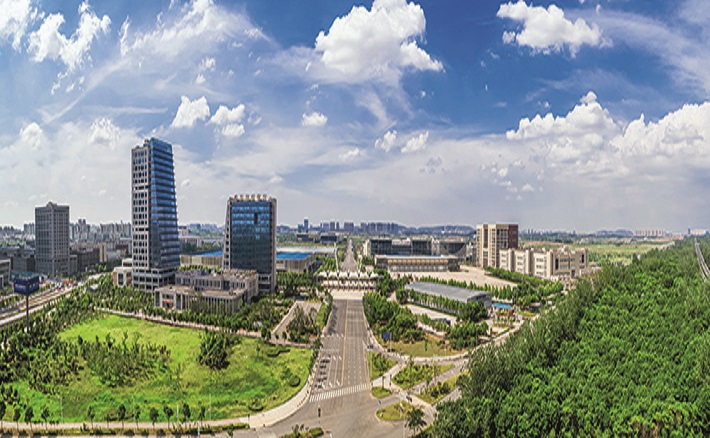
A view of the Wuhan East Lake Comprehensive Bonded Zone (Courtesy)
Connecting to global markets
Hannan Port in Wuhan, one of the few roll-on/roll-off terminals with foreign trade functions in the middle and upper reaches of the Yangtze River, has become a key link in the overseas logistics chain for vehicles manufactured in the city.
Previously, many vehicles produced in Wuhan had to be disassembled and loaded into containers for transport to Yangluo Port, or shipped overseas by China-Europe freight trains via Xinjiang. As exports expanded, the Comprehensive Bonded Zone and Hannan Port began working together in 2025 to expand shipping services, enabling complete vehicles to be transported by water to Taicang, Jiangsu Province, for onward export.
More than 40,000 vehicles passed through Hannan Port in 2025. A customs-supervision facility coordinated by the zone is also expected to enter service, supporting a longer-term goal of exporting 200,000 vehicles annually through Hannan Port by 2030.
The initiative reflects Hubei’s broader efforts to harness the Yangtze River, China’s longest river, as a corridor for international trade.
Today, Wuhan Port links the city to the Yangtze River and, through river-sea shipping, to global maritime routes. With nine port areas, it has an annual maximum container-handling capacity of more than 4 million twenty-foot equivalent units and annual cargo throughput of 150 million tonnes.
The China-Europe freight train service from Wuhan further complements the Yangtze waterway, creating an integrated transport network linking Asia and Europe. By combining rail and water transport, the network gives businesses greater flexibility in moving goods and reaching overseas markets.
Air freight adds another dimension. Ezhou Huahu International Airport, Asia’s first dedicated cargo airport, has strengthened Hubei’s capacity to handle high-value goods and time-sensitive shipments, including cross-border e-commerce products, fresh produce and advanced components.
Together, river shipping, rail services, port facilities and air freight are transforming Hubei’s transport advantages into a comprehensive international logistics network. The province is evolving from a traditional transportation crossroads into a gateway connecting inland businesses with global markets.

|
||
| About Us | Contact Us | Advertise with Us | Subscribe |
| Copyright Beijing Review All rights reserved 京ICP备08005356号-5 京公网安备110102005860号 |


